|
|
|
|
|
|
|
|
|
|
|
|
|
|
|
|
|
|
|
|
|
|
|
|
|
|
|
|
|
Part
2 |
|
|
|
|
|
|
|
|
|
|
|
|
|
|
|
|
|
|
|
|
|
|
|
|
|
|
|
|
|
|
|
|
|
|
|
|
|
|
|
|
|
|
|
|
|
|
|
|
|
|
|
|
|
|
|
|
|
|
|
|
|
|
|
|
|
|
|
|
|
|
|
|
|
|
|
|
|
|
|
|
|
|
|
|
|
|
|
|
|
|
|
|
|
|
|
|
|
|
|
|
|
|
|
|
|
|
|
|
|
|
Menu |
|
|
|
|
|
|
|
|
|
|
|
|
|
|
|
|
|
|
|
|
|
|
|
|
|
|
|
|
|
|
|
|
|
|
|
|
|
|
|
|
|
|
|
|
|
|
|
|
|
|
|
|
|
|
|
|
|
|
|
|
|
|
|
|
|
|
|
|
|
|
|
|
|
|
|
|
|
|
|
|
|
|
|
|
|
|
|
|
|
|
|
|
|
|
|
|
|
|
|
|
|
|
|
|
|
|
|
|
|
|
|
|
|
|
|
|
|
|
|
|
|
|
|
|
|
|
|
|
|
|
|
|
|
|
 |
|
|
|
|
|
|
|
|
|
|
|
|
|
|
|
|
|
|
|
|
|
|
|
|
|
|
|
|
|
Mr. T.S.Randhawa has written the above named
book, which contains excellent introduction to the Sikhs and the Sikh Paintings.
The paintings are of exceptional quality, which the reader will be able to
envisage. I am proud to present some part of this memorable book with the
kind permission of Mr. Randhawa, who has dedicated this work to Dr. M.S.Randhawa,
the connoisseur of Art and Heritage of India, and also to celebrate the tercentenary
of the Khalsa and the new millennium. The canvas of the book is more than
what the title of the book suggests. It expands to cover the regions of greater
Punjab during Maharaja Ranjit Singh's reign and other Sikh cis-sutlej states
and Lords. It is an interesting medley of enchanting images, in diverse mediums
and styles used in Punjab during the past three centuries.
Harjinder Kanwal
|
|
|
|
|
|
|
|
|
|
|
|
|
|
|
|
|
|
|
|
|
|
|
|
|
|
|
|
|
|
|
|
|
|
|
|
It
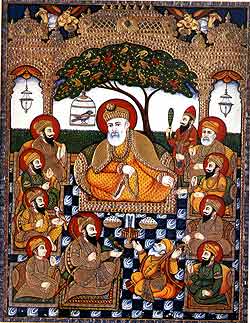
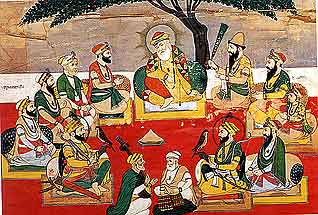
will be appropriate to start on this memorable and inspiring journey with the
blessing of the Gurus, and we start with this beautiful Tanjore painting of
the Ten Gurus |
|
|
|
|
|
|
|
|
|
|
|
|
|
|
|
|
|
|
|
|
|
|
|
|
|
|
|
|
|
|
|
|
|
|
|
|
|
|
|
|
|
|
|
|
|
|
|
|
|
|
|
|
|
|
|
 |
|
|
|
|
|
|
|
|
|
|
|
|
|
|
|
|
|
|
|
|
|
|
|
|
|
|
|
|
|
|
|
|
|
|
|
|
|
|
|
|
|
|
|
|
|
|
|
|
|
|
|
|
|
|
|
I
find it appropriate to print most of the 'Introduction' of the book by Mr. Randhawa
as it will cover a very wide range of subjects pertaining to the painters and
paintings. (Kanwal) |
|
|
|
|
|
|
|
|
|
|
|
|
|
|
|
|
|
|
|
|
|
|
|
|
|
|
Introduction to "The Sikhs - Images
of a Heritage" By T.S.Randhawa
Scholars and whatever little note taken of it has been in
the context of portraiture have often derided Sikh painting. H. Goetz summed
up what many Critics have said of it: "In its late form Kangra painting
was taken over by the Sikhs, at that time upstarts - boisterous, realistic
and puritan. There was no room for Rajput romanticism and mystic symbolism.
Like the early Mughals they appreciated a realistic portrait, enjoyed a
foul zenana jest or could use a few religious pictures where Hindu mythology
had intruded into the Sikh cult. Later they began to appreciate the whole
range of Kangra themes, like the Hindus living under their rule. But then
the Sikh kingdom was already disintegrating and Indian painting everywhere
declining fast."
In view of the role of Sikhs in history and circumstances
these have been harsh views. Sikhism is a comparatively young religion and
after Guru Gobind Singh the holy book, the Granth Sahib, became the
primary object of worship, limiting the role of religious imagery, which
in any case was not for worship but symbolic. Secondly, Sikhism is a very
open religion and even the holy book, Guru Granth Sahib, is full of literature
from other religions and languages. The subjects to be painted, therefore,
were diluted by the Hindu pantheon, and many paintings and murals of the
Sikhs feature Hindu themes, gods and goddesses. The painters at Sikh Courts
even executed beautiful paintings on Gita Govinda and Bhagwat Puran subjects.
Behind all this (in the late eighteenth and early nineteenth Centuries)
was the background of Constant turmoil and war due to which they could hardly
be expected to indulge in such luxuries in the same degree as done in the
hills, and earlier in the stable Mughal order. During periods of strong
rule and comparative peace, like that of Maharaja Ranjit Singh, artistic
activities were encouraged and flourished. Finally, traditional miniature
painting in Punjab also lost out in time due to the advent of British painters
and engravers and, finally, to photography.
|
|
|
|
|
|
|
|
|
|
|
|
|
|
|
|
|
|
|
|
|
|
|
|
|
|
|
|
|
|
|
|
|
|
|
|
|
|
|
|
|
|
|
|
|
|
|
|
|
|
|
|
|
|
|
|
|
|
|
|
|
|
|
|
|
|
|
|
|
|
|
|
|
|
|
|
|
|
|
|
|
|
|
|
|
|
|
|
|
|
|
|
|
|
|
|
|
|
|
|
|
|
|
|
|
|
 |
|
|
|
|
|
|
|
|
|
|
|
|
|
|
|
|
|
 |
|
|
|
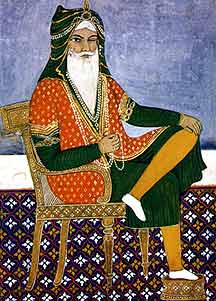
Sher-e-Punjab,
Maharaja Ranjit Singh |
|
|
|
|
|
|
|
|
|
|
|
|
|
|
|
|
|
|
|
|
|
|
|
|
|
|
|
|
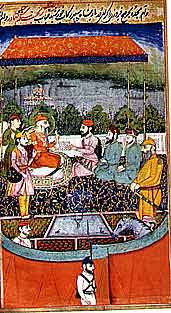
Illustrations
from Maharaja Ranjit Singh's Military Manual, prepared in Persian by his European
Officers - seated opposite the Maharaja, General Allard & General Ventura. |
|
|
|
|
|
|
|
|
|
|
|
|
|
|
|
|
The
painted images of the Sikhs fall into three types - miniatures, ivories and
murals. Miniature painting was the exclusive preserve of the royal families
and though courtiers and nobles were shown with Maharaja Ranjit Singh and later
on his sons, their paintings are lesser in number and they were often relegated
to the smaller ivory paintings. Naturally, the best painters also, like Imam
Bakhsh of Lahore, preferred to paint for royal patrons where the monetary returns
and fame were more. It was in murals and frescoes that the other Sections of
society could indulge in freely, on the walls of their haveli and their local
gurudwara, temple, akhara or dharamshala, though the range was still limited.
It is unfortunate that we do not have substantial glimpses of the general society
in those times but that is true of all miniature paintings, whether Mughal,
Rajasthani or Kangra. There is tremendous vitality in the people of Punjab and
its culture, and during the days of the Lahore court the richness of its crafts
must have been considerable, but hardly any such images exist. Credit goes to
later painters like Kehar Singh and Kapoor Singh who left some record
of every day life in the late nineteenth and early twentieth Centuries, of the
people, crafts persons and trades. |
|
|
|
|
|
|
|
|
|
|
|
|
|
|
|
|
|
|
|
|
|
|
|
|
|
|
|
|
|
|
|
|
|
|
|
|
|
|
|
|
|
|
|
|
|
|
|
|
|
|
|
|
|
|
|
|
|
|
|
|
|
|
 |
|
|
|
|
|
|
|
|
|
|
|
|
|
|
|
|
|
|
|
|
|
|
|
|
|
|
|
|
|
|
|
|
|
 |
|
|
|
|
|
|
|
|
|
|
|
|
|
|
|
|
|
|
|
|
|
|
|
|
|
|
|
|
|
|
|
|
|
|
|
|
|
|
|
|
|
|
|
|
|
|
|
|
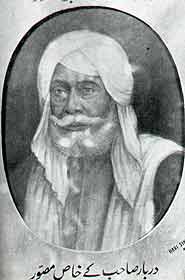
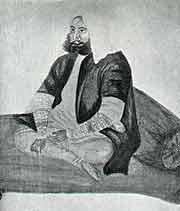
Artist
Kapoor Singh - (courtesy Srivastav) |
|
|
|
|
|
|
|
|
|
|
|
|
|
|
|
|
|
|
Court
Artist Kapur Singh (courtesy Srivastav) |
|
|
|
|
|
|
|
|
|
|
|
|
|
|
|
|
|
|
|
|
|
|
|
|
|
|
|
|
|
The
two broad themes of Sikh painting were religious and court portraiture. Stylized
paintings of the Sikh Gurus were being painted in Guler and other hill areas
even before the advent of Maharaja Ranjit Singh. Also popular were janamsakhi
series based on the life of Guru Nanak. A typical janamsakhi would consist of
a number of folios with paintings of Guru Nanak along with narrative. The paintings
would be of notable episodes in his life and some were indeed well rendered.
Even though the art of miniature painting in Punjab was soon to wane, some brilliant
works were done. The paintings done at Maharaja Ranjit Singh's court at Lahore
and the paintings of the Sikh Gurus done at the Patiala court, around the middle
of the nineteenth century, were as marvelous as the best of other miniature
paintings. |
|
|
|
|
|
|
|
|
|
|
|
|
|
|
|
|
|
|
|
|
|
|
|
|
|
|
|
|
|
|
|
|
|
|
|
|
 |
|
|
|
|
|
|
|
|
|
|
|
|
|
|
|
|
|
|
|
|
|
|
|
|
|
|
|
|
|
|
|
|
|
|
|
|
|
|
|
|
|
|
|
|
|
|
|
|
|
|
|
|
|
|
|
|
|
|
|
|
The
ten Gurus, with Bala & Mardana and Baba Budha |
|
|
|
|
|
|
|
|
|
|
|
|
|
|
|
|
|
|
|
|
|
|
|
|
|
|
|
|
|
|
|
|
|
|
|
|
|
|
|
|
|
|
|
|
For
other Guru Paintings see appropriate sections under 'Gurus' |
|
|
|
|
|
|
|
|
|
|
|
|
Sikh religion is unique to have teachings and examples on extremes of human
conduct, that of piety and forbearance preached by Guru Nanak and the call
to arms of Guru Gobind Singh The Sikn Gurus in between also occupy special
positions for their contributions to the Sikh religion, their acts of resistance
and martyrdom in the face of oppression from the Mughals and the process of
moulding the Sikh identity. Initially when Guru Nanak founded the religion
the identity of Sikhs was not too conspicuous as Sikhism welcomed people of
all religions, castes and classes. Only over the years, under the later Gurus,
Sikh identity crystallized, culminating with the forming of the Khalsa by
Guru Gobind Singh in April 1699. In the painted images, therefore, the largest
numbers are those of the founder Guru Nanak and of Guru Gobind Singh. Individual
portraits of other Gurus are also there as well as those on specific themes
like the compilation of the Guru Granth Sahib, the establishment of the Golden
Temple, depiction of sacrifices and acts of martyrdom by the Gurus. Guru Nanak
is invariably shown with his companions Bala and Mardana in lively scenes
from the janamsakhi series, and sometimes even with Guru Gobind Singh, apart
from other paintings depicting all the ten Gurus together. The paintings of
the Sikh Gurus were never contemporary to their lives and were on the basis
of historical facts and legends. Guru Gobind Singh was the ideal of the Sikh
painters and has been lovingly depicted in the various series. He was a warrior
saint and his entire family was martyred, including his four sons. He was
also a man of letters and among other treatises wrote the Dasam Granth. These
qualities and his turbulent life and struggle made him the most important
icon for the painters. In the paintings Guru Gobind Singh is always shown
as a gentle warrior, baptizing the Sikhs or with his 'beloved five', the panj
pyare. His courage as well as literary skills come out very clearly in his
famous Zafarnama to the evil emperor Aurangzeb.
In court painting there appeared to be two distinct groups of paintings -
those done in the Lahore court during (and just after) Maharaja Ranjit Singh's
time and others painted in the remaining Sikh States. The subjects of Ranjit
Singh, his family and courtiers dominated those of the Lahore court, while
in the other Sikh States their rulers were the main subjects. The linking
of painters with the court of Maharaja Ranjit Singh occurred with his conquest
of the hill states, where the art of miniature painting had reached its zenith
under Maharaja Sansar Chand. In 1809 Sansar Chand was attacked by the Gurkhas
and he asked for Maharaja Ranjit Singh's assistance, who liberated him from
them but made him his tributary. It was fortunate that the Governor he appointed
at Kangra was the genial Sardar Desa Singh Majithia who built up a
good rapport with the local population and facilitated the crossing over of
painters from the courts of the hill Rajas to that of Maharaja Ranjit Singh.
In any case, around that time, with the loss of independence of their hill
Rajas the painters too would have been looking for greener pastures. Describing
the Governor, Barnes writes, "Sirdar Lehna Singh enjoyed a good
reputation in the hills; he was a mild and lenient Governor, his periodical
visits were not made the pretense for oppressing and plundering the people;
he maintained a friendly and generous intercourse with the deposed Hill Chiefs
and contributed, by his conciliatory manners, to alleviate their fallen position.
At the same time, he is held in favourable recollection by the peasantry.
His assessments were moderate for a native system and, although he did not
possess that force of character to keep his agents under proper control, yet
he never oppressed himself, nor willingly countenanced oppression in others."
"He was also," according to Griffin, "known as Hasmuddaula,
the Sword of the State and was a man of considerable ability. He was a skillful
mechanist and an original inventor. He much improved the Sikh ordnance. Among
other things, he invented a clock, which showed the hour, the day of the month
and the changes of the moon. He was fond of astronomy and mathematics, and
was master of several languages. As an administrator, he was very popular.
He never oppressed the poor, his assessments were moderate and his decisions
essentially just. As a statesman, he may be said to have been almost the only
honest man in Lahore."
|
|
|
|
|
|
|
|
|
|
|
 |
|
|
|
|
|
|
|
|
|
|
|
|
|
|
|
|
|
|
|
|
|
|
|
|
|
|
|
|
|
|
|
|
|
|
|
|
|
|
|
|
|
|
|
|
|
|
|
|
|
|
|
|
|
|
|
|
|
|
|
|
|
|
|
|
|
|
|
|
|
|
 |
|
|
|
|
|
|
|
|
|
|
|
|
|
|
|
|
|
|
|
|
|
|
|
|
|
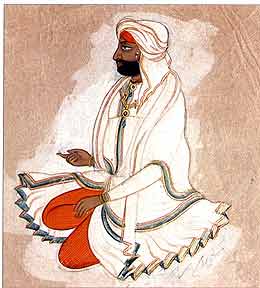
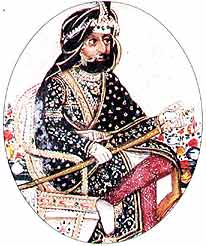
Sardar
Desa Singh Majithia |
|
|
|
|
|
|
|
|
|
|
|
|
|
|
|
|
|
|
|
|
|
|
|
|
|
|
|
|
|
|
|
|
|
|
|
|
|
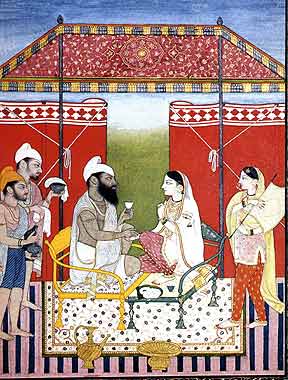
Desa
Singh Majithia enjoying with a Guler lady. |
|
|
|
|
|
|
|
|
|
|
|
|
|
|
|
|
|
|
 |
|
|
|
|
|
|
|
|
|
|
|
|
|
|
|
|
|
|
|
|
|
|
|
|
|
|
|
|
|
|
|
|
|
|
|
|
|
|
|
|
|
|
|
|
|
|
|
|
|
|
|
|
|
|
|
|
|
|
|
|
|
|
|
|
|
|
|
|
|
|
|
|
|
|
|
|
|
|
|
|
|
|
|
|
|
|
|
|
|
|
|
|
|
|
|
|
After
Kangra in 1809, Guler was subjugated in 1813, followed by Jasrots and Jammu.
The links of the Sikhs with the hill people continued to become stronger and
Sardar Desa Singh Majithis also married a hill woman. In 1828, Maharaja
Ranjit Singh did not appreciate Anirudh Chand refusing Dhian Singh's proposal
of the marriage of his son Hira Singh with Anirudh Chand's Sister, especially
since Hira Singh was his great favourite. He himself led a force to Kangra
in 1828 but by the time he reached there Anirudh Chand had fled for Hardwar
where he founded the kingdom of Tehri Garhwal, and Kangra came totally under
the Sikhs without firing a single shot. There is not much evidence of his court
painters following Anirudh Chand and he took with him his best folios, including
the famous Gita Govinds series. Hira Singh ultimately married the daughter
of Fateb Chand, uncle of Anirudh Chand. In the process Maharaja Ranjit Singh
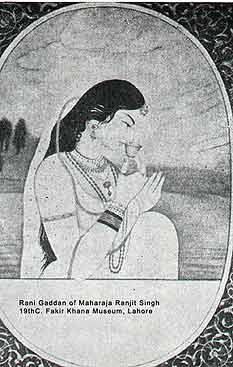
also married two daughters of Sansar Chand and Nokhu, his Gaddan
Rani. The links of the Sikh kingdom with Kangra and its court painters
could not have been more complete. Moreover, in 1830 he appointed Raja Sher
Singh as Governor General of the Kangra hills, which was a good choice as
Sher Singh was as affable as Desa Singh Majithia, and in 1832 it was
Lehna Singh Majithia, also a good soul. When Sher Singh was appointed
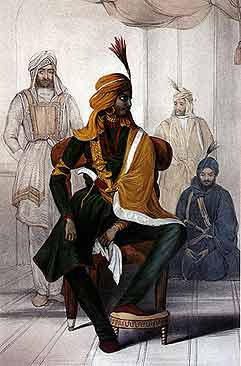
Governor General of Kangra he was only 23 years old, youthful, handsome and
energetic yet gentle. He was an immediate success with the local painters and
there is a lovely painting of him being waited upon by a Kangra girl after
a bath, with his hair open. Sher Singh was to later become a great favourite
of the European artists also. In 1833 Ladakh was added to the Sikh kingdom. |
|
|
|
|
|
|
|
|
|
|
|
|
|
|
|
|
|
|
|
|
|
|
|
|
|
|
|
|
|
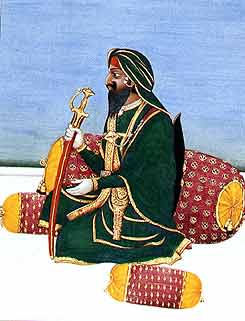
S.
Lehna Singh |
|
|
|
|
|
|
|
|
|
|
|
|
|
|
|
|
|
|
|
|
|
|
|
|
|
|
|
|
|
|
|
|
|
|
|
|
|
|
|
|
|
 |
|
|
|
|
|
|
|
|
|
|
|
|
|
|
|
|
|
|
|
|
|
|
|
|
|
|
|
|
|
|
|
|
|
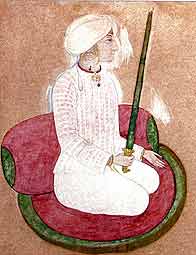
Raja
Dhian Singh |
|
|
|
|
|
|
|
|
|
|
|
|
|
|
|
|
|
|
|
|
|
|
|
|
|
|
|
|
|
|
|
|
|
|
|
 |
|
|
|
|
|
|
|
|
|
|
|
|
|
|
|
|
|
|
|
|
|
|
|
|
|
|
|
|
|
|
|
|
|
|
|
|
|
|
|
|
|
|
|
|
|
|
|
|
|
|
 |
|
|
|
|
|
|
|
|
|
|
|
|
|
|
|
|
|
|
|
|
|
|
|
|
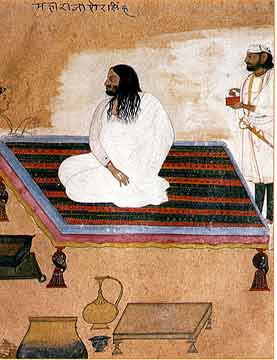
Raja
Hira Singh |
|
|
|
|
|
|
|
|
|
|
|
|
|
|
|
|
|
|
|
|
|
|
|
|
|
|
|
|
|
|
|
|
|
|
|
|
|
|
|
|
|
|
|
|
|
|
|
|
|
|
|
 |
|
|
|
|
|
|
|
|
|
|
|
|
|
|
|
|
|
|
|
|
|
|
|
|
|
|
|
|
|
Maharaja
Sher Singh after a bath |
|
|
|
|
|
|
|
|
|
|
|
|
|
|
|
|
|
|
|
|
|
|
|
|
|
|
|
|
|
|
|
|
|
|
|
|
|
|
|
|
|
|
|
|
|
|
|
|
 |
|
|
|
|
|
|
|
|
|
|
|
|
|
|
|
Raja
Hira Singh son of Dhian Singh- a favourite of Maharaja Ranjit Singh |
|
|
|
|
|
|
|
|
|
|
|
|
|
|
|
|
|
|
|
|
|
|
|
|
|
|
|
|
|
|
|
|
|
|
|
|
 |
|
|
|
|
|
|
|
|
|
|
|
|
|
|
|
|
|
|
|
|
|
|
|
|
|
|
Rani
Gaddan, one of the Queens of Maharaja Ranjit Singh |
|
|
|
|
|
|
|
|
|
|
|
|
|
|
|
|
|
|
|
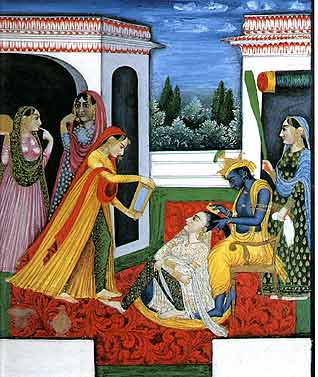
The
style of Kangra painting as applied to the Sikh courts and subjects did undergo
certain modifications and modern accouterments made their appearances, particularly
in the forms of chairs and umbrellas. Two paintings of Radha and Krishna
are published in this book from the later Sikh period, in which they are alternately
sitting on a chair and a sofa. |
|
|
|
|
|
|
|
|
|
|
|
|
|
|
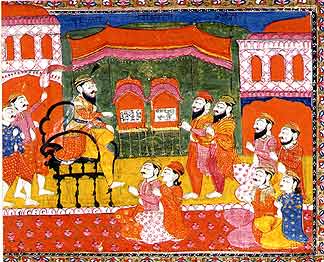
Guru
Arjan dictating from the Adi Granth, while sitting on the chair. |
|
|
|
|
|
|
|
|
|
|
|
|
|
|
|
|
 |
|
|
|
|
|
|
|
|
|
|
|
|
|
|
|
|
|
|
|
|
|
|
|
|
|
|
|
Even
the frontispiece of the Guru Granth Sahib illustrated in this book (circa 1850,
Kashmir) shows a painting in which Guru Arjan is dictating the text sitting
on a chair. Also of significance was the fact that during this period the
painters gradually switched over from mineral and natural colours to artificial
colours with obvious effect. Surprisingly, females were hardly painted in Sikh
miniature paintings and murals, apart from derivatives from the Kangra hills
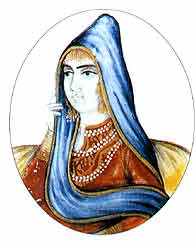
legacy. Only Maharani Jindan, the prima donna in the drama, which unfolded
towards the end of the Sikh kingdom, was painted and sketched. Before joining
Ranjit's boudoir she was the daughter of Ranjit's dog keeper, Manna. |
|
|
|
|
|
|
|
|
|
|
|
|
|
|
|
Lord
Krishna sitting on the chair braids the hair of Radha |
|
|
|
|
|
|
|
|
|
|
|
|
|
|
|
|
|
|
No
traces are there of other prominent Sikh ladies having been painted, though
there were quite a few - starting with Sada Kaur, Ranjit's resolute mother-in-law
(see in Sada Kaur section), who used her position in the Kanhaeys misl to help
install Ranjit in the first place. Though she later fell out with him when she
persisted, successfully, in foisting the claims of her daughter's son, Sher
Singh, to the line of succession; Mehtab Kaur, another prominent wife of Ranjit
Singh, who is said to have had forty six wives in all; or Chand Kaur, Kharak
Singh's wife. Photographs exist of Daleep Singh's wife, Maharani Bamba Daleep
Singh, who was half English and half Abyssinian. (see in Maharaj Dalip Singh
section) |
|
 |
|
|
|
|
|
|
|
|
|
|
|
|
|
|
|
|
|
|
|
|
|
|
|
|
|
|
|
Maharani
Jindan |
|
|
|
|
|
|
|
|
|
|
|
|
|
|
|
|
|
|
|
|
|
|
|
The last famous lady in the line was Princess Bamba Daleep Singh, later Mrs.
Bamba Sutherland (as often written - 'she married a certain Col. Sutherland').
Much prior to that, most of the wives of the Sikh gurus were exceptional personalities,
but none were painted. Among them were Bebe Nanaki (Guru Nanak's elder Sister)
and Mata Sulakhani (Guru Nanak's wife), Mata Khiwi (Guru Angad's wife) who
started the tradition of the langar, free kitchen, Bibi Bhani who was Guru
Amardas's daughter, wife of Guru Ramdas and the mother of Guru Arjan Dev,
Mata Ganga - Guru Arjan Dev's wife, Mata Nanaki - wife of Guru Hargobind and
Guru Tegh Bahadur's mother, Guru Har Rai's wife and Guru Harkrishan's mother
Mata Kishan Kaur, Mata Gujri - Guru Tegh Bahadur's wife and Guru Gobind Singh's
mother, and Guru Gobind Singh's wives Mata Sahib Devan and Mata Sundri.
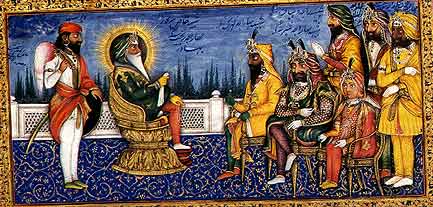
A shortcoming of paintings of the period of the Lahore court was the relative
lack of a variety of subjects. Most of the Lahore court paintings show the
seated Maharaja Ranjit Singh with his real and accepted sons Kharak Singh,
Sher Singh, the infant Daleep Singh; the favourite boy Hira Singh is also
shown with Naunehal Singh; Dhian Singh is respectfully standing at the back
and occasionally shown with his brothers Suchet Singh and Gulab Singh of Jammu.
Ranjit Singh is sometimes surrounded by his non-Sikh courtiers like his
Finance Minister Dina Nath the Brahmin, his Foreign Minister Aziz-ud-din
and Jamadar Khushal Singh, who was actually a Brahmin. Also included in
some paintings are Europeans who organized his army - the Italians Ventura
and Avitabile who were infantry experts, Allard who was his cavalry organizer
and another French man, General Court, who trained and equipped his artillery.
Also included were his friends from Afghanistan and other European adventurers.
(In fact, all these elements of his court are brilliantly portrayed in a later
oil painting of August Theodore Schoefft, a Hungarian who visited his court).
Coupled with this was the fact that Sikh paintings on subjects other than
portraiture were restricted in any case. The miniature paintings, thus, on
surface appear to be very limited in diversity but to appreciate them one
has to understand the historical events and the intrigues of the court - and
then a great drama unfolds, which finally ended when the British defeated
Maharaja Ranjit Singh's successors and disbanded the court of Lahore in 1849.
In fact, the British went to the extreme of auctioning the treasures of the
court to recover their campaign costs, after dispatching the best objects
to London - the Koh-i-noor, jewels and the golden throne.
|
|
|
|
|
|
|
|
|
|
|
|
|
|
|
|
|
|
|
|
|
|
|
|
|
|
|
|
|
|
|
|
|
 |
|
|
|
|
|
|
|
|
|
|
|
|
|
|
|
|
|
|
|
|
|
|
|
|
|
|
|
|
|
Maharaja
Ranjit Singh with his sons, Maharaja Kharak Singh, Sher Singh & Dalip Singh.
Raja Dhian Singh. Gulab Singh & Suchet Singh are alos seen standing behind |
|
|
|
|
|
|
|
|
|
|
|
 |
|
 |
|
|
|
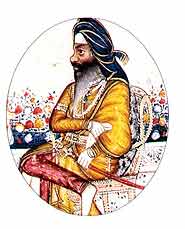 |
|
|
|
|
|
|
|
|
|
|
|
|
|
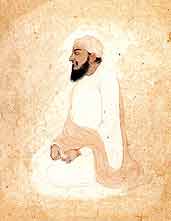
Fakir
Aziz-u-deen |
|
|
|
|
|
|
|
|
|
|
|
|
|
|
|
|
|
|
|
|
|
|
|
|
|
|
|
|
|
|
|
|
|
|
|
|
|
|
|
|
|
|
|
|
|
|
|
|
|
|
|
|
|
|
|
|
|
|
|
|
|
|
|
|
|
|
|
|
|
|
|
|
|
|
|
|
|
|
|
|
|
|
|
|
|
|
|
|
|
|
|
|
|
|
|
|
|
|
|
|
|
|
|
|
|
|
|
|
|
|
|
|
|
|
|
|
|
|
|
|
|
|
|
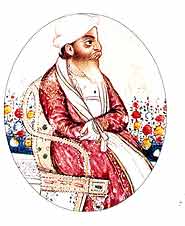
Raja
Dina Nath |
|
|
|
|
|
|
|
|
|
|
|
|
|
|
|
|
|
|
Raja
Khushal Singh |
|
|
|
|
|
|
|
|
|
|
|
|
|
|
|
|
|
Information
regarding this period is available from a number of sources - the camp chronicle
of Maharaja Ranjit Singh, 'Umdat-ut-Tawarikh', British government records and
accounts of European travellers, artists and painters. The Umdat-ut-Tawarikn
was a Sort of daily diary full of hyperbole and praises to Maharaja Ranjit Singh,
though full of interesting facts. The British government records appear to be
fairly accurate on information, but the most absorbing and relevant to this
book are the accounts of the other Europeans, even though their superciliousness
sometimes comes through. Generally these accounts are frank, appreciative as
well as critical and chatty. Thus we have Emily Eden mentioning that Sher Singh
was inviting himself too often to her dinners with his son Pratap Singh "with
eyes as big as saucers, and emeralds bigger than his eyes", and Allard
with his great black and white beard resembled a piebald horse. She found Gulab
Singh to be quite "horrid" though his brother Dhian Singh was "uncommonly
good looking" and Lal Singh, Rani Jindan's paramour, was sensually
built. Vigne easily saw through Dhian Singh's sham display of trying to
throw himself in Maharaja Ranjit Singh's funeral pyre (he would have been greatly
disappointed if he had not been prevented from doing so). From a cheeky account
we learn of how a 'wretched' painting of Maharaja Ranjit Singh was sought to
be presented to the Queen along with rich Kashmiri gifts, and that "the
chief painter in the Lahore court is certainly not a Raphael." Vivid descriptions
of scenes at Maharaja Ranjit Singh's parties are given where liquor and wine
flowed freely. Many, like Barr, could not comprehend with their European sensibilities
the Indian form and perspective of painting. This brash young lieutenant escorted
Col. C.M. Wade on his mission to Afghanistan and, en route, visiting the Lahore
court he wrote: "We were admitted through a low archway beneath the throne
to a small court, and close to a building which contains the regal entrance
to the hall of justice. The exterior of this is covered with paintings in oil
of a very extravagant description, and evidently of late construction, as one
subject represents the interview of the Maharajah with Lord William Bentinck
at Roopur. The parties are supposed by the artist to be assembled in the audience
tent, the Sikhs being arranged on one side and the British on the other. The
two great potentates occupy the center of the scene, and Lady William, accoutered
in white trousers, boots, and gold straps, is seated a few paces behind her
husband. An uglier set of vagabonds than the man of daubs has made of our countrymen
cannot well be conceived; though the people who accompanied us regarded them
as likenesses, and were eager to point out "Macnaghten Sahib", the
"Bakhshee Sahib', and others, who have only to see their portraits to be
grateful. We were subsequently shown into what may in truth be termed "the
Painted Chamber", as it is adorned with pictures of battles in which the
two Generals (Allard and Ventura) were engaged, and executed on the chunam walls
by native artists. The perspective of these scenes is most ridiculous; and at
the siege of Moultan the cannons are turned up on end to enable the gunners
to load them, the figures overtop the fortification, and the cavalry seem to
be maneuvering in the air; and absurdities of a similar nature are perpetrated
throughout them all, and no doubt afford much amusement to their gallant owners,
whose policy has led them this far to assimilate their dwellings with those
of the native population; for it can hardly be supposed their taste is so far
vitiated as to regard these embellishments as ornamental." Barr did not
spare even Lord Krishna and his comments are amusing! "Crishna's exploits
occasionally partake of the ludicrous and disgusting. In one compartment he
is portrayed with a milkmaid shampooing his great toe; in another, he is perched
up in a tree, from the branches of which depend various articles of dress he
has stolen from some fair damsels who are refreshing themselves in a limpid
stream below, and whose heads and hands, clasped in a suplicatory manner, appear
above water beseeching him to return their apparel, but to no purpose, as he
is only laughing at their distress. In a third, he is dashing out the brains
of a man with his club; and in a fourth, tearing out the entrails of a prostrate
foe with the most brutal ferocity." It needed the sensitivity of a scholar
like E.B. Havell to appreciate the subtleties of Sikh miniature painting. In
his book 'Indian Sculpture and Painting (1908)', describing a painting (done
during the period of Sikh influence) showing Mian Jai Singh of Guler hearing
musicians, he wrote, "Like the pure melody of an old folk-song, it is a
true creation of national sentiment, of the poetic impulse which flows spontaneously
from the heart of a people inspired by the joy of life and love of beauty. Here
we have the 'sunshine of sunshine' given with pure delight with which the lark
trills his song of joy in the high heavens on a summer morning. The figures
in the picture are by no means attractive types or very deeply studied as to
character; but their flowing draperies and the gay colours of the musical instruments,
together with the pearly whiteness of the marble and the bright hues of the
flowers, serve the purpose of the artist - to express the beauty and gladness
of the radiant Indian sunlight." There were also Britishers like Macauliffe,
who left his comfortable career in the Indian Civil Service to translate the
religious texts of the Sikhs, a job which he did admirably well and ran up a
debt doing so. Overall these are interesting accounts which help in giving a
perspective to the characters painted in the miniatures as well as the later
lithographs and paintings. Once these personalities are understood the images
of that period seem to spring to life, and the series become like pages from
one big family album of Maharaja Ranjit Singh. Even certain nuances at the court
of Lahore seem obvious, like Maharaja Ranjit Singh having to periodically restrain
Sher Singh from becoming too close to British guests and influences. It was
also ironical that the real son of Maharaja Ranjit Singh, Kharak Singh, was
no match compared to his great stature, was an opium addict, and did not receive
good mentions by chroniclers. Even in paintings he does not stand out as a personality
of significance. |
|
|
|
|
|
|
|
|
|
|
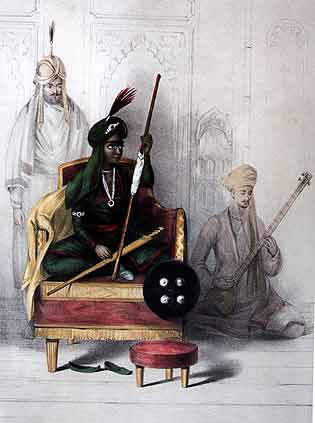 |
|
|
|
|
|
|
|
|
|
|
|
|
|
|
|
|
|
|
|
|
|
|
|
|
|
|
|
|
|
|
|
|
|
|
|
|
|
|
|
|
|
|
|
|
|
|
|
|
|
|
|
|
|
|
|
|
|
|
|
|
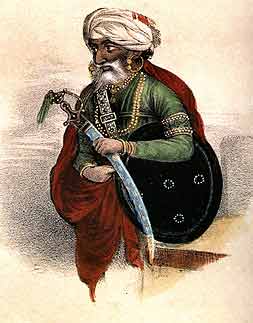 |
|
|
|
|
|
|
|
|
|
|
|
|
|
Maharaja
Gulab Singh-"Horrid!" |
|
|
|
|
|
Kunwer
Partap Singh s/o Maharaja Sher Singh. According to Emily Eden.."with eyes
as big as saucers and emeralds bigger than his eyes." |
|
|
|
|
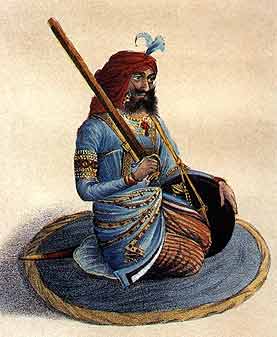 |
|
|
|
|
|
|
|
|
|
|
|
|
|
 |
|
|
|
|
|
|
|
|
|
|
|
|
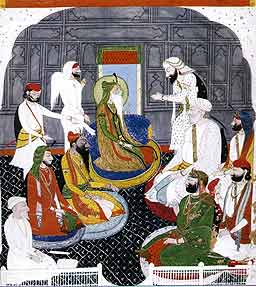
Prince
Kharak Singh & Naunihal Singh in presence of Maharaja Ranjit Singh |
|
|
|
|
|
|
|
|
|
|
|
|
|
|
|
|
|
|
|
|
|
|
Raja
Suchet Singh |
|
|
|
|
|
|
|
|
|
|
|
|
|
|
|
|
|
|
|
|
|
|
|
|
|
|
|
|
|
|
|
|
|
|
|
|
|
|
|
|
|
|
|
|
|
|
|
|
|
|
|
|
|
|
|
|
|
|
|
|
|
|
|
|
|
|
|
|
|
|
|
|
|
|
|
|
|
|
|
|
|
|
|
|
|
|
|
|
|
|
|
|
|
|
|
|
|
|
|
|
|
|
|
|
|
|
|
|
|
|
|
|
|
|
|
|
|
|
|
|
 |
|
|
|
|
|
|
|
|
|
|
|
|
|
|
|
|
|
|
|
|
|
|
|
|
|
|
|
|
|
|
|
|
|
|
|
|
|
|
|
|
|
|
|
|
|
|
|
|
|
|
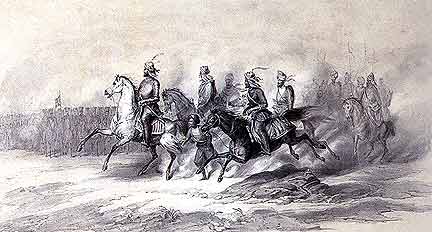
Raja
Lal Singh, Rani Jinda's paramour. |
|
|
|
|
|
|
|
|
|
|
|
|
|
|
|
|
|
|
|
|
|
|
|
|
|
|
|
|
|
|
|
|
|
|
|
|
|
|
The
dazzle of Maharaja Ranjit Singh's court was a great attraction for European
artists. The Russian prince and artist Alexis Soltykoff wrote, "This morning,
the King gave us a state audience. What a sight! I could scarcely believe my
eyes. Everything glittered with precious stones and the brightest colours arranged
in harmonious combinations. The green garden was decorated by a huge crowd of
Sikhs in yellow, red, rose, white, gold, silver, green, lilac and azure, all
armed and strikingly arrayed, some of them being in coats of mail In the midst
of this bevy was the King, coming to meet us, a big stoutish man of forty, covered
with the most beautiful jewels in the world. On his right arm was the Koh-i-Nur,
the finest diamond that exists |
|
|
|
|
|
|
|
|
|
|
|
|
|
|
|
|
|
|
|
|
|
|
 |
|
|
|
|
|
|
|
|
|
|
|
|
|
|
|
|
|
|
|
|
|
|
|
|
|
|
|
|
|
|
|
|
|
|
|
|
|
|
|
|
|
|
|
|
|
|
|
|
|
|
|
|
|
|
|
|
|
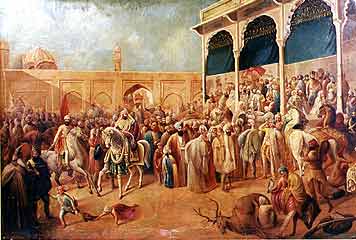
The
dazzle of the Maharaja's 'Lahore Court' captured by artist August Shoefft in
this beautiful painting, with Maharaja Sher Singh in the foreground. This painting
was in the custody of Princess Bamba Dalip Singh. |
|
|
|
|
|
|
|
|
|
|
|
|
|
|
|
The other day we were invited to pass the evening with the King whose palace
is in a fortress at the other end of the city. The King received us in the
open, in the midst of his warriors, in the moonlight in a vast courtyard,
surrounded by crenellated walls. There were thirty magnificent horses there,
covered with precious stones and illuminated by torches and by a kind of Bengal
fire which cast a blue light from the tops of the walls. I might mention that
the Punjabis are famous for their fireworks. Seen thus the white horses, with
their emerald ornaments, seemed like dream figures, while the black ones,
with their ruby decorations, looked like specters from the Inferno, in the
dim torchlight. The King, with the simple and unaffected air, which distinguishes
him, led us along some narrow corridors, and we soon found ourselves in another
court, paneled with marble and hung with beautiful carpets. In the middle
was a basin full of waterfowl and fine jets of water filled the air like diamond
dust. Around it, thousands of illuminated globes of different colours gave
faint, soft light like that of dawn. As we advanced towards some splendid
tents of shawls and gold brocade in the opposite comer of the court, enormous
red curtains were drawn up slowly one after another by means of cords, like
curtains of a theatre, by Sikh warriors armed to the teeth, and as these curtains
disappeared we were more and more overwhelmed by the splendour of a new hall
which was disclosed to view, the walls and ceiling of which were decorated
with green, white, and red crystals framed in gold and looking like a pavement
of precious stones upon an enormous ladder. Thither we were conducted by the
King, and on entering, we saw, spread out to view on brocade covered tables
the royal arms; hundreds of swords, daggers, shields, cuirasses and helmets,
all very richly decorated Then the girls arrived, some thirty in all, pretty
but small and delicate, in splendid costumes with their little noses so loaded
with jewels and their foreheads and eyebrows so gilded that one could hardly
distinguish their features. Their feet and hands, adorned with rings and mirrors,
were very pretty though dark. The transparent veils that covered them were
of gold, silver, or bright colours. Their short coats of velvet or other costly
materials and their tight trousers of silk were very pleasing to the eye.
These charming girls approached the King one by one and gave him one or two
rupees. The King, who was in conversation with the ambassador, turned to them
with an air of careless good humour. There is so much that is good natured
and straightforward about him that, although his figure is awkward, he is
charming and one would say that, in spite of his nervous air, he possesses
plenty of pluck in danger. It seemed a curious household. The girls approached
without any fear, most of them laughing, and looking about them. Then they
sat down together on the ground between the tables. Suddenly a plaintive melody
was heard, and two of them began a slow dance, while the others sat, looking
like butterflies."
The melodrama and nostalgia of Maharaja Ranjit Singh's court did not end
with his death but came back in waves during later periods also, especially
during Dalip Singh's time, and lingered on right upto the death of the last
of his direct family, Princess Bamba Sutherland, in 1957, at Lahore. "Born
on 29 September, 1869 in London, Princess Bamba, with her younger brother
and sisters, was placed on the death of their mother under the care of their
father's Equerry Mr Arthur Oliphant and his wife at Folkstone. She was sent
to Oxford for her university education, and later married a Colonel Sutherland.
Princess Bamba remained in the United Kingdom for part of her life and finally
settled in Lahore, at first in Jail Road and subsequently at 104A, Model Town.
A fellow resident recorded her pathetic condition. 'Old "Princess"
Sutherland, widow of an English army doctor, and last descendant of Maharaja
Ranjit Singh, was heard complaining that she could not get a seat in the lorry
(bus), when all Punjab should have been hers! The old lady spent her days
dreaming about her ancestral glory.' She died at the age of eighty-eight,
on Sunday, 10 March 1957. An item appeared in the newspaper the following
day, giving a brief obituary and ending with the belief that 'the arrangements
for her burial will be made by the United Kingdom Deputy High Commissioner,
Lahore.' In fact her burial was arranged by her faithful secretary, Pir Karim
Bakhsh Supra, to whom she bequeathed her property, including the collection
of Schoeft's paintings, and some Sikh relics. She was laid to rest
in the Gulberg Christian cemetery, two and a half miles across Lahore from
the Fort. Neither the British nor the Sikhs were represented at her funeral.
The Punjab was left to claim its own (Aijazzudin)."
|
|
|
|
|
|
|
|
|
|
|
|
|
|
|
 |
|
|
|
|
|
|
|
|
|
|
|
|
|
|
|
|
|
|
|
|
|
|
|
|
|
|
|
|
|
|
|
|
|
|
|
|
|
|
|
|
|
|
|
|
|
|
|
|
|
|
|
|
|
|
|
|
|
|
|
|
|
|
|
|
|
|
|
|
|
|
|
|
|
|
|
|
|
|
|
|
|
|
|
|
|
|
|
|
|
|
|
|
|
|
|
In
the immediate family of Ranjit Singh first in line to the throne was Kharak
Singh who was born in 1802 by Rani Raj Kaur, who succeeded Ranjit Singh in June
1839 and died in November 1840. Ranjit's other descendants were - Sher Singh,
born in 1807 by Mehtab Kaur, the most genial of Ranjit Singh's real and
accepted sons, who after being the Governor of Kangra was for sometime Governor
of Kashmir and Peshawar, became Maharaja on 18 January, 1841 and was murdered
in September 1843; Daleep Singh, the doe-eyed son by Rani Jindan, catapulted
to the throne when he was six years old but with the Sikhs losing to the British
sent to England in 1854, became a Christian from 1853 till 1886, died in Paris
in 1893; Naunehal Singh, son of Kharak Singh, born in 1821, died only
a day after his father's death on 5th November, along with Udham Singh, son
of Maharaja Gulab Singh, when they were returning from Kharak Singh's funeral;
Pratap Singh, son of Maharaja Sher Singh, born in 1831, was murdered by the
Sandhawalias in September 1843 along with his father, though even in his few
years he made a lasting impression on European visitors.The other dramatis personae
in the court of Maharaja Ranjit Singh were the Faqirs Aziz-ud-din, his
Foreign Affairs Minister, and his brother Nur-ud-din, Ranjit Singh's personal
physician, who was also given state functions during Daleep Singh's time; the
Attariwala family - the father and son Sher Singh and Chattar Singh Attariwala
(Sher was Commander in Chief of the Sikh army during the second Anglo-Sikh war
of 1848-49); Ajit Singh Sandhawalia who along with Attar and Lehna Singh
Sandhawalia mercilessly killed Sher Singh and his son Pratap Singh, only to
be killed some days later by Hira Singh, and be cremated with his next victim
Dhian Singh; Dhian Singh, who entered Maharaja Ranjit Singh's service as a gadvaia
(peon) and rose to become the Chief Minister in Ranjit Singh's court as well
as that of Naunehal Singh and Sher Singh; Dina Nath, the Finance Minister,
who also signed the first treaty with the British; Dost Mohammed Khan of Kabul
who appears in many paintings being feasted by Ranjit Singh; Hira Singh the
favourite boy in Maharaja Ranjit Singh's court, who could take great liberties
with him and even kept sitting in the Maharaja's presence while his own father
Dhian Singh remained standing, eventually becoming Chief Minister to Dalip Singh
but killed in 1844 at the age of twenty-eight; Sheikh Imam-ud-din, the Governor
of Kashmir who tried to create trouble during Gulab Singh's take over and was
exposed; Jawahar Singh, the brother of Rani Jindan who eventually killed
Hira Singh and became Chief Minister of Rani Jindan, executed by the Sikhs in
1845; Shankar Nath Joshi, the chief astrologer to Maharaja Ranjit Siogh, who
was from Travancore and returned there when the bloodbaths started at Lahore;
Jamadar Khushal Singh, who was actually a Brahmin but became a Sikh later and
remained a close advisor to Maharaja Ranjit Singh in spite of Dhian Singh's
intrigues; Lal Singh, a Brahmin who was Rani Jindan's paramour, who escaped
death but was exiled to Benaras; Akali Phoola Singh, a mercurial character,
a rebel and an outlaw; Suchet Singh, the younger brother of Dhian Singh,
who became chief of the eastern Jammu hills, but later fell out with his own
nephew Hira Singh and got killed in March 1844. |
|
|
|
|
|
|
|
|
|
|
|
|
|
|
|
|
|
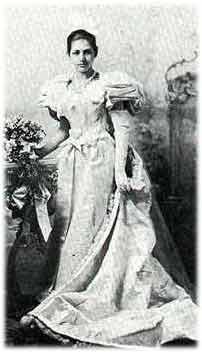
Princess
Bamba Dalip Singh |
|
|
|
|
|
|
|
|
|
|
|
|
|
|
|
|
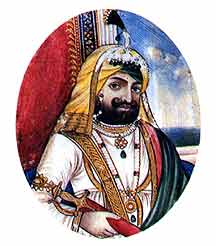 |
|
|
|
|
|
|
|
|
|
|
|
|
|
|
|
|
|
Painting
on ivory of Maharaja Sher Singh |
|
|
|
|
|
|
|
|
|
|
|
|
|
|
|
|
|
|
|
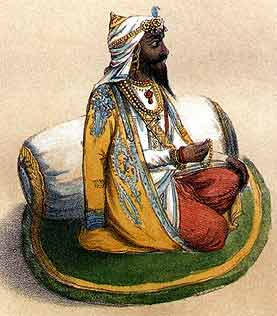 |
|
|
|
|
|
|
|
|
|
|
|
|
|
|
|
|
Maharaja
Kharak Singh |
|
|
|
|
|
|
|
|
|
|
|
|
|
|
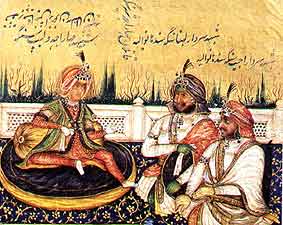 |
|
|
|
|
|
|
|
|
|
|
|
|
|
|
|
|
|
|
|
|
|
|
|
|
Maharaja
Dalip Singh with Ajit Singh & Lehna Singh Sandhawalia. |
|
|
|
|
|
|
|
|
|
|
|
|
|
|
|
|
|
|
|
|
|
|
|
|
|
|
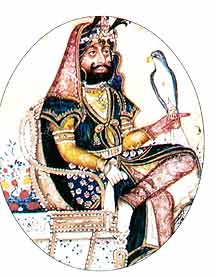 |
|
|
|
|
|
|
|
|
|
|
|
|
|
|
|
|
|
|
|
|
|
|
|
|
|
|
|
|
|
|
|
 |
|
|
|
|
 |
|
|
|
|
|
|
|
|
|
|
|
|
|
|
|
|
|
|
|
|
|
|
|
|
|
|
|
|
S.Jawaher
Singh brother of Maharani Jindan |
|
|
|
|
|
|
|
|
|
|
|
|
|
|
|
|
|
|
|
|
|
|
|
Maharaja
Sher Singh |
|
|
|
|
|
|
|
|
|
|
|
|
|
|
|
|
|
|
|
|
|
|
|
|
|
|
|
|
|
|
|
|
|
|
|
|
|
|
|
|
|
|
|
|
|
|
|
|
|
|
|
|
|
Akali
Phoola Singh |
|
|
|
|
|
|
|
|
|
|
|
|
|
|
|
|
|
|
|
|
|
In
the period after the death of Maharaja Ranjit the chief personality who came
outmost profitably was Gulab Singh of Jammu Sitting quietly in the comers
of paintings, he always played his cards right at crucial points of history.
He later bargained with the British for Kashmir, which he obtained after paying
with money obtained from his former ruler Ranjit Singh's treasury. On the death
of Naunehal Singh he and his brother Dhian Singh had bargained hard with Sher
Singh and Naunehal's mother. In the process Sher Singh got the Lahore throne
and the Koh-i-nur diamond, Dhian became chief minister for life, and Gulab Singh
struck a fortune and rode away considerably richer. "Sixteen carts were
filled with rupees and other silver coins, while 500 horsemen were each entrusted
with a bag of gold mohurs, and his orderlies were also entrusted with jewelry
and other valuable articles. The costly pashminas, and rich wardrobes, and the
best horses in Ranjit Singh's stables, were all purloined by Gulab Singh on
the occasion of his evacuating Lahore, an event which took place on the night
following the cessation of hostilities (Latif)." According to Smyth,
"Gulab Singh exercised the most ruthless barbarities, not in the heat of
conflict or in the flush of victory only, nor in the rage of an offended sovereign
against rebellious subjects; he deliberately committed the most horrible atrocities
for the purpose of investing his name with a terror that should keep down all
thoughts of resistance to his cruel sway With all this he was courteous and
polite in his demeanour, and exhibited a suavity of manner and language that
contrasted fearfully with the real disposition to which it formed an artfully
designed but still transparent covering. He would be all things to all men,
and displayed a readiness to adapt himself to the circumstances even of the
humblest of his subjects that would have won all hearts, had not the tiger-nature
that crouched beneath this fair-seeming exterior rendered him an object of distrust
and terror." |
|
|
|
|
|
|
|
|
|
|
|
|
|
|
|
|
|
|
|
|
|
|
|
|
|
|
|
|
|
|
|
|
|
|
|
|
|
|
|
|
|
|
|
|
|
|
|
|
|
|
|
|
|
|
|
|
|
|
|
|
|
|
|
|
|
|
|
|
|
|
|
|
|
|
|
|
|
|
|
|
|
|
|
|
|
|
|
|
|
|
|
|
|
|
There
were also many interesting foreigners in Maharaja Ranjit Singh's court. Dr.
Martin Honigberger was from Transylvania and came to India in 1829 as a doctor
in the Sikh Army. Maharaja Ranjit Singh initially did not give him full respect
but when he cured him from a serious illness in 1839 he was extremely pleased
with him and gave him shawls and gold bracelets. He was also made a part of
the drama after Naunehal Singh's death when Raja Dhian Singh delayed matters,
awaiting the arrival of Raja Sher Singh. Honigberger wrote, |
|
|
|
|
|
|
|
|
|
|
|
|
|
 |
|
|
|
|
|
|
|
|
|
|
|
|
|
|
|
|
|
|
|
|
|
|
|
|
|
|
|
|
|
|
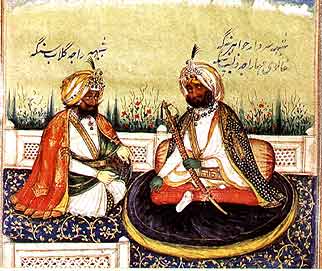
Raja
Gulab Singh with Jawahar Singh |
|
|
|
|
|
|
|
|
|
|
|
|
|
|
|
|
|
|
|
|
|
|
|
|
 |
|
|
|
|
|
|
|
|
|
|
|
|
|
|
|
|
|
|
|
|
|
|
|
|
|
|
|
|
|
|
|
|
|
|
|
|
|
|
|
|
|
|
|
|
|
|
|
|
|
|
|
|
|
|
|
|
|
|
|
|
|
|
|
|
|
|
|
|
|
|
|
|
|
|
|
"The
prince was on his bed, his head most awfully crushed, and his state was such
that no hope of his recovery existed. With that conviction I left the tent,
and whispered to the minister, in so low a tone that no one else could here
it, "Medical art can do nothing to relieve the unfortunate prince";
upon which, the minister requested me to wait there while he re-entered the
tent, and, after a short stay therein, he came out, addressing me loud enough
to be heard by all the assembly, who listened attentively, asking "whether
they might give some soup to the Koonwar Sahib (royal prince), he wishing to
have some". Whereupon I answered. "Of course; he is in need only of
parsley" - a proverb applied to those dangerously ill, and not expected
to live." Honigberger was later dismissed during Hira Singh's time but
re-appointed by Jawahar Singh. After the collapse of Ranjit Singh's kingdom
the British pensioned him. |
|
|
|
|
|
|
|
|
|
|
|
|
|
|
|
|
|
|
|
|
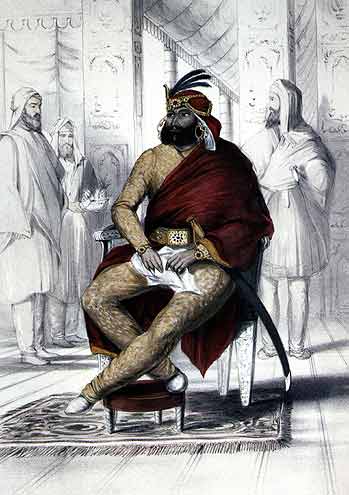
Kanwar
Naunihal Singh (right) |
|
|
|
|
|
|
|
|
|
|
|
|
|
|
|
|
|
|
|
|
|
|
 |
|
|
|
|
|
|
|
|
|
|
|
|
|
|
|
|
|
|
|
|
|
|
|
|
|
|
|
|
|
|
|
|
|
|
|
|
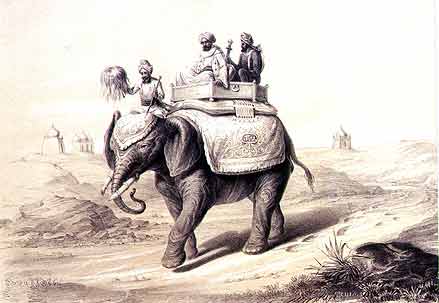
Maharaja
Gulab Singh on elephant |
|
|
|
|
|
|
|
|
|
|
|
|
|
Francis Henri Mouton joined Ranjit Singh's cavalry in 1838 and returned to
France after fighting for the Sikhs at Firozshah and Sobraon. De Ia Roche,
who joined Ranjit Singh in 1838, was a cavalry commander and also performed
some other functions. l.F. Allard was a senior officer under Napoleon Bonaparte
and along with Ventura reached Lahore in March 1822, and Ranjit Singh was
quick to give these experienced officers employment. Allard looked after the
cavalry and lancers, as well as training recruits for Ranjit Singh's army.
He returned to France in 1834 and died in 1839 on a visit to Lahore. Before
that he had been awarded the Legion of Honour by France and the Bright Star
of the Punjab by Ranjit Singh. He had married a Chamba girl who settled down
in France. J.B. Ventura was an Italian by birth and experienced army duty
in the Battle of Waterloo. Coming to India he joined Ranjit Singh in 1822.
After Ranjit Singh's death in 1839 he returned to France leaving behind his
wife and fifty female slaves. P.B. Avitabile was an Italian who came to India
via Persia in 1827. In addition to army duties he also was given civilian
charges. He was discharged from army duty in 1843 and as Aijazuddin writes,
"Avitabile retired to Agerola near Naples, his birthplace, and was soon
married to a young niece by his scheming relatives, keen on sharing his spoils.
Before long, however, the bride and her lawyer paramour were able to accomplish
a feat which the fierce Kurds in Persia, the Sikhs in Wazirabad, and the Peshawari
Pathans had all admitted was impossible. The ageing General was disposed of
silently, it was rumoured, from the combined effects of a poisoned meal and
asphyxiation in a gas-filled room. He died in March 1850, aged fifty nine."
Foulkes joined Ranjit Singh's army in 1836 and died in service at Mandi in
1841. De Ia Font entered Ranjit Singh's service rather late in 1839 and served
under General Ventura. H. Steinbach, a Prussian, entered Ranjit Singh's service
in 1838 but did not have a very happy tenure and returned to Europe in 1843.
H.C. Van Cortlandt joined Ranjit Singh in 1832, was appointed Governor of
Dera Ismail Khan and later on joined the British in India, retiring as the
Commissioner of Multan. C.A. Court, after serving for Napoleon came to India
via Persia. He had a tough time in the chaos which prevailed after Maharaja
Ranjit Singh's death. He married a Kashmiri girl whom he took back to France.
Court was a scholarly man and was also interested in numismatics and archaeology.
All these officers have been portrayed in August Schoefft's classic painting
'The Court of Lahore' and, in his book, Aijazud din has painstakingly pieced
together their itinerant biographies.
The British were intent]y 'watching the events at the Lahore court and their
'intelligence reports' also give information of the prevailing State of affairs.
Their report of 7th November 1840 mentioned, "This day at 11 A.M. Koonwur
Sher Singh arrived by Dak and entered Lahore. Raja Dhian Singh immediately
reported the death of Koonwur Nownihal Singh to his mother Ranee Chund Koonwur,
and to Sher Singh. When intelligence reached the Ranee, cries and lamentations
ensued, and she with the three widows and slave girls of the Koonwur came
to the fort, and looked upon her deceased son. A distressing scene ensued.
Two of the widows viz., Bhuddourwallee aged 13, and Kuttochwallee aged 15
years cried out that their husband was dead and who would now support them,
and that they would burn themselves with his corpse. The Ministers and Koonwur
Sheer Singh, tried to dissuade them, and told them they were too young, but
in vain. They smiled and desired the ministers and Sheer Singh to desist
from such persuasions. The Ministers at last consented. Adorned in their splendid
dresses of all colours, while the Ranees themselves looked like beautiful
fairies the Koonwur's corpse was carried to the Huzzuree garden near his grand-father's
tomb, attended by the two suttees, his mother, and the third widow, daughter
of Sham Singh of Attaree, and a concourse of all the servants and Chiefs.
It was then placed on the pile, the Bhadour and the Kuttoch Ranees also ascended
it, placed the head of the deceased on their knees. The Bhadour Ranee then
granted a "Kulghee" or head jewel to the Koonwur Sheer Singh, and
both prayed to God for the continuance of the Khalsa Government till the end
of the world, and for the happiness of its subjects. The Kuttoch Ranee then
advised Raja Dhian Singh to serve Koonwur Sheer Singh with all
his heart and soul, and then by permission of the ministers, fire was set
to the pile by the Attaree widow. The flames ascended and reduced the Koonwur
and the two fairies to ashes. The Pundit suggested the propriety of the observance
of the Maharaja's funeral rites bv Koonwur Sher Singh, and those of the deceased
Koonwur, by his widow of Attaree, and this was permitted by the Ministers.
After this melancholy ceremony was over, all went to bathe in the Ravee, and
Rannee Chund Koonwur, with Sham Singh's daughter, the widows of the
late Maharaja Runjeet Singh, the slave girls, all returned to the Summonboorj
with shrieks of lamentation. No words can fully and adequately describe the
State of the general mourning in the town. Nothing is to be heard but heart-rending
cries. Some persons ascribe these calarnities to the violent proceedings of
the Koonwur and of Raja Golaub Singh. The one, they say, had ordered a
general demolition of Mosques, Thakurdwaras, and Shuheed Gunges, places sacred
to the Hindus as well as to the Mahomedans, and the Raja struck off Cheit
Singh's head with his own hands, in the presence of Maharaja Khurruck Singh.
It is proposed to proclaim the accession of Koonwar Sheer Singh to the
Khalsa Guddee, in the city of Lahore this evening." The official
British statement, issued by 'T.H. Maddock, Secretary to Government of India'
on 18 November 1840 at Fort William, was more laconic. "Official information
having been received of the untimely demise on the 6th Instant of the late
Prince Nao Nehal Singh, heir to the Lahore sovereignty, from the effects of
an accident sustained while issuing from the palace at Lahore for the performance
of the funeral obsequies and the ceremonial of accession to the throne of
his father the late Maharajah Khurruck Singh, the Governor General of India
in Council in testimony of his sympathv in a calamitv so deeply affecting
a family with which the British Government has long been bound in close alliance
is pleased to direct that the honors due to the memory of a reigning Prince
shall be rendered on this m'elancholy occasion. Twenty-two minute guns corresponding
with what is believed to have been the number of the years of the late Prince's
age will accordingly be fired on this date from the ramparts of Fort William."
|
|
|
|
|
|
|
|
|
|
|
|
|
|
 |
|
|
|
|
|
|
|
|
|
|
|
|
|
|
|
|
|
|
|
|
|
|
|
|
|
|
|
|
|
|
|
|
|
|
|
|
|
|
|
|
|
|
|
|
|
|
|
|
|
|
|
|
|
|
|
|
|
|
|
|
|
|
|
|
|
|
|
|
|
|
 |
|
|
|
|
|
|
|
|
|
|
|
|
|
|
|
|
|
|
|
|
|
|
|
|
|
|
|
|
|
|
|
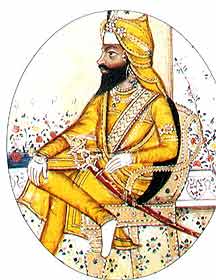
Maharaja
Kharak Singh |
|
|
|
|
|
|
|
|
|
|
|
|
|
|
|
|
|
|
|
|
|
|
|
|
|
|
|
 |
|
|
|
|
|
|
|
|
|
|
|
|
|
|
|
|
|
|
|
|
|
|
|
|
|
|
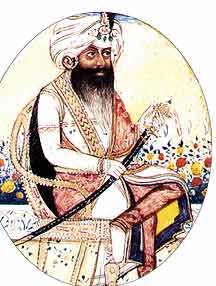
Maharaja
Sher Singh |
|
|
|
|
|
|
|
|
|
|
|
|
|
|
|
|
|
|
|
|
|
|
|
|
|
|
|
|
|
|
|
|
|
|
|
|
|
|
|
|
|
|
|
|
|
|
|
|
|
|
|
|
|
|
|
|
|
|
|
|
|
|
Ranjit
Singh held his court together through a system of personal loyalties and a strong
hand, though he was not a cruel despot. Such was his authority that even during
his crippling paralysis towards the end of his life the affairs of the state
ran effortlessly in his name. Once he died, in 1839, there was considerable
anarchy for a decade till his empire finally collapsed. |
|
|
|
|
|
|
|
|
|
|
|
|
|
|
|
|
|
|
|
|
|
|
|
|
|
|
|
|
|
|
S.
Sham Singh Atariwala |
|
|
|
|
|
|
|
|
|
|
|
|
|
|
|
|
|
|
|
|
There
were a series of intrigues, deaths and murders which wiped out the leading figures.
Sher Singh, Dhian Singh and Pratap Singh were brutally murdered by Ajit Singh
Sandhawalia in September 1843, who in turn was killed by Hira Singh a few days
later; Hira Singh was killed in September 1844; Jawahar Singh, the brother of
Rani Jindan, was executed by the Sikh army in September 1844; Rani Jindan was
exiled by the British in August 1847 and, perhaps, if she had been restrained
some years earlier from imposing her intrigues on the Sikh kingdom its history
might have been different. Prior to his death Kharak Singh had been deposed
by his own son Naunehal Singh in October 1839. With the collapse of the Lahore
court in 1849 and the anarchy that had gripped it in its last decade, and its
coming under direct British rule, a semblance of tranquillity descended on Punjab
till the next upheaval, which was the Mutiny of 1857. Ironically, the sketches
made by European artists like Emily Eden and August Schoefft were converted
into lithographs and paintings and reached Punjab after the deaths of their
subjects. In fact when Schoefft first reached Punjab in 1841 he had already
missed out on Maharaja Ranjit Singh, Kharak Singh and Naunehal Singh, who had
already passed into history. Emily Eden's 'Portraits of the Princes and People
of India' was published in 1844, August Schoefft's' famous painting 'The
Court of Lahore' was finished much after 1850. Even Osborne's book 'The
Court and Camp of Ranjit Singh' was published after the Maharaja died. Soltykoff's
magnificent images were published in 1858. The European artists, therefore,
did not have an immediate effect on the preferences of the Lahore court though
instances are recorded of their making and presenting some paintings to their
subjects during their visits. The last Maharaja, Dalip Singh, was fortunate
to have been portrayed in all mediums - miniatures, water colours, oils, photographs,
and was even sketched by Queen Victoria herself, whose favourite he was.
Comparing his initial miniature paintings with the photographs it appears that
the painters' efforts were quite realistic. There was often a caricature effect
in the paintings. For example, the painters accentuated Daleep Singh's large,
sad, eyes, Hira Singh's wiriness, Sher Singh's grace and vitality, Kharak Singh's
weaknesses, the wiliness of the twin-thumbed Dhian Singh and his brother Gulab
Singh. Daleep Singh in particular became the icon of nostalgia and Aijazuddin
succinctly sums up his predicament. "Dalip Singh's life was not his
fault. History condemned him to a role in Punjabi politics that he was neither
old enough nor competent enough to turn to his lasting advantage; his fellow
Sikhs converted him into a symbolic sceptre of power; his mother alternately
used and abused him; the British professed a fiduciary and paternal responsibility
before betraying him; his adopted religion failed his expectations by rendering
him in the ultimate analysis unacceptable to his Christian equals; and finally
his immature vacillation and re-conversion destroyed the remnants of a frayed
self-respect."
|
|
|
|
|
|
|
|
|
|
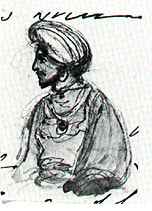 |
|
|
|
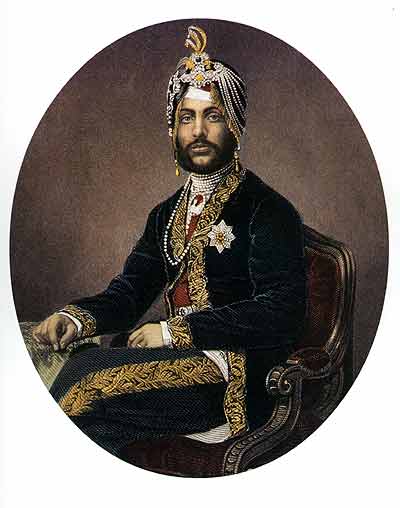 |
|
|
|
|
|
Sketch
of Maharaja Dalip Singh by Queen Victoria |
|
|
|
|
|
|
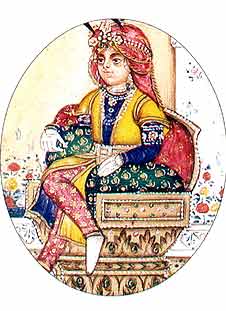 |
|
|
|
|
|
|
Maharaja
Dalip Singh |
|
|
|
|
|
|
|
|
|
|
|
|
|
|
|
|
|
|
|
|
|
|
|
|
|
|
|
|
|
|
|
|
|
|
|
|
|
|
|
|
|
|
|
|
|
|
|
|
|
|
|
|
|
|
|
The
paintings of that era, read with accounts of those times give a fairly accurate
picture of their subjects. Moorcroft, a veterinarian, was one of the earliest
travellers to Maharaja Ranjit Singh's court, in 1820. Of the time spent by him
with the Maharaja he wrote: "On the evening of the 8th of May the Hakim
came to conduct me to the presence of Ranjit Singh. Having passed through one
of the western gates of the fort, we crossed the garden, in which stands the
Jama Masjid, or principal mosque. Thence a long flight of brick steps led to
a second gateway and court, crossing which we came to a third gate that opened
into a more spacious enclosure, in which stood a number of horses caparisoned.
From this we entered a large court flagged with marble, and on the side opposite
the entrance was an open apartment, in which the Maharaja was seated. Upon my
approach he partly rose from his chair, which was of gold, and pointed to another,
of silver, opposite to him, for me to sit down upon. His courtiers sat upon
the carpet on either side, forming a lane from his chair to mine. The gateways
were well guarded, but here were only two matchlock men, sitting one on either
hand of the Raja. After the ordinary inquiries I expressed my thanks to him
for the attentions I had received Since entering his territories, and requested
leave to offer the few rifles I had brought for his acceptance. These were a
pair of double-barrelled, and a pair of three barreled pistols, a sword, and
the model of a cannon, with carriage and all appurtenances complete. This miniature
piece of ordnance was made by Mr. Donnithorne, the mint master at Farokhabad,
and was of singularly beautiful execution. To these I added some white chown
tails and bags of musk from the mountains. Ranjit was much pleased with the
pistols, and still more with the cannon. Entering upon the main purpose of my
travels, that of procuring horses, he ordered some of his to be exhibited and
about fifty were passed in review. They had all rich bridles, saddles, and housings,
and were of the breeds of Dhani and Ghep, forest districts in the Punjab, the
Lakhi, Jangal, Rohtas, Atak, Kabul and Bokhara. One which had cost 1700 rupees
at Bokhara was beautifully made except in the legs below the knees and hocks,
where he was too slight. For a grey Persian horse the Raja told me he had given
7000 rupees, but it struck me as inferior to most of those exhibited. After
the horses had been fully inspected I took my leave. Early on the following
morning the Hakim came and took me to Ranjit, who wished me to see his horses
exercised. I found him in a neighbouring garden seated on a chair under an awning
without any guards, his courtiers sitting round him on carpets. When I was seated,
fifty horses, different from those I had before seen, were brought forward.
The space on which they were exercised was a garden-walk twelve feet broad.
The rider (for only one was employed) mounted each horse in succession, and
sometimes walked a few paces; but in general urged him at once into a short
and high gallop, in which the fore action was very high, the hind low and quick.
This was continued with great rapidity for a few yards, when the horse was suddenly
turned on his haunches, and the same movements were repeated, or they were sometimes
broken by rapid side movements in most perfect obedience to the action of the
body and the hand. Not a single horse neighed, or was restive or vicious in
the slightest degree, or was uneasy at mounting, or diverged from the path,
although the Raja affirmed that they had not been ridden for some time past
On the 10th I was present upon the Raja's invitation at the parade of two regiments
which he had formed on the model of the Company's sipahis. The men were Sikhs,
Hindustanis, and Gorkhas; the first were in general tall well-looking men; the
second were of a mixed appearance; the last generally short but muscular. The
Raja beheld them from the top of a low building at the palace, where I joined
him. He seemed to take great interest in his regular battalions, but they are
not popular amongst his officers. Desa Singh told Izzet Ullah that all
Ranjit's conquests had been won by the sword, and he had never known the infantry
and artillery of any service. The Raja told me that these regiments had been
first trained by a Naik, who had deserted from the Company's service. He was
very communicative. After the review he showed me some more of his horses, chiefly
from Bokhara; and then consulted me on the State of his health, complaining
much that he could not bear such strong potations as he had been used to do
formerly; he told me also that he had once sent an account of his ailments to
General Ochterlony, that a European surgeon might prescribe for him, and that
he had in consequence received some medicines, but had never taken any of them.
These were afterwards sent to me, and finding one of them to be elixir of vitriol,
I mixed a few drops with water, and drank it in the presence of the Hakim, in
order to remove any suspicion that might lurk in a mind so constituted as that
of Ranjit appears to be. After I left him I received a message that I was at
liberty to visit any part of Lahore, whenever and in what way I pleased, and
desiring me to name what breed of horse I preferred, that the Raja might give
me one. I returned due thanks for the Raja's kindness, but declined accepting
the horse, at least until I should return from Bokhara. During the other days
of my stay at Lahore, I had several interviews with the Raja, in all of which
he conversed with the apparent absence of all reserve upon a variety of topics.
One of his favourite themes was his stud. He told me that most of his horses
were presents from his tributaries and zamindars, and that he not infrequently
requited the donor of a superior animal with a village or a jaghir; no wonder,
therefore, that he is not singular, however, in his passion. Every Sikh in the
country keeps a horse and a brood mare, and rears colts for his own riding or
for sale. The Raja monopolizes the best; for in the party, which escorted me
from Jindiala there was only one good horse. Ranjit proposed to me, through
Mir Izzet Ulish, to purchase some horses for him at Bokhara, and I readily assented;
but there was some difficulty as to the model and the matter ended by my stating,
that if he would be contented with but one, he should select it from the string
I hoped to bring down The Raja consulted me also confidentially, regarding his
health, which appeared to me to have suffered chiefly from intemperance and
excess. On my departure I left a paper of remarks and instructions, which I
heard was canvassed by a conclave of native doctors, and was honoured with their
concurrence. In all probability it was but little attended to by Ranjit in practice
. Ranjit conversed also freely upon his military arrangements, and upon his
past exploits. He told me that he lost 1900 men in a few hours, in an attempt
to carry the city of Multan by escalade, owing to its having been made whilst
he was absent. The gates had been blown open, but strong mounds of earth had
been reared behind them. The garrison amounted to 3000 men, the besiegers to
25,000; but the formers were all Pathans, and 'fought with one hand'. In answer
to the question I put, how many survived the capture of the fort, he said 500,
on which Himmel Sinh, a favourite courtier, guessing the drift of my inquiry,
which was to ascertain the truth of the report that they had all been put to
death immediately, remarked that not a man was killed after the fort surrendered.
Speaking of the wealth of the city the Raja said it was estimated at four crores,
on which Himmel Sinh observed that the Sikh officers did not attempt to restrain
the soldiers from plunder, on account of the opposition that had been offered,
and the loss sustained; and the Raja stated that very little of the booty had
come to his share. Neither the Raja nor Himmel Sinh mentioned the severe captivity
to which the gallant but unfortunate Nawab Sirafraz Khan is now subject at Lahore.
The Nawab Mozaffer Khan was killed in the storm with two of his sons. Sirafraz
Khan was a third Son. Although the troops plundered the city, they were compelled
to relinquish their booty to the Raja, and the most valuable part came to the
public treasury. Early on the morning of the 13th 1 had my audience of leave.
The Maharaja was peculiarly communicative and familiar. He told me that when
Lord Lake entered the Panjab in pursuit of Holkar, he felt a strong desire to
see the European general and his officers. His courtiers endeavored to dissuade
him, affirming that the very sight would be unlucky; but he was determined to
gratify himself, and for that purpose disguised himself as a common trooper,
and accompanied by a party of his soldiers, repaired to the British camp. They
went to Mr. Metcalfe's tent, and sent word that some Sikhs had come out of curiosity
to see the Sahibs, and begged he would indulge them. He immediately complied
with their desire, but soon distinguished Ranjit Sinh amongst his visitors After
many assurances of kindness towards me, and of friendship for the Company, he
dismissed me with an honorary dress of valuable shawls, and similar distinctions
of less value to Mir Izzet Ullah, and his son and brother. I had submitted to
Ranjit Sinh a proposal to establish a fixed scale of duties for the admission
of British merchandise into his territories, but he postponed the consideration
of the arrangement until the return of his principal officers from the campaign
in which they were now engaged, as he said he wished first to consult them upon
the subject. This, however, I consider as an adjournment sine die. He readily
consented to my proceeding through Mundi and Kulu to Ladakh, and in case of
my being unable to reach Bokhara from Upper Tibet, I had his authority to pass
through Kashmir with two hundred followers. He appointed Miri Mal to attend
to me till Kulu, and furnished me with written orders to his officers to afford
every facility to my journey In the evening Nur-ad-din, the Governor, came to
conduct me through the city. Lahore is surrounded by a brick wall about thirty
feet high, which extends for about seven miles, and is continuous with the Fort.
The latter, in which the Raja resides, is surrounded by a wall of no great strength,
with loop-holes for musketry; a branch of the Ravi washes the foot of its northern
face, but it has no moat on either of the remaining sides. The palace within
this enclosure, called the Saman Burj, which is of many stories, is entirely
faced with a kind of porcelain enamel, on which processions and combats of men
and animals are depicted. Many of these are as perfect as when first placed
in the wall. Several of the old buildings are in ruins, others are entire, and
throw into shades the meaner structures of more recent date. Ranjit Singh has
cleared away some of the rubbish, and has repaired or refitted some of the ruined
buildings of Jehangir and Shah-jehan; but his alterations have not always been
made with good feeling or taste. The great square and buildings of the principal
mosque have been converted into a place of exercise for his sipahi infantry,
and he has stripped the dome of the mausoleum of Asof Jah, the brother of Nurjehan
Begam, of its white marbles, to apply them to the erection of some insignificant
apartments in the garden-court of the Mosque. The Diwan Am, or general hall
of audience, is a long apartment supported by many pillars. The Diwan Khas,
or private audience hall, is a suite of small chambers offering nothing remarkable.
Lahore is said to have been twelve kos in circumference, and however this may
have been, it is clear, from the ruins of buildings beyond the walls, that it'
was once much more extensive than it is at present. Such of it as still remains
within the walls is apparently very populous. The streets were crowded to an
extent beyond anything I have ever witnessed in an Indian city. The houses were
in general of brick, and five Stories high, but many were in a very crazy condition.
The Bazaar follows the direction of the city wall, and is not far distant from
it. The street is narrow, and this inconvenience is aggravated by platforms
in front of the shops, on which the goods are displayed under projecting penthouses
of Straw to protect them from the sun and rain. Through the centre of the remaining
contracted space runs a deep and dirty drain, the smell from which was very
offensive. The population consists of Mohammedans, Hindus, and Sikhs, the former
in the greatest number I saw no building of any size or magnificence, except
the mosque of the Nawab Wazir Khan. The wall of the city was still under repair,
and 3000 men were said to be at work upon it and upon the moat, which the Raja
was about to add to the defenses. The place, however, could oppose no effectual
resistance to European assailants." Moorcroft went on to the hills and
also left an authentic account of the court of Sansar Chand, the greatest patron
of Kangra painting.
|
|
|
|
|
|
|
|
|
|
|
|
|
|
|
|
|
|
|
|
|
|
|
|
|
|
|
|
|
|
|
|
|
|
|
|
|
|
|
|
|
|
|
|
|
|
|
|
|
|
|
|
|
|
|
|
|
|
|
|
|
|
|
|
|
|
|
|
|
|
|
|
|
|
|
|
|
|
|
|
|
|
|
|
|
|
|
|
|
|
|
|
|
|
|
|
|
|
|
|
|
|
|
|
|
|
|
|
|
|
|
|
|
Next
to Part 2 |
|
|
|
|
|
|
|
|
|
|
|
|
|
|
|
|
 |
|
|
|
|
|
|
|
|
|
|
|
|
|
|
|
|
|
|
|
|
|
|
|
|
|
|
|
|
|
|
|
|
|
|
|
|
|
|
|
|
|
|
|
|
|
|
|
|
|
|
|
|
|
|
|
|
|
|
|
|
|
|
|
|
|
|
|
|
|
|
|
|
|
|
|
|
|
|
|
|
|
|
|
|
|
|
|
|
|
|
|
|
|
|
|
|
|
|
|
|
|
|
|
|
|
|
|
|
|
|
|
|
|
|
|
|
|
|
|
|
|
|
|
|
|
|
|
|
|
|
|
|