THE FOLLOWING ARTICLE HAS BEEN TAKEN FROM A MAGAZINE PRINTED IN DECEMBER 1964 IN NAIROBI AND EDITED BY GURCHARAN SINGH GAHIR WHO ALSO WROTE THIS INFORMATIVE ARTICLE (Kanwal)
KENYA BECOMES A REPUBLIC
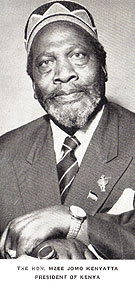
Kenya becomes a Republic exactly after one year of achieving independence (12th Dec.1963), under the leadership of Mzee Jomo Kenyatta. Kenya has decided to continue its association with the Commonwealth as a full, valuable and effective member. Within a short period of one year Kenya has progressed in every sphere. Relations between several races and communities have become happier and more cordial. The whole world is surprised at the way the Government of Kenya under the leadership of Mzee Jomo Kenyatta (below) have solved some immediate and very testing problems.
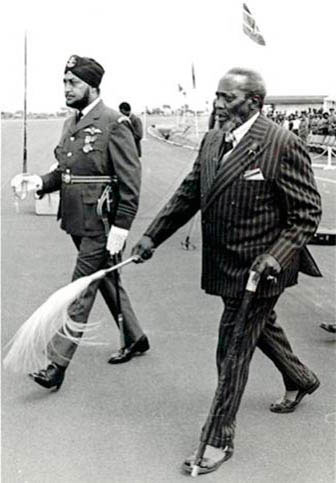
Gurcharan Singh Chana (Chani) was Base Commander of the Kenya Air Force, Eastleigh, which is the largest and main Air Force Base and Air Force Headquarters in Kenya and he was an Air Force pilot and Colonel. Chani's story in East Africa and his contribution as a Sikh in the community is prominent. Here he is seen escorting the Kenya President Jomo Kenyatta at the Eastleigh Airport.
LIEUTENANT COLONEL GURCHARAN SINGH CHANA STATION COMMANDER KENYA AIR FORCE/CAPTAIN GURCHRAN SINGH CHANA BOEING INSTRUCTOR KENYA AIRWAYS.
lieutenant Colonel G S Chana was born in a poor family. Whilst in school it was his desire to become a pilot. After finishing his education he briefly worked for a bank and at the same time acquired a Private Pilot's License. He then decided to join the Kenya Air Force. He completed his officer training with the Royal Air Force in England and on his return he was commissioned by the Late President His Excellency Mzee Jomo Kenyatta. As he progressed in the Air Force, as a pilot, he was the first Sikh to be awarded the rank of a Lieutenant Colonel in the Kenya Air Force. Subsequently he was the first Kenyan Sikh to acquire the position of Station Commander Kenya Air Force. After serving for 20 years in the Air Force, he retired in 1985.
He then joined Kenya Airways as a pilot and having flown most of the aircraft in Kenya Airways he retired as a Captain and Boeing Instructor. He has flown a total of 15 different types of aeroplanes.
He also had a deep passion to go into music and he learned Tabla at the age of 6 years from the great Gurus in India. He practiced regularly and today is regarded as the top percussionist on the Tabla in Africa. He has accompanied the great King of Ghazals Jagjit Singh, Sitar Maesto Ustad Basharat Khan. Ustad Mehdi Hassan and Parvez Mehndi. In addition he has also given numerous musical performances with most of the leading professional artists in the World.
Chani, as he is more prominently known was very close to Jagjit Singh. One of his great moments was when Jagjit Ji came to Nairobi and invited Chani to perform with him on the stage.
Chani is married to his charming wife Jaswant Kaur (Jassy). She has been a Head Mistress of various schools and holds a Mentessori Diploma. They have two daughters namely Taninder and Maninder and a son Ishwinder, all Southampton University Graduates. Their grand daughter Sahiba who is at the tail end of her higher education is a very talented musician. Both Chani and Sahiba have already produced two CD's and two DVD's.
Chani says most people say that Flying and Tabla playing is a very strange combination. It is not, because both Flying aeroplanes and Playing Tabla is done with precision.
When Kenya became independent many people of Western thought considered
that the Government of the country would not be able to efficiently overcome many
problems left by the Colonial people as legacies of their rule. One of such problems
was that an ineffective Opposition which was created by the Colonial Government
to cripple the independent Government of Kenya in discharge of its duties. How
far that worked is known to everyone. The Government of Kenya has not only been
able to withstand the tactics of the Opposition but the Opposition has itself
voluntarily decided to dissolve itself in the national interest of the country.
This is something very unique in the history of the entire continent of Africa.
This is a proof of political awareness and maturity of our leaders. The country
is on the move. Realising that its economy is only on the take-off-stage, it is
indeed very creditable that the Government of Mzee Jomo Kenyatta has undertaken
agrarian reforms. Inequities of the past have died out and in the present independent
Kenya equal opportunities exist for all regardless of the colour and one's skin
or the religious faith he has.
The Sikhs of Kenya are particularly happy on
this historic occasion because the Republic Day falls within the same week as
the 298th Birthday of Sri Guru Gobind Singh Ji, the tenth and last Sikh Guru (Guru
means the preceptor).
We briefly mention here that Sri Guru Gobind Singh Ji
underwent supreme sacrifices; supreme not only in the history of India but unique
in the history of the whole world. He persuaded his father to lay his life in
the cause of righteousness and freedom. He sacrificed his all four sons for the
same cause.
According to Sikh religion whenever there is a special occasion
it is marked by a continuous recitation of the Holy book Sri Guru Granth Sahib.
The ceremony is called "Akhand Path". To mark this very special occasion
of the Republic Day, the Sikh Community have arranged for Akhand Path, in all
the Sikh temples which would be followed by a prayer on Sunday the 13th December,
1964, for the prosperity of the Nation and success in every sphere of the national
Government of Kenya.
ROLE OF SIKHS IN THE KENYA POLICE..CLICK FOR PDF
THE SIKH RELIGION
Punjab,
the land of five rivers, which lies in the north of the Indian sub-continent,
is the source from which the Sikhs have originated. Punjab is replete with long
ancient history and significant legend. It is proud to have produced some of the
stoutest and bravest people in India. In this land of Punjab was born less than
five centuries ago a saint called Guru Nanak. At that time the country was under
the oppressive and cruel rule of the Moghuls. Corruption, inefficiency and nepotism
had gone into the vitals of the country. Religious bigotries were rife. Superficial
prejudices and religious hatred had created water-tight compartments between the
Hindus and Muslims. They had both forgotten the true essence of religion. It was
darkness all over and in the name of religion; tyrannies and oppression were meted
out to the simple and poor masses. From this emerged which is known as Sikhism.
Guru Nanak undertook the task of spiritual clean-up and endeavored by travelling
throughout India, Ceylon and the Middle East to show the true path and explained
the significance of religion in its true sense. He brought out in a very simple
and convincing manner that all religions had very much in common in that they
were all based on truth and preached good human conduct and association of man
with God and truth.
The tenth Guru, Sri Guru Gobind Singh Ji, however, came
to the conclusion that preaching in a pacific manner was not enough in the context
of the circumstances then prevailing. He therefore decided to convert his followers
into "Singhs" who were baptised into a new faith in which they could
take an abiding pride and which they would not be able to disown so lightly. These
were then the circumstances in which the Sikhism was born.
SIKH
MIGRATION:
Sikhs are essentially a peasant community. In the old
British regime in India, a feudal system of land ownership (Jagirdari) was created
deliberately in the home land of Sikhism whereby ordinary peasant families succumbed
to the greed of the overlords and lost their lands, their only means of livelihood.
Ultimately some of them migrated to various parts of the world to earn their livelihood.
They went to Canada, South America, Malaysia, Fiji Islands, Australia and New
Zealand and, of course, various countries of S.E. Asia. Some of them came to East
Africa as well. As a result the Sikhs are now all over the world, naturally, in
extremely different and diversified circumstances. Wherever they are the Sikhs
have proved themselves to be excellent and progressive citizens. They have identified
themselves in the various lands of their choice and have proved beyond any shadow
of doubt their worthwhile ness and sincerity.
In Kenya therefore the Sikhs
feel confident that they can take the initiative. They will prove themselves worthy
of their tradition by integrating with the indigenous people of Kenya.
THE
SIKHS' CONTRIBUTION
One only has to have a look around the beautiful
city of Nairobi to prove that the Sikhs' contribution in the development of the
country of their choice has been sterling. In fact there is not a single building
in any of the cities of Kenya over which sweat of the Sikhs has not been shed.
The Sikh artisans, carpenters and contractors have very greatly made the cities
of Kenya what they look like today over a period of over half a century. They
have adhered to the true traditions of their religion and have been working side
by side, shoulder to shoulder with the Africans. Their contribution in training
the indigenous people in all spheres of their trade has been indeed marvelous.
When the interior of the country was opened it was the Sikh who did the entire
tool work. He was the carpenter, blacksmith, mason and even a coolie.
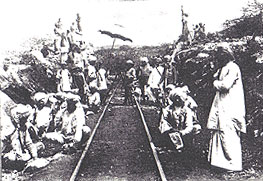
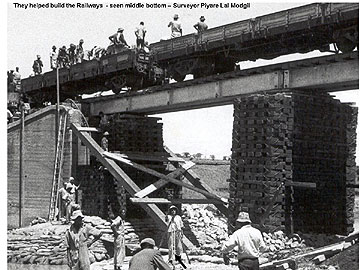 This photo sent by Prem Modgil, shows his father Pyare lal Modgil who was the surveyor during the construction of the Uganda railways. (My sincere thanks to Prem)
The
old Uganda Railway line was built by Indian labour (above) which included
the sturdy Sikhs. Later on they found employment in several Government Departments
and many private organisations and found reasonable scope for their capabilities.
The country in turn found in them the vital means for generating development.
These were the men who erected the buildings and made the roads, who constructed
the factories and houses. These were the men who manned and repaired and maintained
the machinery, the plant and all types of technical equipment.
It was their
ingenuity which enabled the construction work to proceed smoothly.
The Asian
fundee has imparted his skill to the African unskilled worker. He has quietly
and patiently taught and trained the African in his own trade. At present there
is a fairly large African artisan class in Kenya which has emerged from the Asian
artisan class in which the Sikhs have always predominated. It has been an outstanding
example of human comradeship and co-operation.
THE
SIKH AS A SPORTSMAN
The Sikh is not only the artisan in the Modern
Kenya but he holds important positions in every sphere and all professions.
The
Sikhs are known the world over as sportsmen. They have still in their veins the
rustic blood of their forefathers. They are instinctively inclined towards healthy
and active pursuits. Sports therefore are a part of their way of life. In Kenya
and all over East Africa they are known for their versatility in hockey. They
have their social clubs throughout Kenya which are open to all communities regardless
of colour and creed.
Here the Sikh community is particularly proud to mention
that the Chef-de-Mission of Kenya in the 1964 Olympic was a Sikh, Mr. Harbans
Singh Sehmi, one of the best known sportsmen in the world. It was an acknowledgement
of the contribution of the Sikhs in the sports of Kenya.
SIKHS
IN POLITICAL LIFE OF KENYA
The Sikh contribution in the political
struggle of the country for leading to Independence has been no less remarkable
than in other spheres herein mentioned below. The Sikhs are freedom minded people
and they like to live honourably and with their traditional pride. Their sympathies
always go out for the oppressed. The Sikhs have taken active part in the political
life of the country right from the day they settled into this country.
They
have not only been devoured by the man-eater lions of Tsavo, but the colonial
masters of the early 20th century who shot many an Indian on flimsy grounds such
as insubordination.
Then came the phase where the Indian Community politically
organised itself. The First Congress session of the East African Indian National
Congress was held at Mombasa in 1914. In that session a resolution demanding equal
rights for all and a common roll was adopted unanimously. The Europeans and more
particularly the European Settler community was perturbed over such demands.
Then
the First World War broke out. The German army shelled the railway line thus cutting
off the supply line of the allied forces on the front - on the Kenya-Tanganyika
border.
The European settlers took this as an opportunity and pinpointed the
blame on a number of Indians. They wanted to crush the Indian political movement
once and for all.
Mr. Bishan Singh hanged
*As
a result Messrs. Rama Nand, Keshavlal, M. L. Savle, Bishan Singh and Lall Chand
were charged of assisting the enemy. A Military Court Martial was set up at Voi.
The Chairman of the Court was Col. P. H. Dyke and he was assisted by two army
officers on the bench. The Advocate General was Maj. Lazel. The five accused were
brought before the court on December 3, 1915. It was a sort of summary trial.
It did not take more than two hours to conduct the proceedings. The accused were
not allowed to brief any advocate to put up defense. Early next morning at 4 a.m.
all the five accused were called to the court room and were told that the court
found four of them guilty of charge and sentenced them to death. Mr. Rama Nand
was acquitted. They were given twenty four hours to make any statements, if any,
to the court. None of the accused persons made any statements. On 5th December,
1915 they were brought to Mombasa in the train. From the railway station they
were taken by British soldiers to Fort Jesus where they were locked up in separate
cells.
*Bishan Singh was born in Jullundur (Basti Gozaan) in about 1875
A.D. in a Ramgarhia family. His parents' names have not yet been traced.
Sardar
Bishan Singh was taken out next morning at 7.30 a.m. from his cell by British
soldiers for hanging him in the open. Eventually he was hanged at a site where
now Old Market, Mombasa, stands. The death sentences of Keshav-lal and Savle were
commuted to 20 years and that of Mr. Lall Chand to 10 years.
Mr. Lall Chand
was released in May, 1919. He saw the leading Indian leaders notably the Late
Mr. M. A. Desai. Representations were made to the Governor, Sir Charles Bowring,
for the release of Messrs. Keshavlal and Savle. Through their intervention they
too were released.
Murder of Mr. Isher Dass
In
1942 there was political upheaval in India. "Quit India" movement was
in full swing. Subject nations all over the world had their sympathies with the
Indians. In Kenya as well both Africans and Asians and of course right thinking
Europeans had their sympathies with the Indians in their struggle. To make the
matters worse, the Kipande system for the Indians and Defense Regulations were
introduced at the same time.
Mr. Isher Dass was the Deputy Director of Manpower
(Indian).
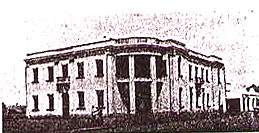
He had his office in Desai Memorial Hall (above), Nairobi. He had
very wide powers and he soon became very rude to the general public who had to
go to him for one thing or another in his official capacity. He was particularly
harsh with the artisans and low paid clerks. He was considered as a stooge of
the colonial government and a traitor. He lost respect in his community. People
were fed up with the insults and indignities that he used to perpetrate day in
and day out.
Two young Sikhs,* Saran Singh and Balwant Raj, shot Mr. Isher
Dass in his office in Desai Memorial Hall on the 6th November, 1942. They were
arrested with another young Sikh, Harbaksh Singh, who was acquitted in appeal.
They were charged and ultimately Saran Singh and Balwant Rai (below) were sentenced to
death. They were hanged on the 12th February, 1944 in H.M. Prisons, Nairobi.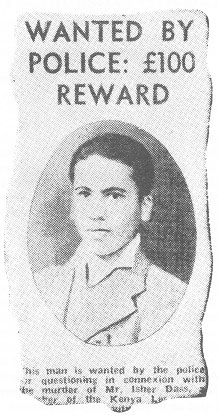
The
two young Sikhs were acclaimed as martyrs throughout the country. A funeral procession
was taken out through the centre of Nairobi. Thousands of Indians of all communities,
Hindus, Muslims and Sikhs, joined the procession. They were cremated at cremation
ground. A film was taken which is in India now. Akhand Paths were performed for
seeking eternal peace of the departed souls and prayers were held.
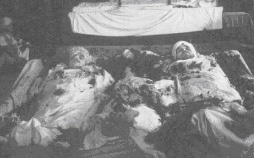 The bodies of the accused in the Sikh Temple-Balwant Rai Dhanna Ram and
Harbuksh Singh Dharam Singh (photos taken with courtesy from www.balwantrai.com)
1. *Balwant
Rai was born at village Dadiyal. District Hoshiar-pur in about 1917 A.D. to widowed
mother, Mrs. Dhanna Ram of a Ramgarhia family. He was the only son.
2. Harbakhsh
Singh was born in village Bhulle Wal. District Hoshiarpur in 1928. His father,
Mr. Dharam Singh Ryat, was the president, Ramgarhia Artizans' Union, Nairobi.
3.
Saran Singh was also born in village Bhulle Wal, District Hoshiarpur in 1918.
His father's name was S. Chattar Singh. He was a near relative of Mr. Dharam Singh
Ryat, who brought him to East Africa.
A book "The trial of Balwant Rai & Others" has been written by Mr. K.Lal, which in detail describes the actual incidents with photos and charts. More details can be had from the web site: http://www.balwantrai.com/index.htm
Mr.
Makhan Singh
Mr. Makhan Singh was born on the 27th December, 1913
in the village Gharjakh, District Gujranwala (now in Pakistan).
He first came
to Nairobi in April, 1927, and passed his London Matric in 1931. He joined his
father's printing business and also took keen interest in the Labour Trade Union
movement. In 1937 he founded the Labour Trade Union, Nairobi, and became its first
secretary.
He spent most of his time organising the Labour Trade Unions. He
took keen interest in politics. He condemned the Immigration Control Bill at the
Mombasa Congress Session in 1948. On April 23, 1950, he delivered an impassioned
speech at the Kaloleni Hall, Nairobi, calling upon people of Kenya to unite and
demand in a single voice that Kenya was theirs and that no foreign power had any
right to rule over it. He also made a public statement that he was a Communist.
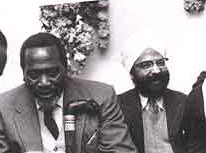
Makhan Singh with Jomo Kenyatta
The Government was looking for an opportunity
and Makhan Singh was arrested on May 15, 1950 charged with various offences. The
trial was held at Nyeri and Mr. Chanan Singh (now Mr. Justice Chanan Singh) defended
him. He was acquitted. But the Governor, Sir Philip Mitchell, ordered his detention
for an indefinite period.
He was released on the 20th October, 1961 after about
ten years' detention. He is regarded as the father of the trade union movement
in Kenya.
Jarnail Singh was another young Sikh who used to assist Mr. Makhan
Singh in his work of organising the trade union movement. He was deported to India
in 1950. Mr. Jairnail Singh returned to Kenya early this year.
Indian
Political Trends
Now, we come to another crucial phase in Kenya
when unrest among the Indian community was felt over issues confronting them and
their grave consequences. Mr. Haroon Ahamed and Mr. D.K. Sharda of the Colonial
Times and the Daily Chronicle, Nairobi guided them and created an influential
opinion in the country. The government was perturbed and awaited for an opportunity
to trap them. This gave rise to the Indian nationalism and youth movement. The
general secretary, Indian Youth League, Nairobi Mr. Gurcharan Singh Gahir, convened
the First Kenya-wide Youth Conference during the Christmas holidays in 1947 in
Nairobi. Mr. Haroon Ahmed, who was released after completing a term of sentence
for sedition, was elected unanimously Persident of the Conference.
He declared
that Kenya was our "Homeland" and our goal was full independence. His
statement was endorsed by the delegates.
Then Dr. Y.M. Dodoo and Dr. Naicker
of South Africa paid short visits to Kenya and helped in forming stronger bridge
between African and Indian common front. This further upset the authorities in
this country.
There was difference of policies between the younger politicians
and the old clique of the Kenya Indian Congress on major issues. It was worried
ever the growing influence of the younger elements. Naturally division was created
at the sessions of Mombasa, Kisumu and Nairobi. Some Indian journalists were charged
for sedition and sentenced to imprisonment.
Then came most difficult phase
of the longest Emergency (1952-61). Members of the Kenya League were active. But
it was refused registration by the Registrar of Societies at the close of 1952.
The Intelligence Branch found an opportunity to put the younger Indian politicians
behind the bar. It was openly discussed that Messrs. Jagdish Kapila, Haroon Ahamed,
F R. S. De Souza, Jaswant Singh, Gurcharan Singh Gahir. V. P. Mandal, the Late
D. K. Sharda and the Late K. D. Travadi would be arrested and detained under the
Emergency Regulations.
The then Secretary of State for Colonies, Mr. Lyttelton,
paid a hurried visit to Nairobi in 1954 to assess personally the impact of Mau
Mau movement and the security situation of the country. He met Elected Members
of European and Asian, and the African Nominated Members. He produced a Constitutional
Formula just to
gather all the communities for basis of joint sharing of the
responsibilities of Independent Kenya. First time Asians were given two Ministries
and the Africans bagged one. All the groups accepted the Lyttelton Plan with protests
and reservations.
Mr. Lyttelton advised the government not to detain any Indians
at that crucial juncture of the Emergency otherwise the turn of Mau Mau tide would
change. His personal intervention saved the situation.
Mr.
Jaswant Singh
Mr. Jaswant Singh was born at Chamkaur Sahib, District
Ambala on the 24th April, 1924. He came to Kenya in 1933 and passed his London
Matriculation from the Government Indian Secondary School, Nairobi in 1940. Then
he went to India for further education and did his M.A. from the Lucknow University
in 1946. He qualified as a Barrister from the Lincoln's Inn on January 19, 1949.
He
commenced his practice at Kampala, Uganda in 1949. In 1952, he moved to Nairobi.
The prominent cases in which he appeared were -Kapenguria Trial, Appeal at Kitale
and Lari Massacre Trial. He was also Legal Adviser to Kenya African Union.
He
was associated with the Kenya Indian Congress, Kenya League (it was the first
multiracial political party formed in Kenya in 1952 but was refused registration
later by the Registrar of Societies at the close of the year) and the Pioneer-a
fortnightly Sikh newspaper started during the Emergency.
Mr. Jaswant Singh
left for India in September, 1954 and was declared a prohibited immigrant in November.
The British Government in a House of Commons statement declared "that after
his departure it was discovered that he was associated with Mau Mau".
He
joined the Ministry of External Affairs of India and was posted as a Consular
Attache, Indian Embassy, Djakarta, Indonesia (1955-57). He was Under Secretary,
West Africa, 1957-58. The ban against him was withdrawn and he returned to Kenya
in August, 1958 and he resumed his legal practice.
DEDICATION
TO KENYA
In the end, we would strongly advise the Indian Community
generally and the Sikhs particularly that they should fully identify themselves
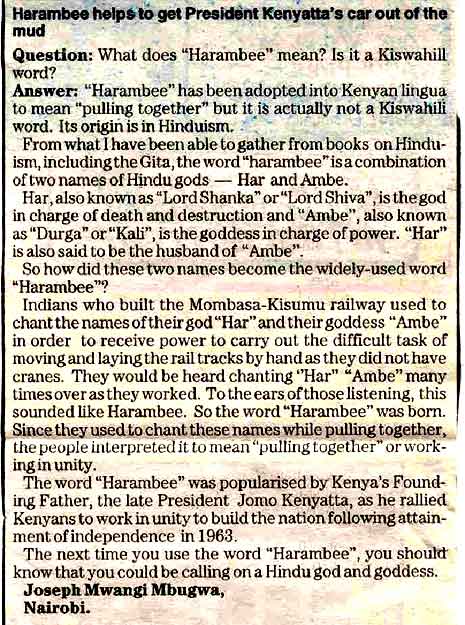
with the aspirations of the masses of the country. In the spirit HARAMBEE they
should treat Kenya as their only home. They should take out Kenya citizenship
which is in fact a privilege rather than an obligation now rather than leaving
it to the last minute. They should be ready to make any sacrifice for the good
of this country. Whereas they would like the Africans to know more about their
religion, they should
also try to learn about the African customs and way of
life because this is the only way in which the race relations can be improved.
We
would also urge upon the Government to give opportunities to the young Sikhs of
this country to enlist themselves in the Armed Forces of Kenya to prove their
versatility as born warriors.
------------------------------------------------------------------------------------------
100 YEARS OF SIKH TEMPLE - NAKURU
((We present a brief article by Mr. D.S. Bhangu, Hon Secretary of the Gurdwara during the 60's. This article has been taken from a magazine printed in 1966, hence there could be lots of changes to the gurdwara presently. (kanwal))
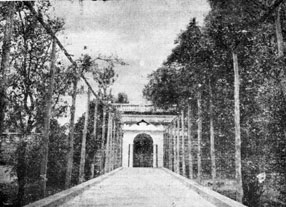
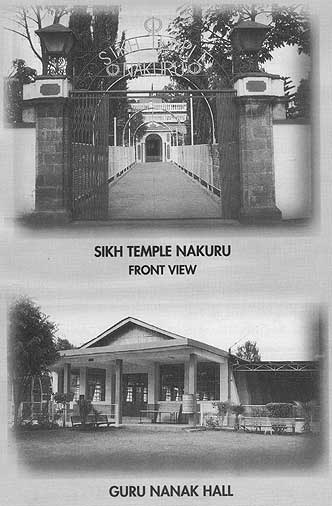
Sikh Temple Nakuru
It was in 1905 that a temporary building of the Temple was built near the Railway Quarters with the efforts of the Sikh railway employees, who had arrived in Nakuru that very year.
The lease for the present site was executed in 1913, and due to immense enthusiasm among the members of the Sikh Community, the Temple building and Rest Houses were completed the same year, but unfortunately this corrugated iron sheet building was gutted by fire in 1933.
3. Not wasting any more time the enthusiast Sikh Sangat built the present magnificent building with Rest Houses, Office, Library, Stores and a flat for the Priest in 1934. Later on some other necessary additions were made including a kitchen for cooking and a shed for washing and cleaning the utensils. In this connection, the Sikh Community can never forget the contributions of the following:—
Late BHAGAT MOOLRAJ,
who remained the President for a number of years, LA.TE S. INDER SINGH, S. HARDEV SINGH, S. WASSAN SINGH, LATE S. KARTAR SINGH JATHEDAR, S. ISHER SINGH, ELBURGON, S. HAKAM SINGH LONDIANI, LATE S. NARWAIR SINGH, S. BHAGAT SINGH MANGOWALIA, S. HARI SINGH & CO.
4. Bearing in mind the needs of the religious knowledge of young Sikh children a Primary School with Punjabi medium was started in 1938. The classes were held in the temple building, and the priest was given the duty to impart religious knowledge through Gurmukhi script. In 1940 the School had its fall, but it was due to the efforts of Mr. Tika Singh the then Manager that it became popular with the parents, the number of pupils increased and sometime later two lady teachers were employed. In 1959 the present building of the school was built with a cost of Shs.220,000/-. Keeping in view the change of time, the name of the school has been changed to Harambee Khalsa school from Sikh Girls School. At present the number of pupils is well above 200 and the school is open to children of all races, with English as medium of instruction. The devoted Headmaster and members of his staff spare no pains to see it progressing.
5. In 1951, a huge Community Kitchen Hall named as Nanak Hall was built, and at present it is serving very useful purpose for dining at big religious congregations as well as for other social functions for other communities. 6. In 1952, Sikh Union Club House was built, which now is running as an independent body.7. Ladies Istri Satsang Sabha is playing an important part and is of immense help to the Parbhandak Committee. It is holding two religious services every week.
8. Sikhs of Nakuru and district meet at this institution on all important days and they celebrate all Gurpurbs with Zeal, Zest and Enthusiasm. They also take active part in all the national causes of the country.
Its membership is open to everybody.
At the end of last year a handsome amount was presented to the Chairman of the Famine Relief Fund.
D. S. BHANGU,
Hon. Secretary
A HUMBLE CONTRIBUTION Of THE SIKH TEMPLE, NAKURU
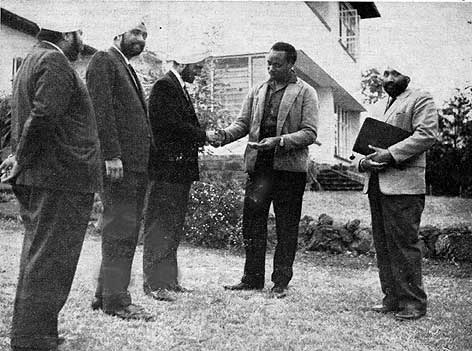
A delegation of the Sikh community headed by the President of the Sikh Temple,Nakuru, Mr. J.S. Bassan, is seen presenting a cheque for the famine relief fund to the Hon- Minister for Home Affairs, Mr. Daniel Arap Moi. Others in the photograph are: (L. to R.): Mr. N. S. Calay a former President Mr. S. S. Sahans, Treasurer, Mr. J. S. Bassan, President, Hon Mr. Daniel Arap Moi
and Mr. M. S. Mangat, Secretary.
A BRIEF HISTORY OF SIKH TEMPLE NAKURU
The history of Sikhs in Kenya's Rift Valley and its largest town, Nakuru, is long and
Distinguished. In the early years many worked for the railway, the biggest employer, while others were employed by the Government Public Works Department and by the many European farmers who had settled in the area – notably Elburgon, Gilgil, Londiani, Mau Narok, Mob, Naivasha, Thomson's Falls and Subukia,
When people migrate from one geographical regions to another they generally carry with them their culture and religious values and beliefs. The Nakuru Sikhs were no exception and the fact was recognised in 1903 by the railway authorities who allocated a plot north
of the Nakuru marshalling -yards, for the construction of a Gurudwara (place of worship),
(Most of the early Gurudwaras in Kenya were built along- the route -of the railway);
The first-Nakuru Gurudwara soon became a centre for regular diwans (assemblies) and for celebrating Gurpurabs (a festive, special occasion) attended by Sikhs from all over the Rift Valley. Many of the European settlers employed Sikhs 'from all over the Rift Valley. Many of the European settlers employed Sikhs on their farms and held them in high esteem as hardworking people with an all-round ability to tackle any job. Most of the Sikhs had technical backgrounds and were skilled in sawmilling, mechanical engineering, construction, cabinet and furniture making and were also able to thrive under harsh conditions. Lord Delamere, who farmed vast tracts of land around Njoro and Elmenteita, employed a number of Sikhs as syces (grooms) and jockeys for his horses which he raced in Nairobi at the old racecourse (known as Racecourse Road)
Earlier records indicate that the present plot was acquired on 1st April 1917 and the title registered on 3rd June 1918 in the name of S. Gian Singh, S. Boota Singh, S. Wariyam Singh, S. Santa Singh and S. Dasaundha Singh as trustees.
As the Community grew, the need for another larger plot was recognised. In 1925, Sardar Sunder Singh was deputed to be the Community’s spokesman to the administrative authorities in negotiations for another and larger plot. Sunder Singh was an overseer on Keringet Estate, Molo, with a number of Sikh artisans working under him. He spoke English well, fairly uncommon in those days, and was a good communicator and the ideal person to put the Community's case. A plot, where today's temple stands was quickly allocated but the grant brought the Sikh Community into dispute with the neighbours. However with the assistance of the then District Commissioner, Mr. Hobley and indulgence of Sardar Sunder Singh, the matter was promptly resolved to allow the Sikhs to go ahead with developing their temple plot.
The Community stalwarts wasted no time and in about 1926-27, a fully functional and decorated building was completed in three months. The Gurdwara was built with the timber framework, clad with corrugated sheets and lined with tongue-and-groove timber and with verandas on the north, south and west sides and painted throughout.
The new Gurudwara became the central place of worship and was well attended for every
Sikh religious function and celebration. As the area developed agriculturally and commercially
the membership increased. The plot was fenced with cedar posts and steel wire interleaved
with bamboo splits, or 'droppers' and the surrounding grounds were improved. An orchard
of lemons, guavas, pawpaw, peaches and pomegranates was established; as there were
no restrictions on anyone helping themselves it soon became popular, especially among the
children on their way to and from school who would pluck lemons and suck them with great
relish.
Next it was decided to provide overnight accommodation for members who travelled long distances for the Akhand Paaths (reciting Holy Book) and who had no relatives or friends in
Nakuru with whom they could stay. Rest-house accommodation was built comprising rooms, a kitchen and communal bathroom. Sardar Kishen Singh, the railway shed master in Nakuru, devoted a great deal of time and hard work to this development. In later years the accommodation became popular with foreign backpacking tourists who could not afford expensive (to them) hotel accommodation.
In the early days some settlers, who were familiar with Sikh traditions from the time of the British 'Raj" in India, transported their Sikh employees to celebrate their ‘Jor Melas' (a form of celebration) and stayed on to join the 'Langar' (Community meal) after finishing their business in town. The settlers did not escape the worldwide economic depression of the 1930s. Many Sikhs, working on the farms, lost their jobs, for them the Temple rest-house was a boon. A few even camped around the precincts, and showed resilience by planting cabbages, peas, potatoes, beans and maize. S. Pritam Singh Ahluwalia, who had a grain mill at Rongai and was a generous man, regularly supplied wheat floor to the temple although he was himself affected by the depression.
A few of the affected Sikhs opted to return to their villages in India while some decided to stay on. Sardar Inder Singh of Revelco developed a system of rotational employment in his contracting business so that those employed could save enough to travel to India. It was a simple system and it worked: men would be employed for a month and make way for another lot and so on. The idea caught on and employers in Nairobi followed the example and allowed many of those who had lost their jobs through no fault of their own, to earn enough for the fare by ship to India.
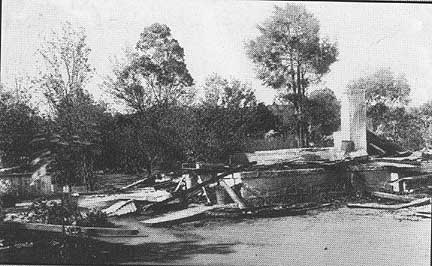
In 1936 disaster struck: the Temple was gutted by fire and reduced to ashes (above). Although the cause of the fire was a source of speculation, it was probably accidental. A lantern was always left burning throughout the night and it is likely that it was tipped over and set fire to the furnishings. Whether it was tipped over by thieves or a cat will never be known. The Sikh community tackled the disaster with typical courage and fortitude; part of the rest-houses were modified and decorated to house the Guru Granth Sahib and used as a temporary Temple.
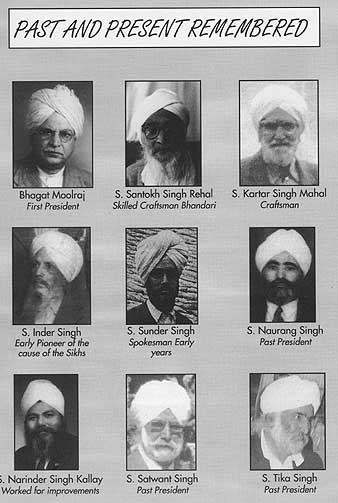
Plans for a new Temple were drawn up by Sardar Ganga Singh, a civil engineer with the railway. The plans formed the basis of the temple as one sees it today and once approved by the Nakuru Municipal Council, construction was soon under way. The local Sikh Community combined with those living in the rest-houses in ‘sewa’ (voluntary work). The laying of the concrete foundations and the floor was completed during a single Sunday. It was an amazing sight to see so many people including children as young as ten years, working so fast and shifting heavy buckets of concrete.The following Sunday, Sardar Ganga Singh was accorded the honour of laying the foundation stone; afterwards he donated 500/- to the temple fund (in 1936, Shillings 500/= was a large sum). The building stone was carried from Naivasha and chiselled to a fine finish by S. Niranjan Singh, who was nicknamed ‘first class’. The entrance door, designed by S. Inder Singh, was crafted by S. Kartar Singh Mahal who today (1999) lives in Birmingham, England aged 94.The building was completed in just five months through voluntary work and a wholehearted contribution by the community and was universally regarded as a truly beautiful building-worthy testimony to the craftsmanship and skills of Nakuru Sikhs.
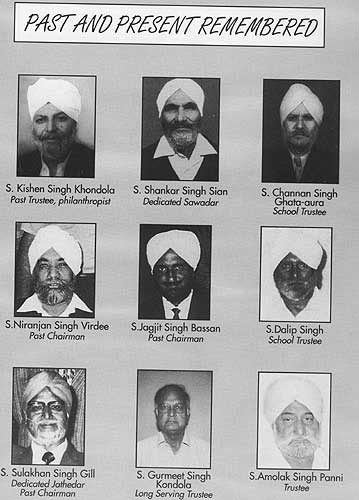
The official opening, after the Akhand path ceremony and other religious ceremonies, was performed by S. Dhanwant Singh, an advocate from Kisumu, and was attended by Sikhs from all over Kenya. The Guest of Honour was the Provincial Commissioner, the Hon. J. G. Hamilton Ross, who was generous in his praise for the Sikh Community in erecting such a fine building in a matter of months and warmly congratulated them.In early thirties enthusiastic Sikhs working for Railways purchased a timber built structure comprising of several houses, contributing from their meagre resources, dismantled it and rebuilt opposite main temple building which till today accommodating several families, sometimes is referred to as the 'Green House'. The contribution by one remarkable man over many years of the Nakuru Sikh Temple's development must not be forgotten. Bhagat Moolraj, a trader from Elmenteita was appointed President of the temple in 1928. He believed in Sikhism and had adopted its teachings and faith. He devoted considerable energy and commitment to the temple’s affairs and was a sobering influence in the community. After 22 years of dedicated service, he voluntarily relinquished his post as President to make way for others to serve.
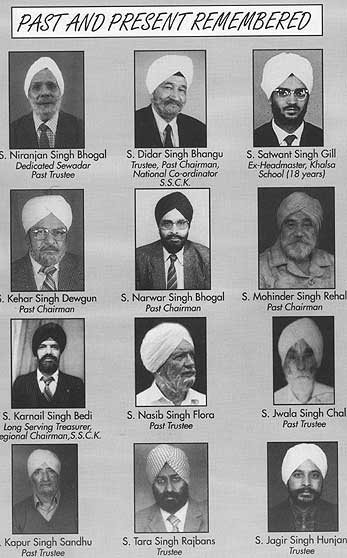
Following Bhagat Moolraj’s resignation, Sardar Hazara Singh, a chief Inspector of Police, was elected as President. He was followed by S. Satwant Singh of Rivelco whose tenure was marked by the restoration of peace and tranquillity, which was continued under S. Narwair Singh, a Nakuru furniture maker.
A stalwart of the Temple was Sardar Santokh Singh, who served as regular bhandari (he who says grace) for several years now aged 98 and living in Nakuru. And in fact his younger son S.Mohinder Singh Rehal continued in the footsteps of his father and served as a bhandari for several years before he was honoured to the Chairmanship of the Temple. During Sardar Satwant Singh's term of office a start was made in founding a Sikh School for Girls. A piece of land having been acquired under the auspices of Sikh Temple Nakuru, the building came up within a short period. Messrs. Mehar Singh Bros, building contractors performed the religious opening ceremony on 12th June 1960 with the then Rift Valley Provincial Educational Officer Mr, G. G. Knight officially opening the school on 22nd October 1960. S. Dharam Singh Lall led the School Board in managing its affairs. With the success and increasing demand, a Secondary wing was started with the foundation stone laid by the family of Late S. Bhagat Singh of M.O.W. followed by donation of further classes by Coronation Builders of Nairobi. The ever growing student population made it necessary to move the Primary School to another piece of land allocated by the Municipal Council of Nakuru. Fourteen classrooms were built by the Community from their own financial resources. Today these schools are named Harambee Khalsa Primary School and Khalsa Secondary School, in keeping with the changes that took place from time to time. More recently a double storey block has been added to the Secondary School and plans for commencing the London G. C. E. classes are at an advanced stage. Dedicated members of the Community headed the School Board after S. Dharam S. Lall, S. Bhagwant S. Jassal, S. Pyara S, Ghata-aura, S. Jagir S. Jutley, S, Harbhajan S. Gill, S. Narinder S. Ghata-aura, S. Bhagwant S. Tung served as Managers. S. Gurbux S. Bhogal is the current Chairman of the Board and leads the enthusiasm of its keen and dedicated members.There is a long history of intrigue within Sikh Communities, and the Nakuru Sikhs were no
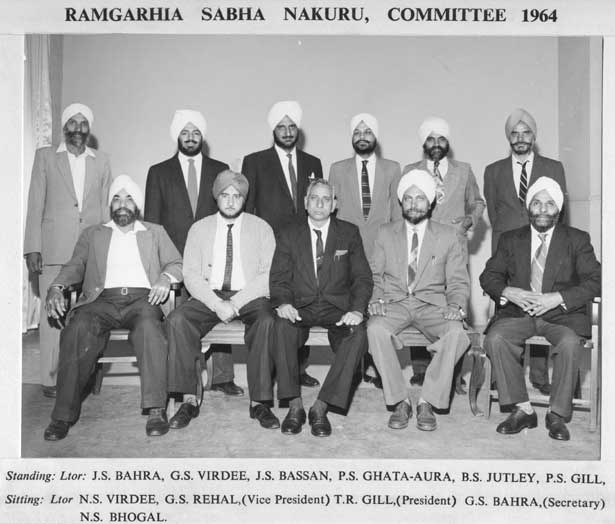
exception. S. Tika Singh, a local watchmaker was for several years in the limelight as Secretaryand President, S. Narwar Singh Panesar, S. Naurang Singh, S, Sadhu Singh, S. Tika Singh, S. Narinder S. Gill followed until after independence the status of all Presidents of institutions and clubs etc., except the President of Kenya was changed to Chairman. In 1963 S. Niranjan Singh Virdee took over from S, Satwant Singh, who after serving for a year decided to relinquish his position in favour of S, Karam Singh Panesar, a Police Inspector, who handed over to S. Jagjit Singh Bassan, the Vice Chairman due to his transfer from Nakuru and was unanimously confirmed by Saadh Sangat as Chairman and later re-elected to serve the Community for several years until his sad demise at the end of 1974. To fill the vacant position, S. Sulakhan Singh Gill who was known as 'Jathedar' due to his dedicated service not only in the langar' but as renowned 'Akhand Paathi' was elected unanimously as Chairman in early 1975, the position he occupied till mid April 1981 until his departure to USA for permanent settlement. S. Didar Singh Bhangu, who then took over and steered the temple affairs for some years with admirable skill and diplomacy. Mr. Rattan Singh kandola who was a long time serving Vice chairman opted to stay as such with s. Didar Singh Bhangu, although he could have been a unanimous choice for the position of Chairman but for his sad demise in 1982. S. Kehar Singh Dewgan, a long serving member on the Managing Committee who filled the position as Vice Chairman was later a popular choice for chairmanship after the retirement of Mr. D.S.Bhangu in July 1987. S. Narwar Singh Bhogal another senior member on the
Committee who also served as an Auditor for many years took over from S.Kehar Singh Dewgan and served the Community with great zeal and enthusiasm. It was during his tenure that the purchase of adjacent plots commenced providing abundant acreage to the community for future developments. S. Mohinder S. Rehal as mentioned earlier then took over until January 1999 when S. Narinder Singh Kandola was unanimously elected as the chairman and became perhaps the youngest person to do so. His tenure is blessed with the 300th Anniversary of the Khalsa Panth, which ia a rare and distinct honour.The role of S. Gurnam Singh Mankoo as a Building Supervisor is also acknowledged with gratitude and so is that of S. Jasject Singh Heer in a similar capacity for rendering commendable service to the community. Sardar Seta! Singh Panesar is worthy mention for his invaluable service of the improvements of and image of the Temple. Sardar Gurnam Singh of Dalgity has left a lasting impression of his sewa as Bhandari for 'his' prashad set the mouths to water even up to this day. S. Malkit Singh Bansal is currently the Bhandari and carries out his duties with great diligence.The Bed! brothers, S. Karnail Singh Bedi and Jarnail Singh Bedi have for several years rendered an immaculate and useful service of providing turban and hair fixer to the community amongst other recognised sewas, truly following the selfless devotion to the Shrine of their. undaunting mother, Mrs Chand Kaur Bedi, S. Sarup Singh Sahans and S. Malvinder Singh Sahans also rendered useful service to Sikh Temple Nakuru and its institutions. During the time of Sardar Naurang Singh and Sardar Narinder Singh Calay it became evident that improvements were needed for the distribution of langar after celebrations. The Langar used to be served on old newspaper with the congregation squatting on the Temple floor. Once again Sewa was employed and a fine social hall, the Nanak hall, was built through self-help. Today it is the social heart of the Temple, and weddings, and other function are frequently held there. A major Temple landmark is the Nishan Sahib - a 60 foot (18 metre} high column, constructed of tapering sheet steel cylinders. It was pieced together with rivets, on site, with purpose-
made jigs. it is a magnificent example of craftsmanship at its finest and its erection was
another splendid feat accomplished without lifting gear, other than strategically positioned
guy ropes, and was hoisted manually in place amid the recitation of Guru’s hymns. The operation was watched from a distance by the Nakuru Town Engineer, Mr. A. Crates
and the Town Clerk, Major A, A. Lawrie, both of whom had grave doubts over its success. They felt that the immensely tall structure was bound to collapse and be a danger to all present. However, by Satguru's grace all went well and the officials were well pleased although, at the same time, amazed! A light is fitted at the top with the Khanda Kirpan, the Sikh emblem, and the ceremonial cladding of the pole with saffron cloth, after
the cloth is bathed in milky water, is a spectacular event done by Sikh devotees who have no fear of heights. It would be unforgivable if the role of Sikh ladies in the affairs of the Temple was not acknowledged. Mrs. Moolraj, Mrs. Tej Kaur of Rivelco, Mrs. Pritam Kaur Sahans, Mrs. Chand
Kaur Bedi, Mrs. Harbans Kaur, Mrs. Swaran Kaor Bhogal, Mrs. Satwant Kaur Marwa, Mrs.
SwaranKaur Sian, Mrs Tej Kaur Johal, Mrs. Rajinder Kaur Kondola played a prominent
selfless role in the welfare of the Temple. Mrs. Ravinder Kaur Bhangu too made a lasting
impact on the ladies for her guidance during the intricacies and tier role of a great ‘sakhee’ teller amongst them proved to be very popular. To Mrs. Harbans Kaur goes the credit of teaching children Gurmukhi and shabads and also to play harmonium under difficult circumstances, This role which prominently featured in the lives of several Sikh children was continued in the recent past by Mrs, Mohinder Kaur Dhillon, Mrs. Surinder Kaur Ghata-aura, Mrs. Surinder Kaur Tung, Mrs. Sukhdev Kaur Gill and lately by Mrs. Diljit kaur Bhogal, Mrs. Harbans Kaur kandola served as the Chairperson of the ladies ‘Istri sabha’ for 14 years with the Late Mrs.Surjit Kaur Sehmbhi as the Vice-chairperson until her death in1994. Mrs Charan jit Kaor Deogan's service as the Secretary for several years cannot escape without recognition. Mrs. Harbhajan Kaur Bhogal is currently at the helm of the activities, with Mrs.Surjit Kaur Rajbans as her assistant, Mrs Surinder Kaur Bedi and Mrs.Hardev Kaur Dhanoa carry the important role of Secretary and Treasurer respectively. Mrs Avtar Kaur Kondola, Mrs Mohinder Kaur Lottay and Mrs Balbir Kaur Bansal together with other ladies continue their sewa with utmost devotion.Through the years many sectors of the Sikh Community have devoted time and money,contributed goods in kind and faith to the development of the Nokuru Temple, Deserving of special mention, among so many, are Settlers Engineering for providing and installing a steam boiler; the Bhogals for the attractive landscaping of lawns and gardens around the Temple; Sardar Karnail Singh Bedi who served as Treasurer for several years and more recently, Sardar Jagir Singh who as secretary has streamlined various aspects of Sikh traditions. His directory of Sikhs in the Rift Valley and Nakuru and his monthly newsletter are valuable contributions. A great many notable Sikhs have contributed to the development over so many years, and it is not possible to mention each and every one. However, especially noteworthy for guidance and support were stalwarts such as Sardar Kishen Singh Contractor,
Sardar Niranjan Singh Bhogal, Sardar Amolak Singh Punni, Sardar Shanker Singh Sian. Sardar Jwala Singh Chal, Sardar Gurmeet Singh Kondola, Sardar Channan Singh Ghat-aura, Sardar Nasib Singh Flora, Sardar Kapur Singh Sandhu have been notable Trustees
of the Temple.
A famous 'strong man' in the days when athletic contests and martial arts featured as important events, was Sardar Sojan Singh. He was able to prevent a four-
cylinder Chevrolet from moving by leaning on the front mudguard and grasping one of the front wheel's wooden spokes, As the car turned on the power the rear wheels churned up clouds of dust and the car remained stationary. Sardar Harnam Singh, known as 'Shell' because he worked for Shell Oil Company, displayed his skills on a motor bike, He would enter the ground at high speed, standing on the seat and snake high-speed turns and skids. Sardar Sojan Singh was a champion shot-putter, while Sardar Kartar Singh Mahal regularly won the marathon cycle race (Nakuru to Kipkelion) many years in succession, A great step forward by the community recently has been the formation of the Nakuru SikhYouth Organisation under the able leadership of Sardar Bhupinder Singh Bhogal by involving the younger generation into its fold of future leadership. Nakuru's Gurudwara is now almost 61 (in 1999) years old. In Great Britain it is a ‘listed building' to be retained for posterity without alteration. Built during the difficult times of the 1930s depression it is, quite apart from its religious significance and role, a historical monument to diligence, commitment, community spirit and faith, While we must accept a process of development and improvement, it would be sad if this happened at the expense of history and at the risk of losing the legacy of fine craftsmanship, Nakuru Sikhs of today should build on the legacy they have inherited from their diligent forbears without damaging the history of a magnificent monument to a Community's commitment and faith work together in true Community spirit to continue the vision of those who came earlier.
Compiled by Sardar Pyara Singh MBE with notable assistance of Sardar Patwant Singh, Nottingham U.K.and Sardar Didar Singh Bhangu, a long serving member of the Community. (Taken with courtesy from a brochure by the Gurdwara printed in 1999 -Kanwal)
Some more memories from Nakuru - photos supplied by Satwant Singh Bassan s/o late S. Jagjit Singh Bassan of Ilford.
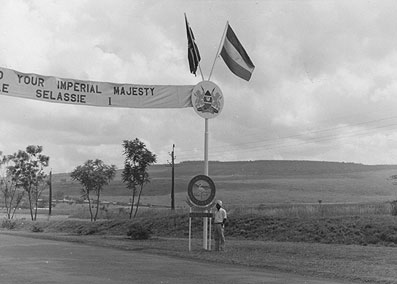
Welcome to Emperor Haile Selassie of Ethiopia on his visit to Nakuru -arranged by Mr. Jagjit Singh Bassan for Nakuru County Council
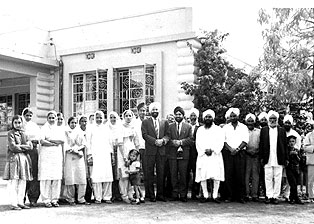
At the house of S.Didar Singh Bhangu - with Sant Ji from India
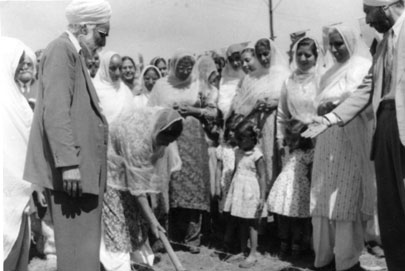
Mrs. Tika Singh laying foundation of school
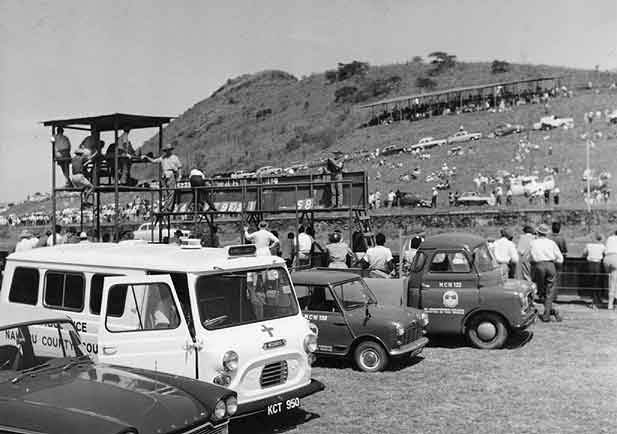
Racing on the Langa Langa track
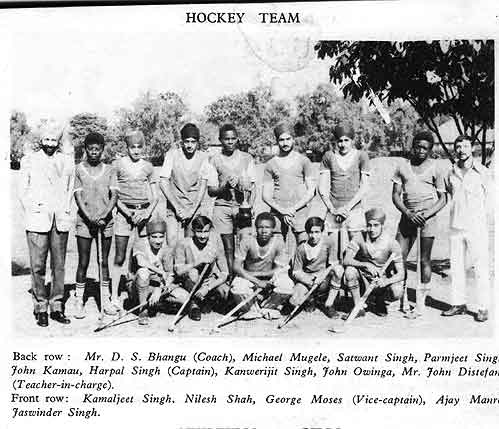
Menengai Hockey team
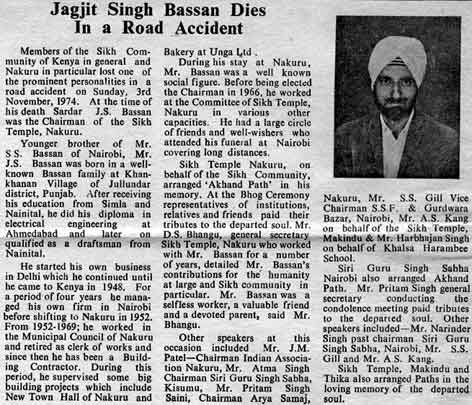
Taken from the Spokesman 23/12/1974
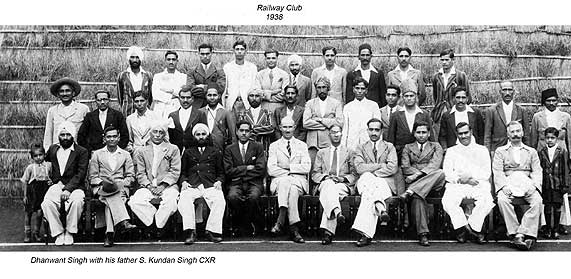
Railway Club 1938 (courtesy photos by Dhanwant Mundae-in picture)
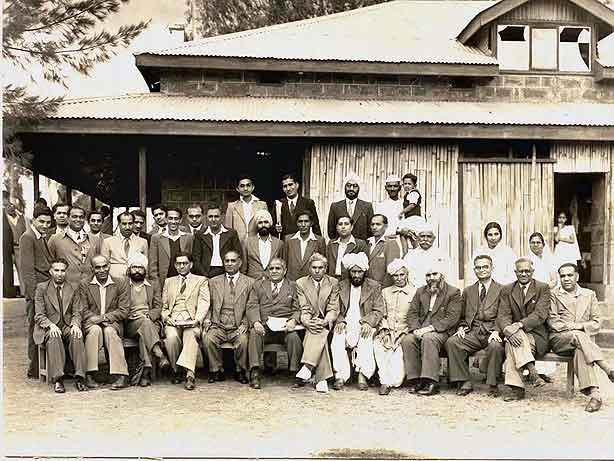
Trade Union Conference 18/12/1949 at Nakuru - S. Makhan Singh & S. Gopal Singh Chandan can be seen on the front row (photo courtesy Amarjit Chandan)
..................
A very interesting story has been sent by Nelson Dias (article posted by Selma Carvalho in the Goan Voice UK), which is printed below. If any one has more information on the subject, kindly relate.
------------------------------------------------------------------------------
ELDORET
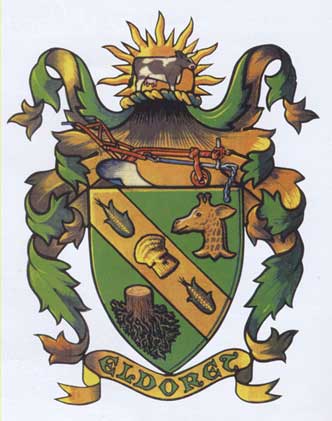
The following articles and photos have been taken with courtesy from the magazine "ELDORETERIAN" -edited by Shanti Chauhan. Most of the photos do not have any captions and I am encluding them as they are. If any Eldoreterian knows anything about the photos please do contact me so that the right caption can be put to the photo. (Kanwal)
For more information on Eldoret see also www.eldoretassociation.com
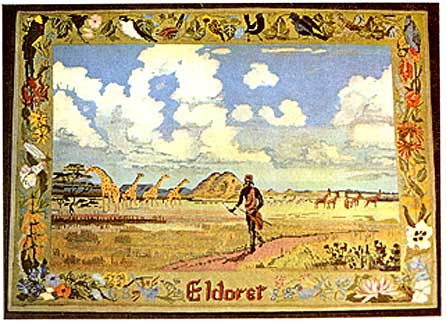
Copy of the Tapestry exhibited in Art & Crafts show held in Nairobi in 1970 circa organised by E.A. Women League.
Eldoret, known in the early days of settlement as "64", is a busy thriving town and the main commercial centre of the Uasin Gishu Plateau. In 1907 the then Postmaster-General, Mr. Gosling, made a safari to the Plateau to establish a post office and after touring the area and studying the position of the farms not yet taken up for development, he chose Farm 64 as a central place tor a district post office.
In the early days, with the exception of those places through which the Ugandc railway passed, every settlement and out-station depended tor its mail upon the system of "runners". Starting from the principal stations on the railway the "runners" were posted, sometimes as much as thirty miles apart, and the mail was passed from relay to relay until it reached its destination.
The Eldoret Panel shows the "runner" postman with his cleft stick in which the letters were carried, and his spear for protection against the wild animals which roamed the countryside.
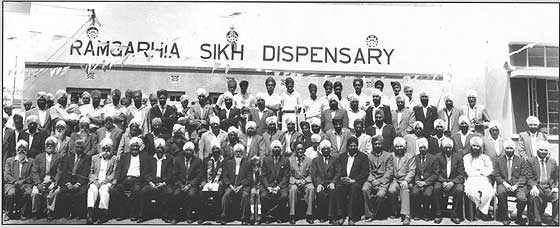
Sikhs from all over Kenya attendingh the opening of the Dispensary at Eldoret. Jagat Singh of Nairobi garlanded in middle with other prominent ramgarhia members of Nairobi, Nakuru & Eldoret.
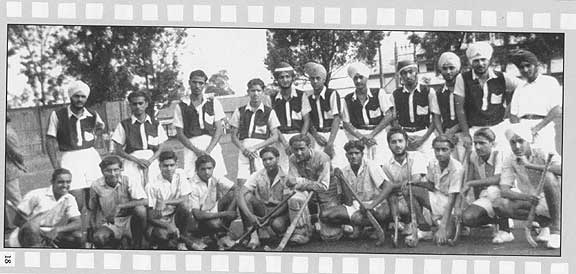
Eldoret Hockey team
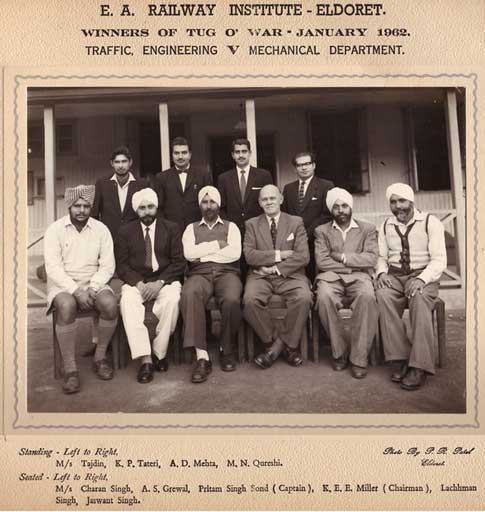
Photos courtesy: Krishan Tateri
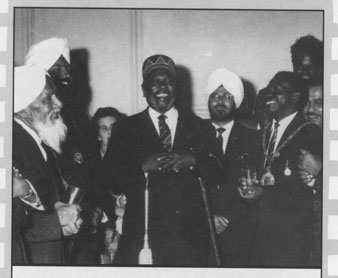
S.Gajjan Singh, Mr. Bansal and others with President Jomo Kenyatta at Eldoret
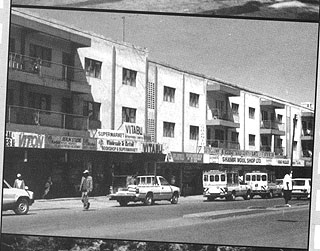
A street in Eldoret
MALKIT SINGH BANSAL -THE PEOPLE'S MAN
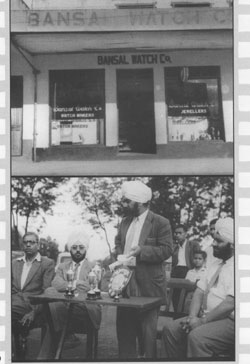
Malkiat Singh Bansal, on arrival from India in 1947, joined his father Late S. Kumvar Singh Bansal in the family business, Bansal Watch Company.
The name Malkiat Singh Bansal is synonymous with Eldoret. He was one of the first elected Asian councillor of the Wareng County Council, for his dedicated service to the community. In recognition of his active service he was elevated to the role of Alderman of Eldoret Municipal Council whereby he had the honour and privilege to meet the multitude of VIPs such as Her Royal Highness the Queen Mother, His Highness The Aga Khan, His Excellency Hon. President Jomo Kenyatta and His Excellency Hon D.T. Arap Moi on their official visits to Eldoret.
On the Community level his contributions to the Gurudwara and the Sikh Union was invaluable.. He founded the '64 Secondary School'. This dedication even continues today as a Governor of two schools in Birmingham, President of Rosehill Residents Association, and Vice Chairman of Traders Association, member of Police Consultation Committee, and Lay visitor - West Midland Police.
Eldoret was famous for its Sporting activities. Malkiat Singh was a member of the Eldoret Hockey Team. The towering Bansal Hockey trophy featured as annual event on the Sikh Union Sports calender, attracted teams from Kenya, Uganda and Tanganyika.
Eldoret was overwhelmed by Refugees from the Congo and Uganda crisis. Eldoret being Eldoret responded to thishumanitarian cause very humanely through the expert co-ordination of Malkiat Singh Bansal.
The unfortunate members of Eldoret were to benefit greatly from the Rotary Club of Eldoret of which Malkiat Singh was the Charter Chairman and still serves througl the Handsworth Rotary club in Birmingham.
In recognition of his services, he was honoured as a "Freeman of the City Of London" in 1989..
Keeping up with the family tradition his three sons Nirpal, Inderpal, and Jaspinderpal have successfully teamed up with Malkiat Singh in their business world of Opticians.
Eldoret Association also received his unfailing support and encouragement in realising the Dream oi Reunion into Reality.
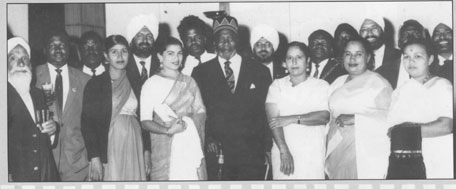
Prominent personalities of Eldoret with President Kenyatta
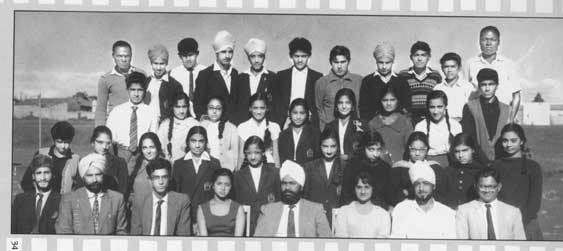
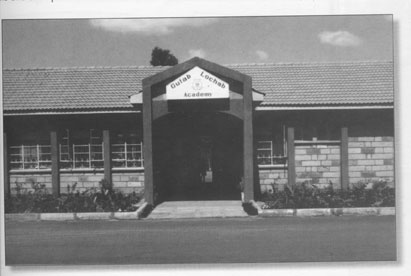
Parents in up-country towns had to send their beloved children to places like Nairobi and Nakuru, to receive quality education. Parents had to make this painful sacrifice, to empower their offsprings a firm foundation in Education, necessary to pursue further studies.
"GULAB LOCHAB ACADEMY" (above)was set up to address this dire need, to provide qualitative education, through the 'DONORS' namely the Ken-Knit and the Lochab families. The Academy is affiliated to the Sikh Union Club for the land it made available.
The ground breaking ceremony by Mata Dhankaur Lochab on an auspicious "WAISAKHI" day - 13th April 1993, with prayers by both Gianiji and Lakhu Maharaj, was blessed by all the family members in presence of close relatives, friends and the Eldoret community.
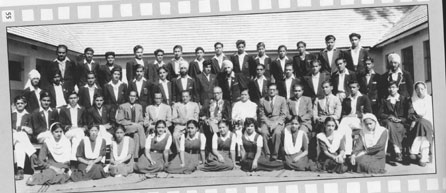
ELDORET '64' (1900-1964) THE GOLDEN ERA
The Era in the history of Eldoret which coincidentally lasted 64 years. Let us look at some of the factors contributing to the hassle-free, friendly, peaceful, healthy, safe and secure lifestyle during this GOLDEN ERA.
Eldoret, as we know, was named after 'El-Dore' - a stony river. A visiting British dignitary also referred to it as'El-Dorado'- meaning'fictitious country rich in gold'. To him there was nothing fictitious about Eldoret. Because of heavy losses suffered by Britain in terms of human life and financial, the wealth generated by the British Colonies was much needed. Any place that brought substantial income without high administration costs meant respect, preferential treatment and privileges for its people, Eldoret was one such place.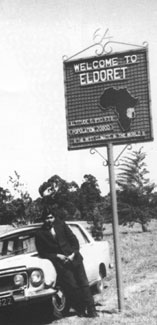
As Eldoret started from nothing and was constantly growing, there were opportunities galore for everyone. In return for our contribution in the civil service, transport (railways), commerce and as providers of services and supplies to the European community, we were treated with respect and could live our lives and prosper without hindrance.
At the time, owing to lack of education amongst the indigenous population, all meaningful jobs were filled by the
Asians who proved themselves to be responsible, adaptable and competent.
Eldoret was claimed to have 'the Best Climate in the World'. This was officially claimed by the Eldoret County Council and was internationally unopposed. Signs on the outskirts of the town confirmed this claim.
It was a town small enough for everyone to know everyone else and Eldoreterians lived as one big family. One who may have travelled the world and has visited Eldoret would endorse that Eldoreterians had a heart of gold.
The Independence of Kenya was the turning point as it brought many
changes social, moral, political and economic. Many families decided to move abroad. Rapid developments began and Eldoret became more of an Industrial Capital as opposed to the Agricultural Eldoret, memories of which we cherish the most.
Sadly the clocks cannot be turned back, but we still have fond memories of the GOLDEN ERA and undying love and respect for each other. May the spirit of Eldoret live forever.
~ Dipak Hindocha
Lochab Bros
LOCHAB BROS is one of the big names among the pioneer settlers of Eldoret from India. When the Joint family System in India is declining due to the western culture and the Urban Single family System, the Lochab Bros in Kenya not only represent the various business of the family, but also signifies the strength and unity of the Joint family System to everyone. The unique system in the Lochabs is that they stay with their families under the same roof and eat together from the food of the same kitchen.
Family history dates back to 1887, when the pioneer, Late Mr Hira Singh Lochab came from Ishapur, Punjab, to make a fortune in Kenya. His son Late Mr Ghumand Singh Lochab joined the Marine Department of Kenya Railways. At that time, Kenya was the HQ of the East African Community and it was difficult to get a technical job under the colonial system and by dint of his hard work and dedication, he rose to the position of 2nd Engineer, which was generally reserved for the Britishers. He worked for the Railways in Uganda and Kenya till 1939, and started a Saw Mill in partnership at Kaptagat.
In 1941, he came to Eldoret to start the transport business andacquired a quarry in 1952 when his son Late Mr Naranjan Singh Lochab
joined him. He bought a Farm at Eldoret after the Independence of Kenya.
Late Ghumand Singh was the founder member of Sikh Union Club, started in 1954 and took lots of interest in the social and community work.
The transport business proved to be the life line for the family business of Lochabs. After the demise of Mr Ghumand Singh in 1966, the sons went into partnership to form M/S LOCHAB BROS, wherein all the brothers became equal partners in this business with six trucks. In 1996, the business was converted to a Private Limited Company, called M/S LOCHAB BROS COMPANY LIMTED, wherein only the family members became the shareholders. Thus from a single Pick-up in 1941, the business has grown to a commendable fleet of 120 trucks operating in and around Kenya, hauling goods and containers over long distances to Uganda, South Sudan, Tanzania, and other neighbouring countries.Lochab trucks carrying logs for the Pan African paper Mills and Kenya Power & Lighting and Petrol tankers in Kenya is a common sight.
The dynamic vision of the Lochabs diversified their j transport activities to Agriculture, Horticulture and I Manufacturing industry such as the 10000 Acres Wheat ] farm in Narok, Eagle Retread Limited, Bahati Quarry
Eldoret Bearing and Tools, Kitale Timber, U.G. Timber <' and Joinery Works
Slumberdown Industries,Lochab Gardens ( Rose '] Farming at Eldoret) and
Lochab Investments Ltd.
Lochabs also have the following Joint Venture Projects
-with the Shah family of Ken-Knit group of Eldoret.
.. ELTEX (EPZ) LTD - a cotton Yarn Mill in the Export
- promotion Zone at Athi River, near Nairobi. In 1966 it •i was awarded the First Prize - a gold Trophy for being ' the Best Local Invester between 1991 and 1995.
•j ELDORET STEEL MILLS- a composite Mill with Arc
• Furnace and Rolling Mills
AMKURA GINNERS LTD= a company to feed the cotton requirement of ELTEX.
Lochabs name is quite famous on the Car Rally scene. This being their main hobby. In 1971, they started competing in small rallies with Mr Narinder Singh as the Driver, and Mr Amarjit Singh as the Navigator. Soon other brothers Hardial Singh and Ranjit Singh took interest. In 1982, Serviced by the family team, and led by Mr Hardial Singh, they competed in the World Class Safari Rally, an international event mostly participated by the foreign professionals. In their first attempt, they were placed in 10th overall and awarded the 'Best Local Crew' trophy. Eversince, the Lochabs have won many local rallies, and still hold the record for 'Best Hill Climbing' in Kenya.
If late Mr Ghumand Singh is called the founder of of the Lochab Business Enterprise, his wife Late Mrs Dhan Kaur Lochab was the inspiration not only to her husband but also to sons and grandsons. The pattern of the family set-up based on common understanding and discipline owes much to her everlasting teaching for being united under a common roof, After the death of her husband, She led the family in all matters till herdeath in 1996.Mrs Dhan Kaur Lochab was associated with various religious and Philanthropic work, laid the foundation stone of the 'Gulab Lochab Academy' which is acclaimed today as one of the outstanding schools in Kenya. She also took keen interest in the extension of the Gurudwara with a hall and flats, and was connected with various donation work. She was fondly called Mata Dhan Kaur by the Eldoret residents. She was respected by elders and loved by the children. Many residents used to come to her for her counsel on various matters. Even after her demise, the business family of Lochabs has continued to live as single unit. The torches of the family bondage has been cemented with sons and their wives.
Truly, the Lochab Family is a unique example of Unity, Common Understanding, Obedience to Superior and individual respect.
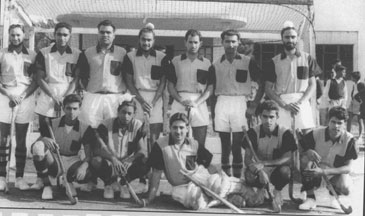
Sikh Union Hockey team
Dr Anant Ram's life in Eldoret
a synopsis.
The year was 1938 when my father was welcomed at a tea party held at the small garden adjoining Railway Dispensary. I featured in the group photograph with some children of the eminent members of the Asian community - indeed the pioneers of Eldoret.
Subsequent years meant many a disturbed nights for the family when relatives of patients would knock at the door to request my father to go over and see the sick member of the family. On numerous occasions I would accompany him to different parts of Eldoret, outlying farms and outstations. The latter in an open rail car, that used the same track as the railway trains. I found this trips exciting though quite a bit draughty and at times scary in the middle of the night.
I vividly remember an amazing episode when he organised detonators to be exploded on the rail track at Eldoret Station and later at Plateau Station on the departure of doli, at a wedding.
During the war years, we were spared listening to Marconi wireless by music of 78 RPM records on His Masters Voice gramophone. Railway Club was the centre of all activities for both the adults and the children.
The Indian community rejoiced on 14th /15th August 1947 to celebrate Independence of India and Pakistan. My father got tricolour masted to his Dodge, the first American car in Eldoret.
In 1948 Eldoret XI scored first (within 10 minutes) against the World Champions.the All India XI hockey team, captained by Dhyan Chand. The mastery of ball control, stick work of the prominent players Babu, Raju, Gopal Balbir etc. was a delight to watch.
A.B.Pant the first Indian
High Commissioner was
entertained at our house in
the Railway Quarters.
Similarly Jomo Kenyatta,
then the head of KANU
was our guest. My father
believed bars and prejudices were ravings of perverted
minds and we should never allow our minds to be hurt by
these; take the hurts on the feet. Justice and honour for all
men, peace and prosperity is the birth right, though they are
equally created.
Dr Anant Ram received praise from various dignitaries including SP Kruger OBE who wrote to a Legco member " During Dr Ram's long tour in UG district, it is evident that he is a very capable and efficient doctor, and he has no doubt given complete confidence and satisfaction to all his patients and the poorer members of all communities have benefited most by his generous treatment".
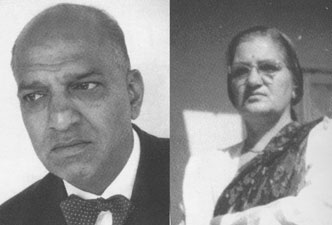
In 1954 Dr Ram resigned from the Kenya Medical Services with numerous tributes. He planned a house with a built in surgery opposite the Sikh Union.
On Education front, my father was an active member of the UG School committee. Messrs V.C.Bhatt, G.S. Amar, Pimenta, Varghese, CD.Kapoor, C.C.Desai, and others, were constant companions of my father in pursuit of excellence of education for the children of Eldoret.
Mr Naginder Singh had the distinction of breaking the net into two with his most powerful serve while playing Tennis at the Railway Club, with my father and Insp. Inderjit Singh Giddy. Cricket was his favourite sport. He watched us being coached by Walker of Glamorgan County in Wales, A.O.Malik (an Oxford Blue) pioneer of Eldoret also took pains to teach us basic techniques.
Music featured in reasonable measures in his hectic life - he played mouth organ (Anil became his disciple), harmonium and flute; used music as a tonic for health.
In recognition of his services to the St John Ambulance Brigade, he was awarded Hon. World Membership.
Doctor Ram didn't expect too much from life, he firmly believed that he must give to life at least as much he received from it. The fullest of his achievement can only be gauged by the name he had left behind on his demise in 1973. No man can ever say truthfully, I know everything and everybody", but Dr Ram could truthfully say "All Eldoret if not all Kenya knew him".
My mother who stood by him lavished hospitality on all comers to the house/surgery. Mrs Ram was a kind person who would do one favour and then call upon and thank for the opportunity to do it.
Our parents endowed us with moral seriousness, a social conscience, a sense of duty and responsibility. We are grateful to them for all they did for us in most difficult times.
We are not steeped too much into past but to accept it; we are not resentful of the present but are coming to terms with it; we are not fearful of the future but beginning to look to the future in U.K. through Eldoret Association - a collective heritage of great value to be propelled forward with earnest desire for the friendship and welfare for one and all in Eldoret Style.
I conclude, let yesterday be a lesson, today an action, tomorrow a hope.
Susheel Kumar Ram s/o late Dr & Mrs Ram of P.O.Box 36, Eldoret.Kenya.
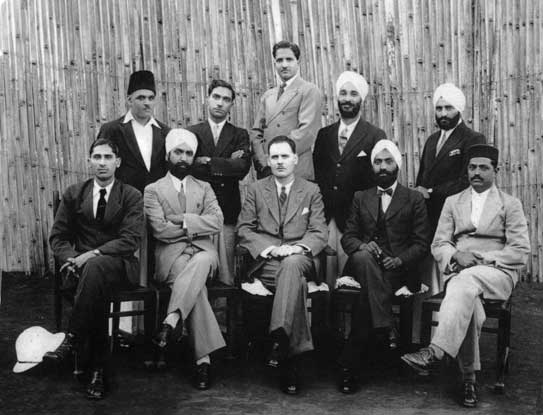
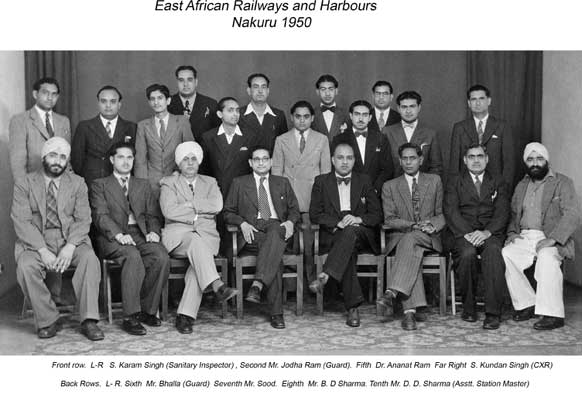
Staff of Eldoret Railways - extreme right CXR Kundan Singh (photo courtey Dhanwant Mundae)
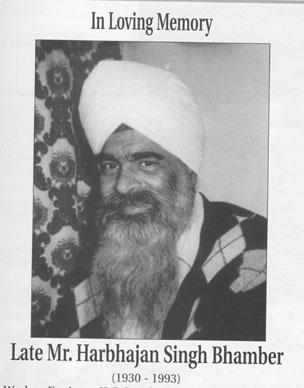
(Atlas Engineering Works, Engineeer K.C.C. Bhamber Refrigeration & Elect. Engineers)
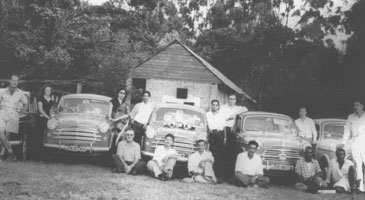
Fiat Car Club?
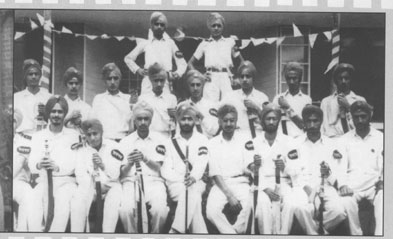
Khalsa Sewa daars
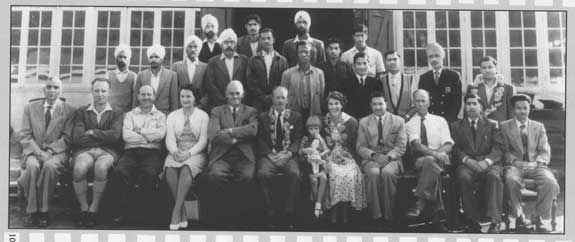
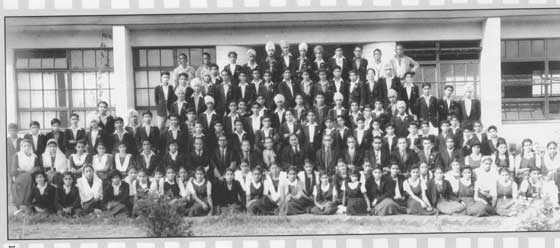
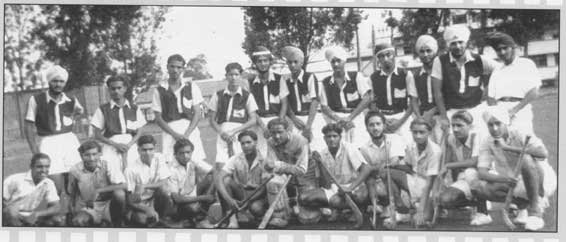
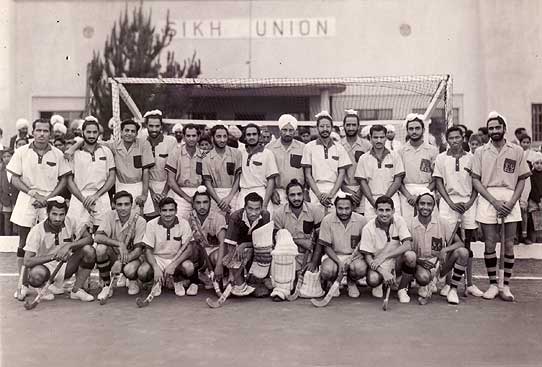
The visit of the Indian Hockey team with the Sikh Union players from Nairobi & Eldoret. (photo courtesy Avtar Bansal)
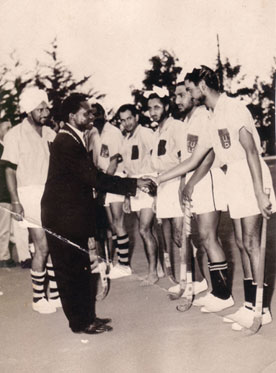
Hockey teams being introduced to the Mayor (photo courtesy Avtar Bansal)
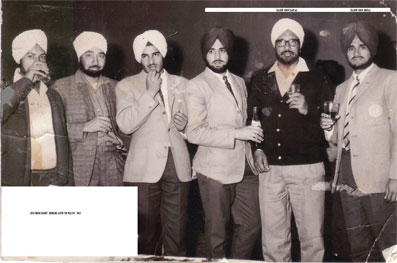
Party at Sikh Union after matches with Indian Hockey team 1962(photo courtesy Avtar Bansal)
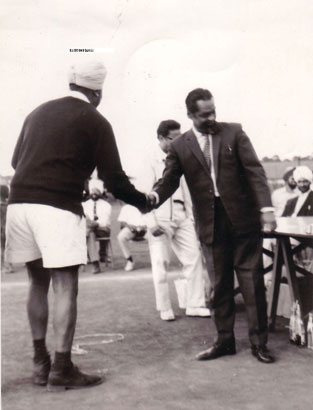
Balbir Singh Bansal being congratulated. (photo courtesy Avtar Bansal)
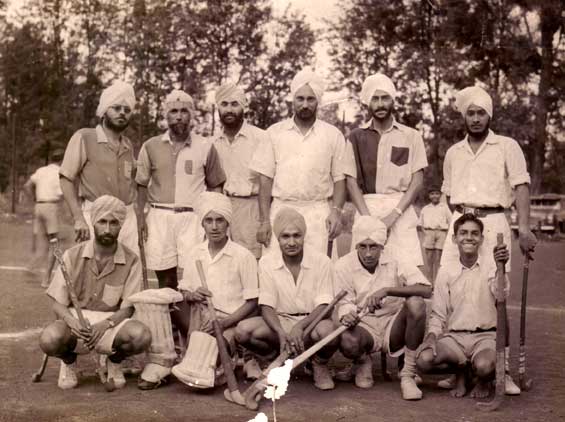
Eldoret Hockey Team (photo courtesy Avtar Bansal)
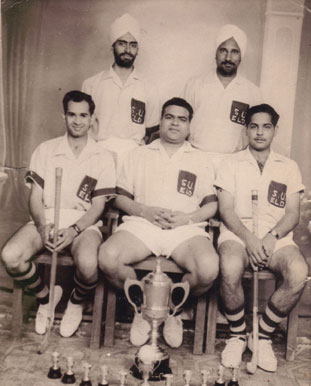
Members of Eldoret Hockey team (photo courtesy Avtar Bansal)
A Brief History of Eldoret Sikh Union
Material Contributed by Gurbux (Baxi) Mudhar
The Sikh Union Club was founded in 1952. Initially there was only a hockey playing ground with a bar in the premises. Original and subsequent committees had lot of problems in running the club due to lack of membership, individual jealousies and debts. A stage came when the club was to be auctioned to pay the contractors.
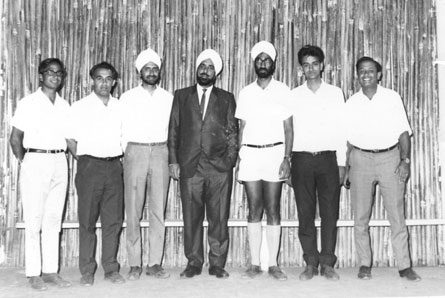
Committe members who took over running of club in 1963/64 : L to R. Sports Sec Bakshi Mudher, Soc. Sect. Shiv Sharma; treasurer Mohinder Sehmi; Patron, Jagir Sidhu; member, Amarjit Gill; member,Parvin Parmar; Secretary, Ramesh Aggarwal. (not in photo- Naginder Sehmi, Davinder Tamana, Bhupinder Bowry
Eventually a new committee (above) in 1962 of young friends under took to run the club and pay all the debts plus made extreme efforts to raise finance for the smooth running of the club. More facilities were introduced in the club such as vollyball, badminton, darts, tennis, cards, tombola, regular get together for food & drink.
Sikh Union Eldoret became a very organised club and International teams from India, Pakistan, Germany & Holland visited Eldoret and played numerous hockey matches (see photos above of Indian hockey team). International badminton and table tennis teams from China & India also visited Eldoret and entertained the entire population.
Professional coaches were invited to coach school children in various sports without any fee. This all motivated the Sikh Union club and it became one of the leading clubs in Kenya.
Annual events such as Guru Nanak Sports day were celebrated every year for the Sikh Community.
There was a move to change the name of the club to Simba Union etc., but the Eldoret committee stood their ground and uptil now it is still SIKH UNION CLUB-ELDORET.
During the last few years the club has undergone many changes in bigger hall and other activities but the name Sikh Unionis still embedded in the hearts of the Eldoretrians.
ACTIVITIES AT THE SIKH UNION IN PICTURES SENT BY BAKSHI MUDHER
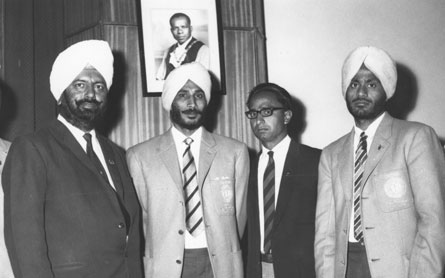
Indian hockey team at Mayor's reception. LtoR Deputy Mayor Cll. Gian Singh, Indian Capt. Prithipal Singh;Eldoret Capt. Bakshi Mudher & Indian player Balbir Singh.
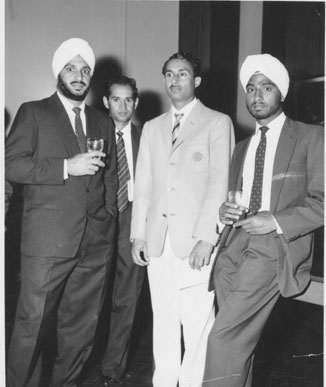
Sikh Union Hockey players Mangat, Bachu & Bakshi with Indian Hockey team captain Charanjit
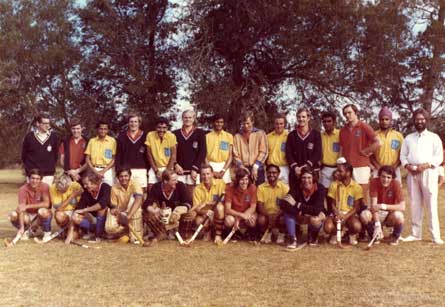
Sikh Union Eldoret hockey team lined up against Holland XI
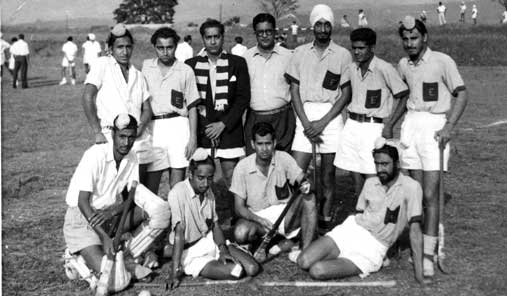
Sikh Union Eldoret Hockey team on a tour to Uganda to participate in a Goan Festival at Kampala and Mbale.
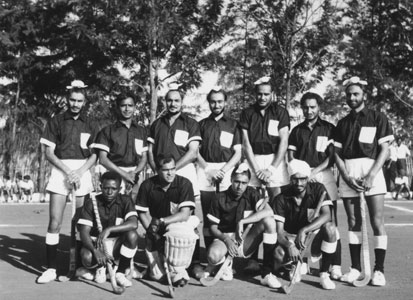
Rift valley Hockey team against India. Guest players from Nairobi, Nakuru & Kisumu.
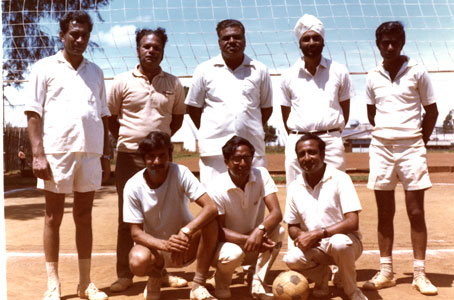
Sikh Union Eldoret Volleyball team
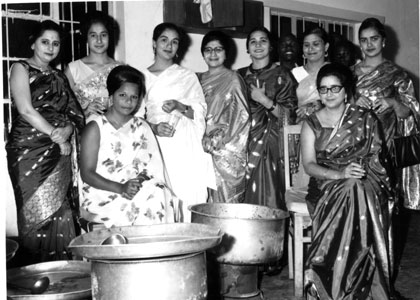
Ladies of Sikh Union committee members always helped with cooking for receptions for visiting hockey teams.
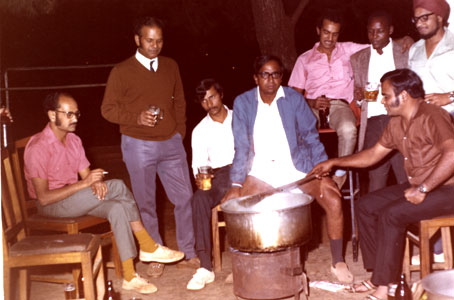
Nyama Choma & Nyama sufuria nights at Sikh Union every Fridays
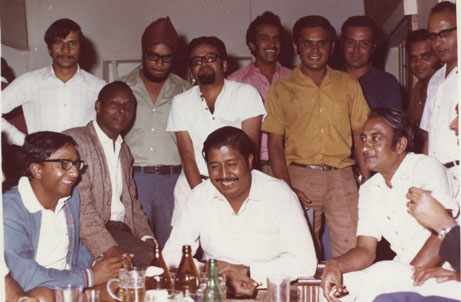
Socialising with beer & Nyama
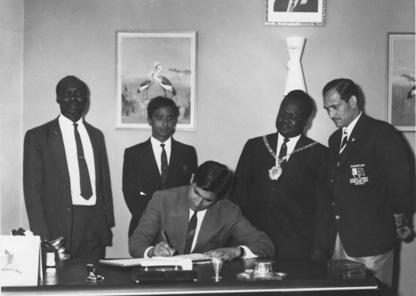
Major Atif of Pakistan signing the Mayor's book. LtoR; Mr. Asembi-town clerk;Mr. Bakshi Mudher-captain;Mayor Macharia; Munir Dar-coach.
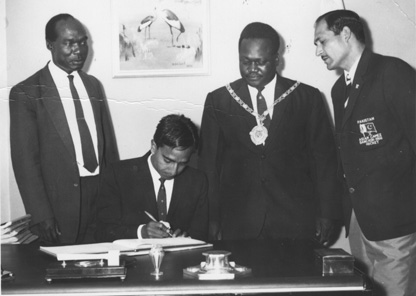
Bakshi Mudher signing the Mayor's book during Pakistan National Hockey team's reception.
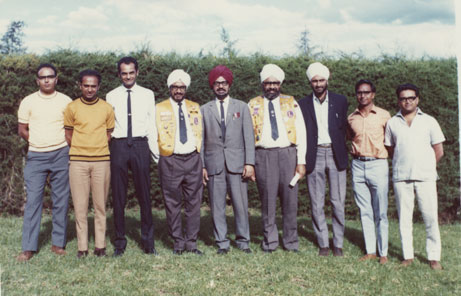
Members of Lions Club Eldoret at Mr. Hem Singh Bhangra's house in Kapsabet.
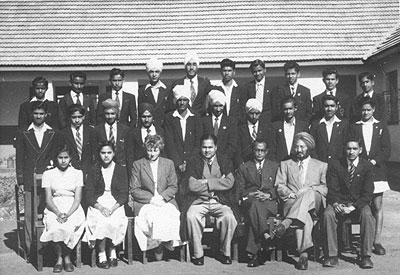
Uasin Gishu Secondary School Form IV (1959) Teachers LtoR Miss Bryson (Mrs. Njonjo), Mr. Varghese, Mr. Parkar, Mr. Binepal.
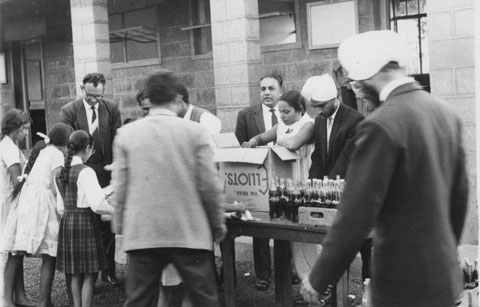
Uasin Gishu Primary School staff organising term-end party for children
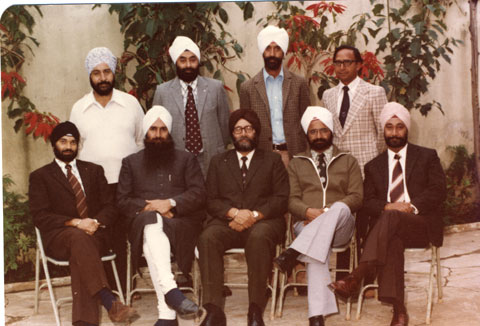
Managing committee of Sri Guru Singh Sabha Eldoret
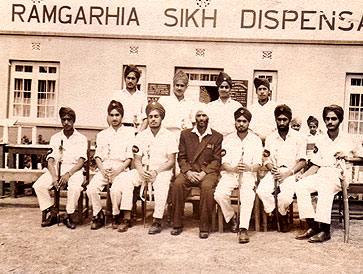
S. Jagat Singh with sewadaars of Ramgarhia Sikh Dispensary (photo courtesy Avtar Bansal)
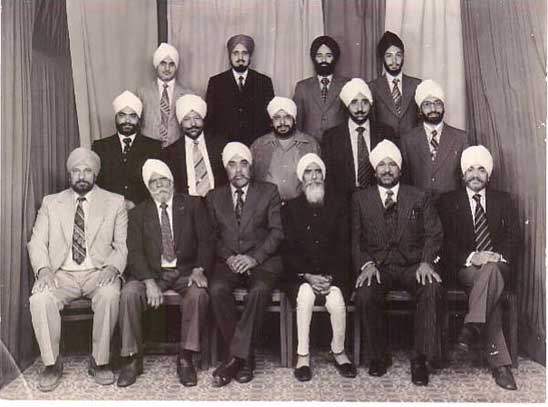
Prominent members of the Sikh Community Eldoret (photo courtesy Avtar Bansal)
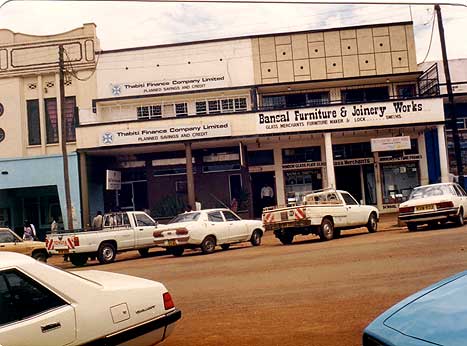
Premises of Bansal Furniture & Joinery Works Eldoret (photo courtesy Avtar Bansal)
ELDORET OR EL-DORADO
It gives me unbounded pleasure to write for the Souvenir magazine of the Eldoreterians in the UK about the beautiful town of Eldoret and the great educational institution of Uasin Gishu Secondary School, which stands proudly on the road to Eldoret West. It was In this institution of learning that I was privileged to teach for fifty one months, about thirty seven years ago.
When Shanti Chauhan and Marendra Sumaria, my former students rang me up on 12th March, 1998 to inform me of a benevolent reception they were organising on Sunday 31 st May, 1998 in Leicester I could scarcely believe my ears that such a rendezvous could be possible especially as I had tried and failed over the years, to make contact with my old students of Eldoret. This news immediately set my mind bursting with nostalgia and all dreams about this wonderful place on earth began to crowd my memory so powerfully.
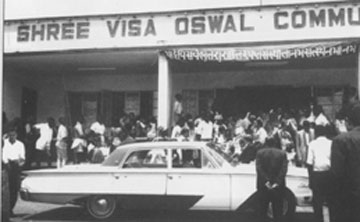
It was nearly four decades that I had taught Biology and Health Science at the asian secondary school. The lush and plush green countryside with its aluminium rich red roads snaking through inhospital mountains and valleys began to dance upon my inward eye. Such monumental picnic spots as Tambach and Kamarin came instantly alive, especially the latter escarpment, which the Queen Mother had graced during her royal visit to Kenya in 1958.
Eldoret was reknowned for its salubrious climate for years and now it had been elevated to having the best climate in the whole world. The teaching staff at U.G. Secondary often referred to it as being the "El Dora do" of Kenya. "El Dora do", is the product of a poet's fertile imagination when he portrayed an imaginary city in Amazon where early explorers set out to chase golden rainbows. Indeed, Eldoret, is this living reality. And as we journey down the memory lane we cannot but help reminiscing the Town Hall that was newly built in 1957, the tallest building of its time, standing guard over its township. The highly fragmented Uganda Road with its shanties used as shops by asian traders, as was the High Street which ran down to Sosiani River. The town centre belonged to the trading class, Kays Motors, Oxford Grocers,
Bansal Watch Company, Moorjani's Juma Hajee, Gulabs Limited, Bhogal Brothers. These are a few popular business sites. The "Roxy" and "Lyric" were centres of supreme entertainment. Uganda Road also abounded in business stalwarts like Patel Trading, Narottam Nathu, Madatallys, Esmail Lalji, Hassanalis, Sumaria Bus Service, Pandit the sweetmeat shopman etc: who were always busy serving their clientele, as were Dr.R.RPatel and Dr.Modi. Their business impact permeated all tiers of the village-town's public life in as much as the Patel Samaj, the Arya Samaj, the Sikh Union and the Aga Khan Jamat Khanna which had the social cum-religious sectors of the town.
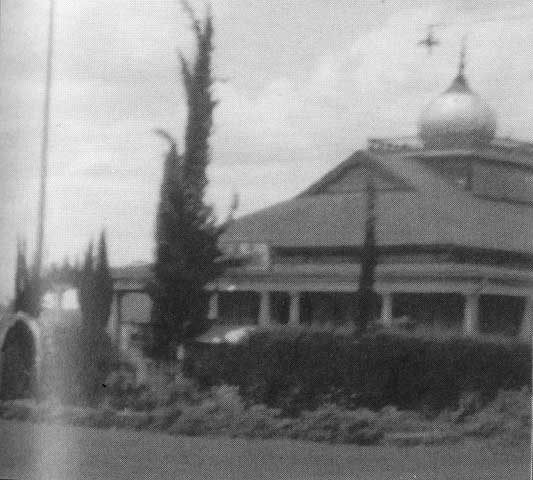
Eldoret Gurdwara
It would be blatantly unkind if I am unable to extricate myself from the mazes of Eldoret's business world and revert to the island of excellence- Uasin Gishu Secondary School, where I dare say, I taught one of the best pedigree students of my teaching career, who • were as much brilliant in their
academic work as they were on the playing fields. It would be invidious to mention names but the demand of natural justice is so overwhelming that a reference to certain student would seem imperative in view of the invaluable contributions they had made towards the corporate life of their alma Mater.
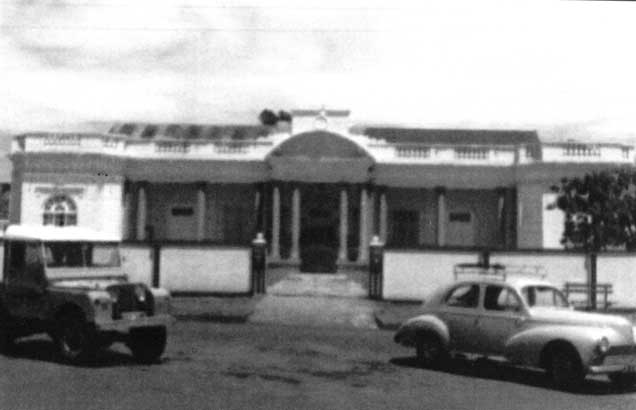
Prominent among these were: Bhakta Pratap and Dindass, Roshan and Meru Fitter, Supinder and Gurbux Singh, Yashwantrai, Nirmala, Afzal, Urmilaand Kamla Randev, Ahsan, Akram and Qayyum Cheema, Ramesh and Manohar Aggarwal, Abdul Qayyum and Gaffur Arian, Doris Carvalho, Sushil, Rajinder, Surinder and Kanwal Ram, Basil and Mary Varghese, Sartajali, Saeed Ahmad, Varinder Chauhan, Amina Nanji, Sarowar, Zeenat Lalji. A special mention is made of Shanti Chauhan, Narendra Sumaria and Abdul Qayyum Arian, all of whom are successful today. Memory fails to retrieve cores of other students who deserved mention here. This story would appear woefully incomplete without any reference to the teaching staff in early sixties. The school was headed by N.VVarghese, andlater by G.U.Amin, and the teaching staff which comprised of Mrs Kerr Sheppard, JJ.Amin, A.A.Patel, A.R.Parkar, R.K.Aggarwal, D.N.Saint, A.N.Sharma, M.S.Binepal, M.A.Begg, M.S.Mujail, Darshan Singh, D.VJoshi, B.M.Patel, Y.D.Yarnold, A.Brister, R.W.Walmsley, M.R.Desai, Miss Tuskett and Margaret Bryson and Connie Maxwell, as learner teachers.
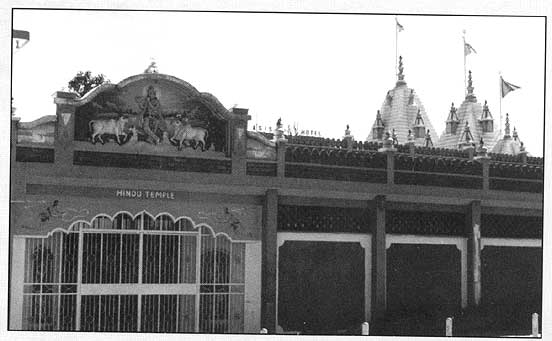
Eldoret Mandir
The staff imparted education with dedication besides creating a quiet oasis of intimacy with their students making the whole scenario as a success story. Teaching in a mixed school is a unique experience for any practicing teacher, besides being a soul-inspiring opportunity. As a young teacher I was much influenced by "Mr Chips". I always felt that a teacher's foremost function ought to be to transfer a part of his/her academic and professional self into his/her prospective student. How far I was able to succeed in this venture is a matter for my former students to judge!
They understood me better, they saw me as no one else could have seen me. And as I sit back and relax, with my hair becoming sparse and grizzly, these words might sound distant and cold. But I must hasten to dispel the notion as there is nothing cold in me. If anything, I still possess a warm glow in my heart with a penetrating quixotic politeness for my students even today, is an eloquent testimony of our mutual love and sentiments, which I gratefully acknowledge as being the most bounteous reward of my life.
M.A.BEGG
15 Mounthurst Road
Hayes, Bromley, Kent BR2 7QW
Tel : 0181 402 3507
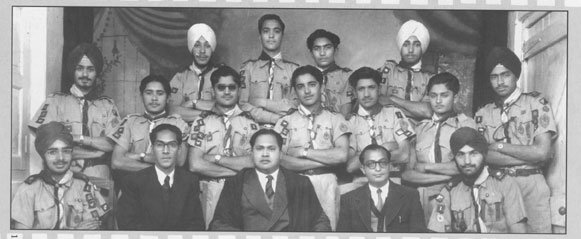
Eldoret Scouts
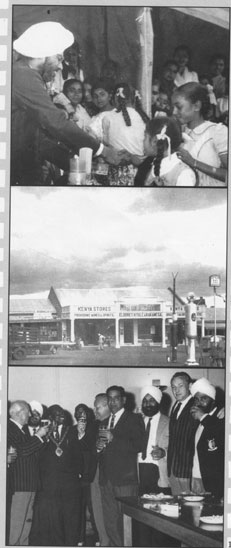 K.S.Bawa & Sukhdev Singh from Sikh Union Nairobi attending some sort of gathering in Eldoret.
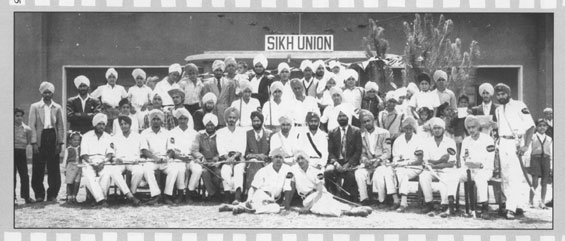
Sikh Union Eldoret
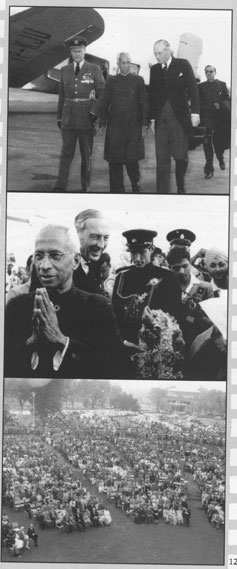
Dr. Radha Krishnan -Vice President Of India welomed to Kenya by the Governor Sir Evelyn Baring.
TIME-TRAVEL IN UASIN GISHU PLATEAU & ITS CAPITAL ELDORET
E L D O R E T will always have a special place in my heart and my sentiments and so will you, for it is not just the place but also the people who are special. I hope you will treasure this in your memory as well
Kind Regards - Natu Faldu
The place of birth - Janma-bhumi and formative year of education and place of work-Karma bhumi is thought of with reverence by us all -'Wanainchie ya Eldorettee!' Therefore there is a craving to know all we can about the place - Eldoret.
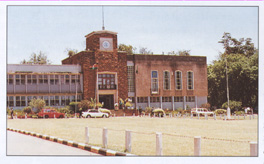
Trip down memory lane can be experienced by thinking of the time, the place and the people. But when did it all begin? The history of Eldoret virtually starts at the beginning of this century and it would be apt to celebrate Eldoret's first centenary at the millennium! The Africans had always lived here but not a lot has been documented and same as many of towns in Kenya, Eldoret developed after the migrants came to settle here. The colonisation brought the first Europeans to Eldoret in the 1900 and the first Asian around 1908.
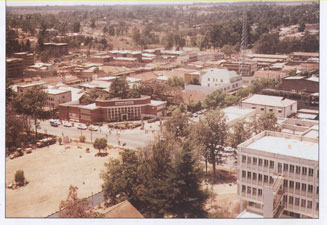
The Afrikaans came from South Africa and the British Asian businessmen also moved here from other towns. This was the time when Eldoret was just a vast expanse of grassland and very few trees. The travellers would have had to cross the river near the Hajee's Drift (named after Mr Juma Hajee) to get here. The town had been known simply as Sixty-Four-'64', as it was situated on Farm number 64. It also happened to be 64 miles from Londiani - which at the time was already an established town. Although only 64 miles away, it used to take the ox-wagons anything between 4 to 6 weeks to get here because there were no bridges and the roads were but muddy and treacherous dirt tracks!
Then the governor Sir Percy Girovard decided to make '64' the administrative centre and at a great gathering of farmers it was decided to name '64' as Eldoret.
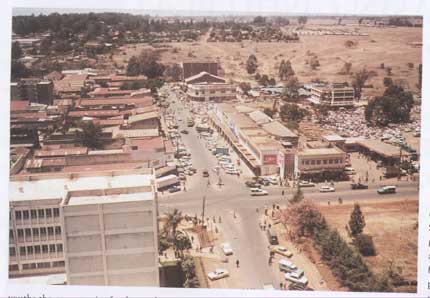
The name was derived from a Masai word 'Eldore' meaning 'stony river'- with due reference to the Sosiani River which we all agree was a very stony river! The letter 't' was added to the word Eldore, keeping in line with traditional Nandi way of ending names of places in this way. Eldoret was situated in the Uasin Gishu District.
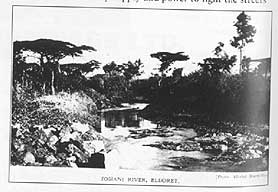
The word 'Uasin Gishu' in the Masai dialect means 'stream of cattle'- so perhaps now we know why the schools were named Uasin Gishu schools!
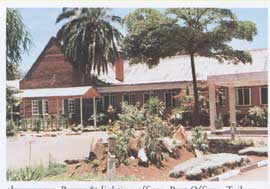
On 14th of November 1912 the township-status was
officially announced and the PoliceStation, Administrative
Offices and civil residences were also built. The occasion
was also
celebrated by
holding the first
Eldoret
Agricultural show.
This in later years
became an annual
event and many of
the school trips
here gave theyouths the opportunity for fun and romance!
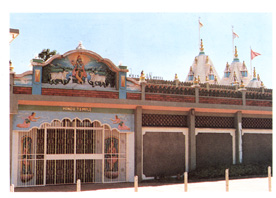
Many of the towns houses were then built by the European partnership business - Smith & Mundell which was owned by Wreford Smith and McNab Mundell. They also built Eldoret's first bank which was a branch of the Standard Bank of South Africa Limited. It is difficult to imagine, but in 1912, this Bank was but a mud and wattle building and it was thought to be the only Bank in the world where the Bank was constructed around the safe!
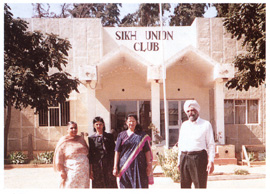
The story goes The safe was brought here by bullock-cart and when the safe was being unloaded it fell against the wall and toppled part of the bank! The safe was so heavy that the builders decided to leave it where it fell and instead built the bank around it. Soon after, in 1920, Barclays Bank DCO opened its branch and it wasn't until 1929 that the National Bank of India came to town!
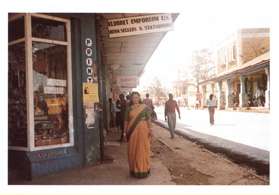
As the township prospered, the first golf course was opened and the first major trophy competition was between the District
Commissioners officials and the Hospital Staff. Sir Robert Coryndon, the governor of Kenya, arrived in Eldoret on the first train and the town picked up speed in its expansion. To
commemorate the occasion, the main street in Eldoret was named Coryndon street and this in later years, after Kenya's independence, was named as Kenyatta street.
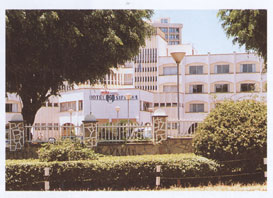
By 1926, the population of Eldoret was greater than that of Nakuru and it also surpassed that of Eldama Ravine, which was a renowned town at that time. With the population expansion came the need for all other amenities.
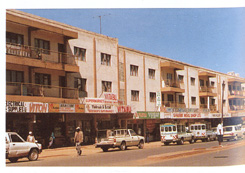
Uasin Gishu Primary School catered for most of the Asian children and it wasn't until 1963 that the first African children also enrolled in these school. "64' Secondary School was set up round this time. Special school for girls originally setup in 1913 and catering for European girls also became accessible to all and was named 'Highlands School'. This is now called 'Moi Girls School'. Eldoret has always been the home of education for many in the district and hasalways managed to turn out the elite in education. Today, the Establishment of Moi University and Eldoret Polytechnic continue to give the new generations, the right foundation. Perhaps it is the only town in Kenya which has consistently produced the best of academic students over the years at all times.
Mr. Harbans Lal Modgill was the railway surveyor from 1937-1971 (he was an active arya Samajist who always was in the forefront where Arya samaj activities were concerned all over East Africa. He was he president of Mombasa Arya Samaj from 1954-1956.) - His son Om Modgill was the site Engineering assistant during the construction of the 'Two Rivers Dam' -the following photos have been sent by him which show the opening ceremony of the dam by the Governor of Kenya & the mayor of Eldoret.
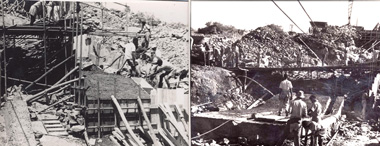
Construction of the Two River dam
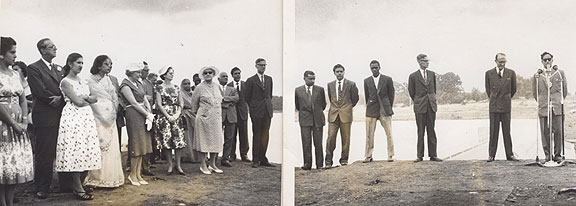
At the opening of the dam 1962
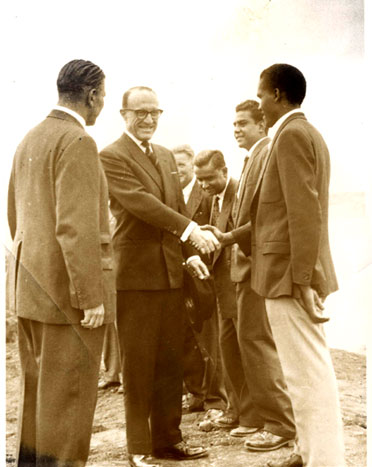
Opening of the dam
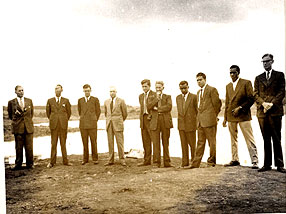
Eldoret Municipal Engineer's Dept. Staff - 28/2/1962
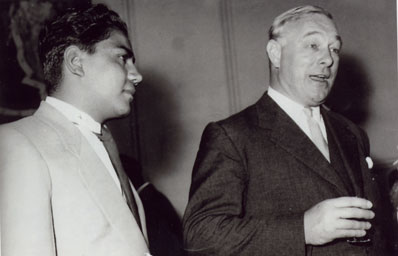
Om Modgil Son of Mr. Harbans Lal with the Governor of Kenya Sir Patrick Renison -1960
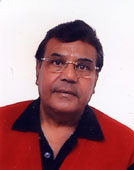
Om Modgil worked for Eldoret Municipal Council 1959-1969 - came to London 1969 and got job with Greater London Council in the Planning Transportation as a Surveyor 1969-86 -L.R.B 86 to 1994
In 1928 piped water from River Sosiani was the project undertaken by the railway company.
The water supply always kept up with the towns demand and it was much later, in 1962, when the two river dam was built (see above). In 1933 Kenya Power and Lighting Company Limited brought the electricity supply and power to light the streets
of the town, although the lanterns in the homes of many were the only source of artificial light! -at that time. In 1937, for the high flyers, the municipal board built the
Aerodrome and it had a single strip for take off and landing. Small planes provided the flights to Nairobi, Nakuru and Kisumu. This was of course basic compared to the modern Moi International Airport facilities of today.
The Town Hall was built in 1956 and Eldoret was elevated to Municipal status in January 1958. The first Mayor J Wolston Beard was elected in November 1959. Mr Aziz Pieera was the first Asian mayor of Eldoret in 1961/62. Mr.Daulatram Aggarwall was the deputy mayor during
1962/63 followed by Mr.Gian Singh Bahra in 1963/64. The first African mayor was councillor A.N.Oloo. In this way, the mayors office certainly kept up with the changes in the peoples power. Eldoret's expansion from the 40's to the 60's was quite astonishing. The principle trunk road that ran through the town from the East-Doming from Nakuru) was 'Uganda Road'. This was parallel to the Railway-line and inbetween the railway station and the Uganda road were the KFA warehouses, Wagon Wheel Hotel, Lyric Cinema, District Offices and many more. Opposite the Town Hall stood the Barclays Bank and the Standard Bank, flanked by car dealers, Chemists, Electrical dealers, etc. The diagonal streets were the European Bazaar with photographic studios, clothing shops, Roxy Cinema, saree shops, TV & Electricalshowrooms, Power & lighting offices, Post Offices, Tailors and Bakery with appetising smell of freshly baked bread, etc. On the banks of the Sosioni river stood the Sosiani House, one of the few multistorey buildings in town. The gardens opposite were the 'Raani Baag' which served as the picnic spot and had the flowerbeds beautiful enough to stage many a photographs. To the Westside was entirely different story. The soda bottling plant and the bakery manufactured relentlessly to fulfill the needs of the township. 'Majengo' housed many of the working staff from the town. Each evening, swarms of bicycles were seen heading in this direction.
India street was the roots for many of the Asian businesses. It also provided the basic housing needs for many and the corrugated galvanised-sheet roofs of the houses imprinted the pitter patter of the rains in the memory of many. The spiritual and social needs were met by the Mandir (which even today is monumental with its unique ceiling paintings etc.) - standing next door to the Kabutor House. The Aga Khan Jamad Khana stood along with Visa Oswald Community Hall, M V Patel Memorial Hall and the other side of the road, further along from the Mandir were the Gurudwaras. India Street had retailers, wholesalers, tailors,
carpenters and repair shops. The market was built to house the stalls for fresh fruits, vegetables, fish and poultry and had the smells and the sounds one would remember along with the busy bus station.
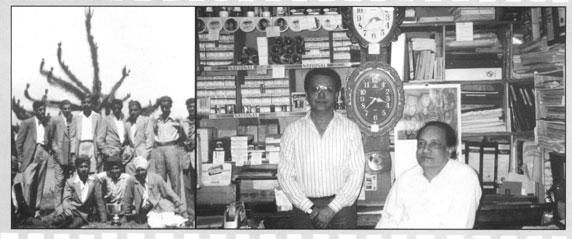
Going towards the west end of India Street were the orchids around the Kabrastan. Incidentally, the schools nearby had the endless supply of mogo, makai, mapaira and lukat from those orchids. Arya Samaj building stood at the end of the road running parallel to India street. Past the Uasin Gishu Schools the road took you to the larger of the residential areas in Eldoret-West. The Sikh Union, '64' secondary school and the sports grounds would hold many memories for the sports men amongst us. At the far end of the residential area in the west, was the 'Samsaan' (crematorium), on the banks of the river Sosiani. The place was perhaps the most quiet and peaceful in the whole of thetown and the location was certainly rightfully chosen. Geographically right at the other end of the town was the East, obviously! The bungalows with the gardens, flourished here over the period and the European area became the 'Bana Makuba's Jumba ya Mali Mingi!' The hospitals were not so far from the Sosiani House location and these certainly catered for the health of the community.
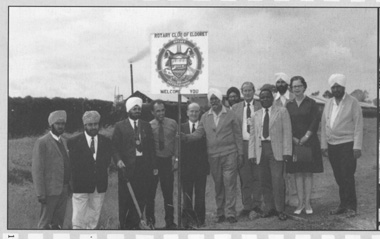
Unlike many other prosperous towns, Eldoret has expanded tremendously but it has always retained that 'something special.' Today Eldoret's industrial prospects has grown notably. Government of Kenya helped in setting up many industries and encourage international
and private investments. National Cereal Board and Kenya Grain Growers Cooperative Union are the base for granary of Kenya. Eldoret has developed vastly in industrial field. Notable industries are East African Tanning Extract Company Limited, Kenya Cooperative Creameries, Unga Mills, Maize Limited, Cheese Factory, Raymond
Woollen Mills, Rift Valley Textile Limited (Rivatex), Ken-Knit (K) Limited, Rai Plywood Factory, Rift Valley Bottlers, Arkay Oil Mills, Eldoret Oil Mills Limited, Highland Paper Mills Limited, Tyre Retreading Plants and Eldoret Steel Mills Ltd. Among the notable buildings in the town are the Town Hall with its recent extension, Library, Divisional Police Headquarters, Sirikwa Hotel, National Bank
Building, K.VD.A. Plaza, Eldo Centre, New Post Office, Eldoret White Castle Motel, Sosiani View Hotel.
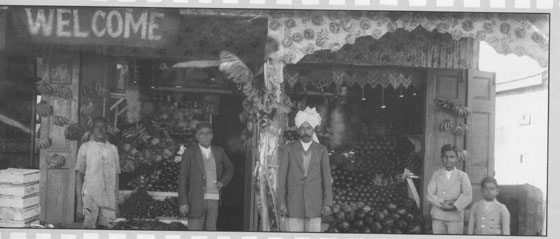
These are but a few words to jog ones memory, perhaps to inform you of only a small part of history but most of all, to bring out that Eldoret nostalgia!
'BACHPAN KI MOHABT KO, DIL SAI, NA JUDHA KARNA,
JAB YAAD MEREAIYE, TO MILANAY KI DUVA KARNA'
Kind Regards From Natu Faldu-(Natu S.K. PATEL of Uganda Road Shop,opp.POWI)
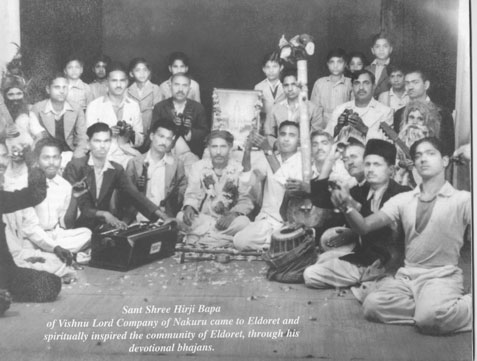
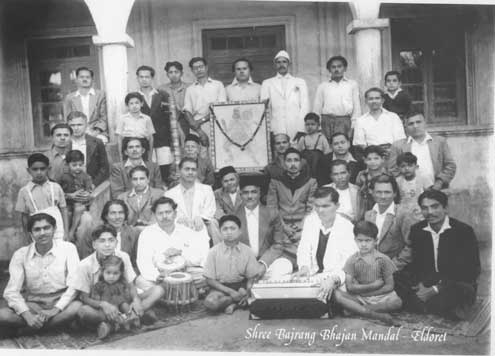
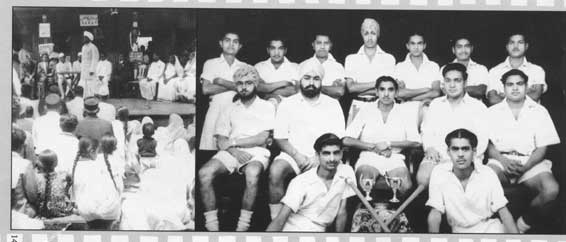
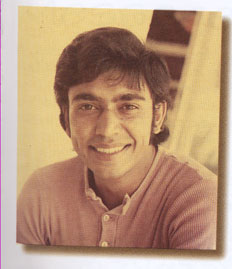 The above information has been taken from the booklet 'Eldoreterian' prepared and ably edited by SHANTI CHAUHAN (above). I thank him and also thank Mr. Kesar Singh Panesar an ex-barclays bank official- Eldoret
for providing me with a copy of the 'Eldoreterian'
The above information has been taken from the booklet 'Eldoreterian' prepared and ably edited by SHANTI CHAUHAN (above). I thank him and also thank Mr. Kesar Singh Panesar an ex-barclays bank official- Eldoret
for providing me with a copy of the 'Eldoreterian'
HISTORY OF SIRI GURDWARA RAMGHARIA SABHA ELDORET
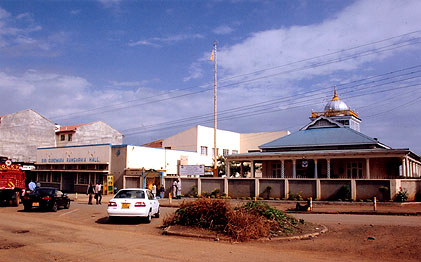
The Sikhs around 1895 started coming to E. Africa and were employed by E.A Railways as skilled and unskilled labour force. Soon afterwards traders followed. As the traders grew more in number, some of them started moving to the interior.
Wherever Sikh traders went they retained their religion and established Sikh temples at the first available opportunity. In Eldoret, the first Ramgharia temple was constructed in 1925, which was next to the present temple and was constructed of wooden structure. As the population grew, the need for bigger temple was felt so during 1933 November, the present temples foundation stone was laid by LATE MR. BUR SINGH LALL (below) .
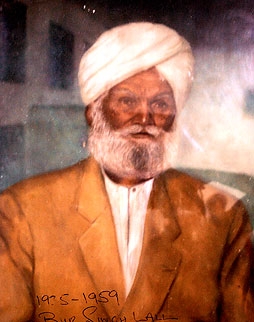
It was said that all the Sikh community supported this worthy cause and built the temple which was ready by 13th April 1934. The opening ceremony was performed by DR. WAZIR SINGH.
In early days all the religions as well as social activities were centred on the Ramgharia Sabha Eldoret, and a need for some residential houses and a social hall was felt, which resulted in their construction in 1948 from donations from Sikhs.
18th E.A RAMGHARIA CONFERENCE (below) was organized in Eldoret in 1960 under the chairmanship of S. Tara Singh DOGRA & Vice Chairman S. Mohan Singh Alderman.
During June 1961, Ramgharia Sikh Dispensary was started and the opening ceremony was performed by MR. JAGAT SINGH.
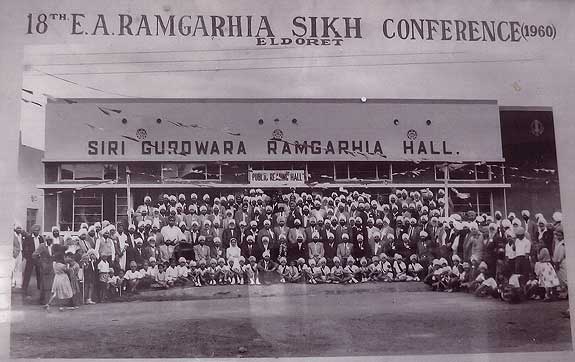
Gurdwara Hall next to the Gurdwara
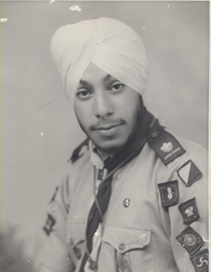
Kitchen flats for Giani Ji and six guest rooms were built on 23/10/1988. The foundation stone was laid by H.S. RANAUTA and K.S. DEOGAN (above) On 11/3/1990 opening ceremony was performed by PRITAM SINGH PANESAR.
The following were the chairmen since Gurdwara started:-
1935 to 1959 LATE MR. BUR SINGH LALL
1959 to 1975 LATE MR. GAJJAN SINGH DEAGON (see below)
1975 to 1977 LATE MR. PRITAM SINGH RANAUTA
1977 to 1983 DALBIR SINGH BHOGAL
1983 to 1984 MR. AJIT SINGH SIRA
1 984 to 1 986 KUNDAN SINGH SUDDLE
1 986 to 2008 Harjit SINGH RANAUTA
The above history shows that much has been done since the arrival of First Ramgharia Sikh to the town and it is sincerely expected that much will be done by future Rarngharia Sikh generation in all fields of development and will surpass their fore-fathers.


PRESIDENT: H.S. RANAUTA
30th July 2008
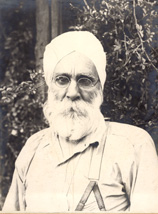
Prem Singh Ranauta 1941 - elder of Ranauta family.
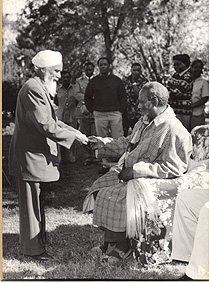
S. Gajjan Singh Deogan presenting a cheque to Mzee Jomo Kenyatta on behalf of Sikh Community Eldoret.
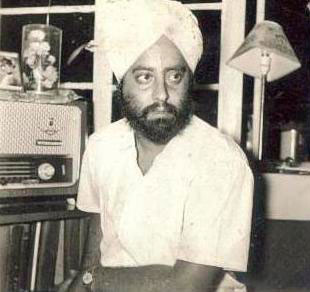
Harbhajan Singh Attalia (above & below) – The man who actually installed Electricity at many railway stations of East Africa. He was a electrician working for the EA Railways, who later in Life became a Station Foreman / Manager in Mombasa / Voi / Nairobi / Kampala. (30years + service)He then Emigrated to London in 1976 and has since passed away (photo courtesy Kuldip Attalia)
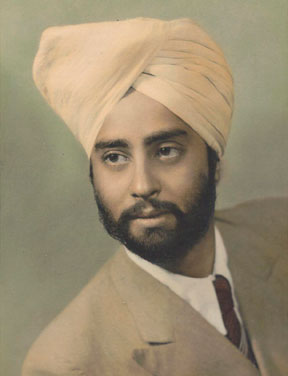
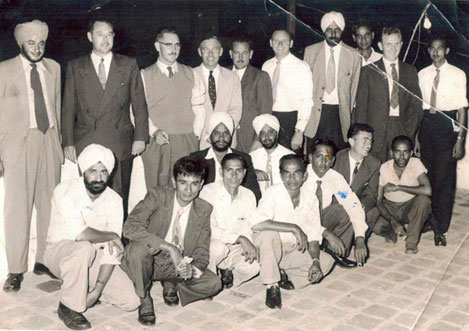
Harbhajan Attilia with his team (photo courtesy Kuldip Attalia)
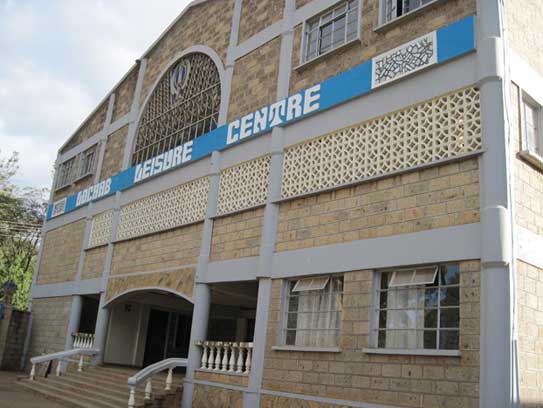
Lochab Leisure Centre Eldoret (photo courtesy Kuldip Attalia)
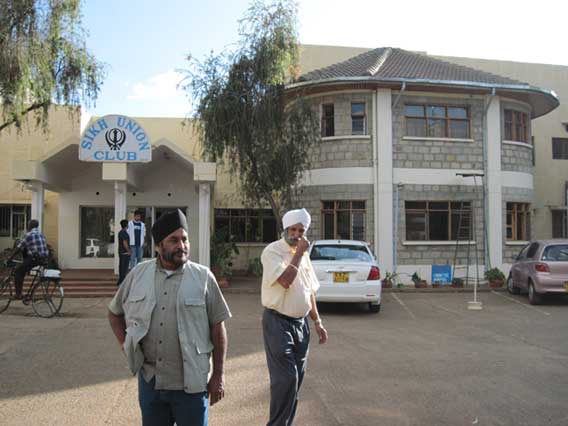
The Sikh (Simba) Union Club (photo courtesy Kuldip Attalia)
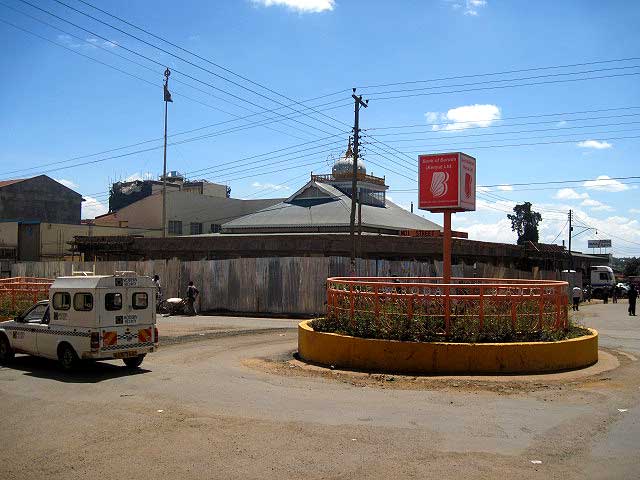
Gurdwara as at 2009 (photo courtesy Kuldip Attalia)
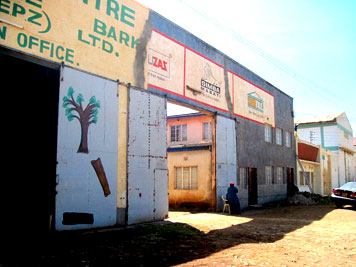
Sira Godown (photo courtesy Kuldip Attalia)
--------------
The following biography has been sent by Brijendra Sood - Some of his friends might be able to recognise him. (Kanwal)
Dr. Brijendra Sood
51 Sweet Water Place,
Calgary, Alberta.
T3Z 3C6
Dr.Brijendra Sood C.M.,C.stJ.,M.B.,Ch.B., L.R.C.P.Lond., M.R.C.S.Eng., F.R.C.S.Ed., F.I.C.S., D.Obs.R.C.O.G.
Dr.Brijendra Sood has had a interesting and colorful career. He was born in India in 1927 in a medical family, was raised in Kenya, East Africa. His father was Dr Faqir Chand Sood who practiced in Kenya from 1929 to 1970 and after retirement came to live in Calgary near the family. After completion of his High School in East Africa and two years of College in Lahore (1944-1946)India, he went to England where he obtained his medical degrees from University of Birmingham. After internship and residency training in England he returned home to Kenya where he joined Her Majesty’s Overseas Civil Service as a Medical Officer. His first two years were spent working in bush hospitals looking after Leprosy and TB cases. He was involved in looking after many a wounded during the Mau Mau rebellion.
Dr.Sood and his family were pioneers in a way. They were the first Indian family ever to immigrate into Canada from East Africa. He came to Canada in 1964 having obtained his Fellowship from the Royal College of Surgeons of Edinburgh. After a year in Manitoba in a small community Deloraine, he came to Banff. He was well liked in Deloraine, Manitoba, because of his community involvement. The local Boy Scouts Group needed a Scout Leader and he soon found himself in charge as a Scout Master, being a First Class Boy Scout himself during his youth days. In Banff he became a very popular doctor especially with North American Indians who considered him one of them. Because of his compassionate attitude and excellent care he provided to his Indian patients, in 1967 at a very colorful ceremony in Banff, Stoney Indians west of Calgary under Chief Walking Buffalo admitted him into the tribe as a blood brother and Honorary Chief naming him Chief Rainbow.
Medical Service:
While practicing in Banff in 1966, Dr.Brij Sood became an examiner for St John’s Ambulance Brigade. After his move to Calgary in 1967, he got himself involved in the work of St. John’s Ambulance Brigade that he had first joined as a student while in College in Lahore India in 1945. He has been a volunteer worker with this organization in India, Africa and Canada. He has served this organization in Calgary since 1974 and his long and dedicated service earned him the Order of St. John, which he received from the Governor General Jean Sauve in 1987. For many years he was a Divisional Surgeon and for many years now he has been Area Surgeon to the Brigade with responsibilities for maintaining high standard of training and efficiency. Because of his long and excellent service and active involvement, Her Majesty Queen Elizabeth made him an Officer of that Order, the insignia of which and he received from the Lt. Governor of Alberta, at an investiture on May 18, 1995. Subsequently in 2002 he was made Commander of the order of St John.
For many years he also helped Operation Wheel chair in Calgary.
He served on the Medical Staff Executive of Alberta Children’s Hospital in Calgary for many years and was President and subsequently Chief of Staff. In Calgary General Hospital Dr.Sood served on the Executive of the Dept. Of Family Practice and Dept. Of Surgery. He served as the Treasurer of Archives and Museum Committee of that Hospital. He has been very active in the Calgary Medical Society and has been on its Executive for the last twelve years. He was the President of the Society for two years 1994-1996. Being a first class magician, he is the resident magician of Calgary Medical Society and has entertained members and their families at Society’s Christmas Party every year for many years.
In 1983, Dr.Sood got the ball rolling to get the Calgary General Hospital create non-smoking areas in the building. At a quarterly medical staff meeting he moved the first resolution designating the auditorium of the Hospital as a smoke free area in the institution. This was voted very favorably by an overwhelming majority and since that day slowly and progressively the Calgary General Hospital totally banned smoking in the building.
His travels overseas always turn into a busman’s holiday. In every instance he has been called upon to attend to medical emergencies. To give a few examples, he had to perform a tracheostomy on a child on board a passenger ship in the Bay of Biscay in 1964. He was called upon to revive a Chinese patient on a flight from Tokyo to Hong Kong. On another occasion he treated a sick French lady on an Air France Flight from Djibouti to Paris. Before Air Ambulance Services started in Alberta in mid seventys he flew many a time to oil drilling stations in the Arctic to treat and bring back sick and injured patients, thus being the first flying doctor in the Province.
Cross-cultural, Community, Church & Social Service:
In spite being a new arrival and struggling to get established in Canada and raise a young family he found time to become involved in community affairs. In Calgary he noticed a lot of bias and prejudice against immigrants. With the help of other concerned Calgarians he was instrumental in founding Calgary Multicultural Centre in 1975. This group was formed to build cross-cultural bridges and not to create ethnic ghettos. Now Calgary Multicultural Centre is a very vibrant and thriving institution with a building of its own. It is interesting to know that since those years Canada has been recognized as a Multicultural nation by our Government.
In the early years East Indian community was tiny. Dr.Sood with the help of a few others started India Canada Association which helps East Indians enter the mainstream of life in Canada and promotes East Indian culture. This organization now represents about 40000 East Indians in Calgary. On the demise of a family member and subsequently with the increase of East Indian population after the arrival of refugees from Uganda in 1972 he felt the need for a religious Hindu organization. He was one of the founders of Hindu Society that now has a Hindu Temple in the City catering to the religious and spiritual needs of a fifteen thousand strong Hindu community. He has served as President of all these organizations and has left these vibrant groups in the hands of younger members. Till recently he was one of the Trustees of Calgary Hindu Temple. He has given talks on TV and at Health Fairs on medical topics relevant to East Indian population.
It is of interest that at the time of the assassination of Prime Minister of India Indira Gandhi, he openly preached that immigrants should consider themselves Canadians first, share thir culture with the mainstream community and keep their religion at home. This gave him a bad name in a segment of the community and for some time he was on a hit list of the extremists. His bold stand, however, earned him great respect in the East Indian community of Calgary, which he has continued to serve. Because of his excellent record of community interests he was appointed to serve for two years on the Alberta Heritage Council. In 1993 after the earthquake in India he helped raise nearly $20,000.00 for relief of victims of that disaster.
He has served on the Board of Directors of Calgary Hospice Society. He holds many public appointments like Medical Examiner for Immigration Canada, Immigration Australia, Civil Aviation Canada, Medical Director Park Ambulance Service, Medical Consultant to Immediate Response Service Calgary etc. etc.
AWARDS:
He has received many prestigious awards the highest being THE ORDER OF CANADA:
1. Honorary Indian(North American) Chief named Chief Rainbow by Stoney First Nations of Alberta. 1967
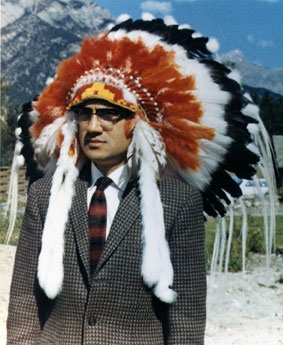
Dr. Sood as Chief Rainbow.
2. Govt. of Alberta Achievement Award for Outstanding Contribution to Ethno-Cultural Development. 1984
3. Order of St John. 1984
4. Outstanding Service Award. India Canada Association of Calgary. 1984
5. Award of Excellence in Professional & Occupational Field. 1995.
6. OFFICER of the Order of St John 19957. Outstanding Service Award. Hindu Society of Calgary. 1995.
7. Nominated as Immigrant of Distinction 1999, 2000, 2007.
8. Outstanding Physician of the Year 2000. Calgary Medical Society.
9. COMMANDER of the Order of St John. 2002
10.Queen Elizabeth Jubilee Medal. 2002.
11. MEMBER of THE ORDER OF CANADA. 2002
12 Presidential Citation from International Brotherhood of Magicians for promoting the Art of Magic. 2003
13. Citation from THE SENATE of Canada: In recognition of status as a role model for Asian-Canadian Community. 2003
14. “100 Physicians of the Century”.
Alberta Medical Associaion & College of Physicians & Surgeons of Alberta. 2005
15. Certificate of Merit. Calgary Medical Society.
16. Lifetime Achievement Award. National Indo-Canadian Council of Canada. 2005
17. Alberta Centennial Medal. 2005.
18. “WIZARD” Award. ternational Brotherhood of Magicians.2006.
19.“Eagle Feather” Award. Chiniki First Nations of Alberta
Dr. Sood is still in active medical practice. He is in excellent health, plays golf and is a great stage magician. In this field he has entertained audiences in in India, Pakistan UK. USA and also performed at Rideau Hall for the Governor General when he was admitted to The Order of Canada in 2003’
His wife is Narindar and they have two daughters and one son. Rupa is the eldest and she is a business woman living in Seattle, Washington. Veena is an actress and has appeared in many TV shows and movies. Manoj is also an actor and is known as the Muslim Archie Bunker on account of his role in the current CBC show Little Mosque on the Prairie.
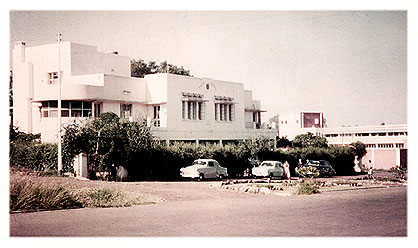
In Kisumu our home (above) was right opposite the
Gurudwara in the centre of the City. When my parents left Kenya in
1970 the building was sold to the local Sikh Temple and converted it
into a charitable dispensary (below 2002). We used to live upstairs and dad had his
medical office downstairs It was called ANAND BHAVAN
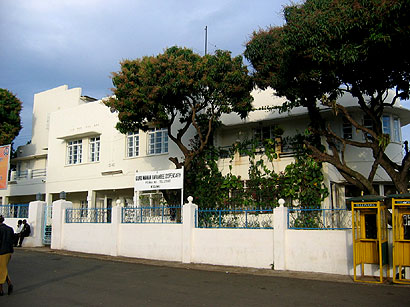
--------------------------------------------------------------------
History of Channan Family. April 4th 2012
To:harjinder@kanwal99.freeserve.co.uk
Subject: History of Eldoret, Kisumu and Nairobi.
Hello Harjinder,
May I respectfully ask you to consider including the following facts in your article.
“Dev Dhar Channan Born in India Punjab August 1 1900 Died Dec 7 1941. He had intermediate Fellow of Science Degree from University of Punjab during the British India Empire.
Dev Dhar came to Kenya in 1916.. Their family was well placed in Punjab.. His father’s family was the first family converted to Vedic Religion and were members of Arya Samaj Hoshiapur. They donated land for construction of Arya Samaj Centre and land for DAV HIGH SCHOOL and DAV Girl School in Hoshiarpur.
After a few months as a clerk in a bank Dev Dhar joined Kenya Civil Service. He would go with the District Commissioner and open Tax Posts of the Government. He would train clerks and then move to the next station.Dev Dhar got married in 1928 to Shanti Devi in India in 1928. Thereafter he joined the Nairobi High Court as Chief Clerk. Also he bought a farm in Kibigori in Songhor District and had a manager Khushal Singh to help in Managing the Farm. Due to the locust invasion he sustained heavy losses in the farm. His wife Shanti sold the farm in 1996 as none of my brothers except me were interested in farming. The farm could yield sugar cane, tropical fruits, tea and coffee but we did not farm.
My father was involved in getting free two lots in Eldoret where Arya Samaj Centre was built.
After my father’s death my mother educated herself and she could write and speak fluently English Hindi, Gurumkhi, and spoke the African language Swahili. I worked in the East African Tax Department.
My late brother Jai Kar Nath Channan retired from East African Railways Nairobi.
I retired as a lawyer in Toronto Canada. I was first Asian lawyer who worked as Attorney and counselor at law of New York State. I was the first person from Asia, Africa and West Indies to hold degrees of Barrister and solicitor of England. I had LLB and LLM from University of London. I had financial aid and admission to study BSC economics in the Royal College in Nairobi. I had admission to study Law Tripos and LLB at Trinity Hall Cambridge University but I did not go but came to Canada. I was the first non white officer in the East African Tax Department with the powers of Commissioner of Tax EASCO. I retired from there in 1966. I was the first Asian offered a position in Ministry of Agriculture in Kenya and also admission to Egerton College at Njoro. My best opportunity was to study Two years Program at Harvard University but did not avail it due to the politics of the English Commissioner of Tax.
I helped the two Gurdwars in Hamilton and one in Brantford Canada by doing all their legal work free and also gave donations in cash for their buildings. Also I did legal work in registering Arya Samaj in Toronto.I was the first person born outside Canada to run for membership of the legislature of the Province of Ontario in 1977. Although I did not win but the Minister of the Government lost his seat in the legislature. I am told that I am 2nd person in North America to run for political office. Mr Mand was the first person to be elected in the House of Congress USA. My sonPeter is a medical specialist in three hospitals and his degree is FRCS.
My friends in Kenya and Canada were Sikhs. I found them very honest and men of principles as they observed their religion very strictly.”
Krishna K Channan. Email :kkchannan@sympatico.ca
------------------------------------------------------------------------------------------------------------
KAMPALA
Emblem for Ramgarhia Sikh Sports Club - Kampala
In the year 1951 a few members of Ramgarhia Sikh Community gathered together to discuss the desirability of setting up a sports club mainly for the purpose of putting up a Hockey Team of their own. The authorities were approached to acquire site for building a club and the services of Late S. Kehar Singh Kalsi ^proved very—useful in acquiring the site. The draft rules and regulations were prepared by the chairman of the formation committee, S. Gurbachan Singh Jando and were put before the members in the Library Hall of Ramgarhia Sikh Society Building in early 1952. The members approved the draft rules and regulations in principle. A general meeting was called in which most of the enthusiastic, young and old members numbering to approximately one hundred and fifty gathered and discussed the aspects of a club for the Ramgarhia Sikh Society. It was unanimously recommended that a proper committee should be formed and the formation committee should hand over to the appropriate committee all the shovel work. S. Mehar Singh Panesar, who was the President of the Ramgarhia Sikh Society, Kampala was elected the first president of the club, on the 19th day of November, 1952, and S. Gurbachan Singh Jando voluntarily offered his services as Hon. Secretary to the club.
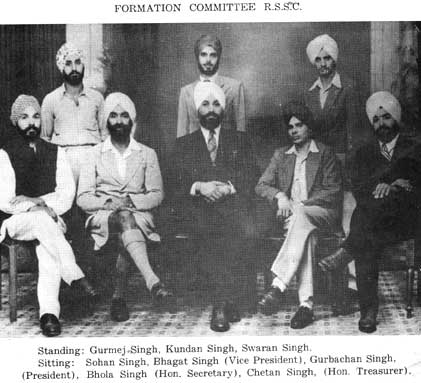
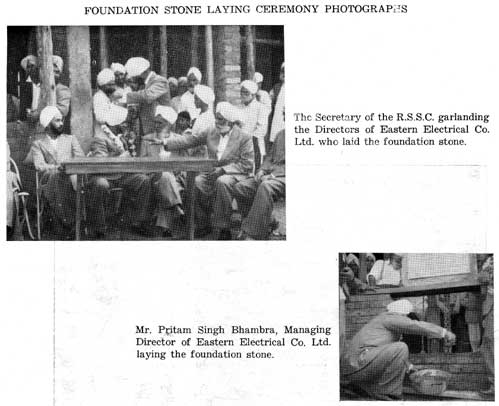
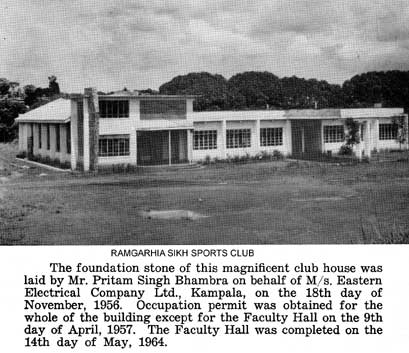
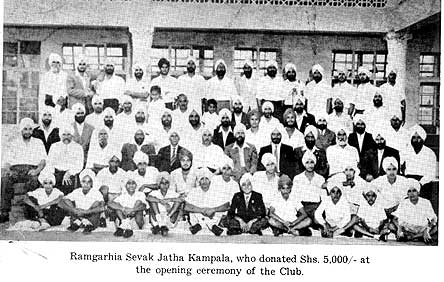
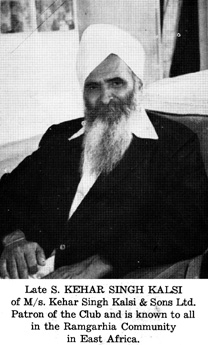
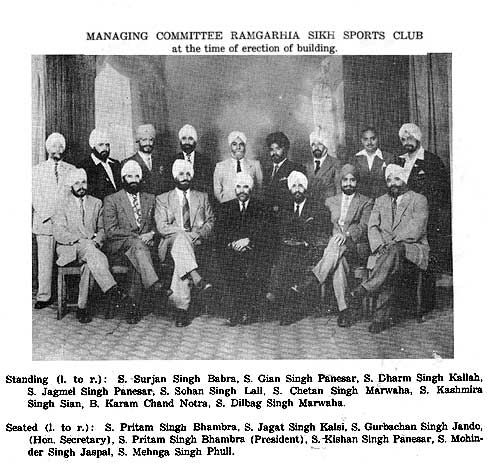
A SHORT HISTORY
of
THE RAMGARHIA SIKH SPORTS CLUB
KAMPALA
On one fateful evening in 1951 a few young men of Ramgarhia Sikh Community, Kampala, gathered together to discuss the desirability of setting up a sports club, mainly for putting up a hockey team of their own. In 1952 the hockey enthusiasts approached Chetan Singh Marwaha and Sohan Singh Kalsi, I.N.A., with intention of obtaining advice of the elderly members of the Community. A number of meetings were held in the Library Room of the Ramgarhia Gur-dwara, Old Kampala. The guidance came forth unhesitatingly. The community leaders discussed the proposition. It was felt that the promotion of a club on communal basis was not desirable in that it could give rise to breakaway tendancies but the opinion prevailed that so long as attitude were kept healthy, there was no inherent risk of any bitterness.
In early 1953 the Formation Committee to go further in the matter was set up under the chairmanship of Gurbachan Singh Jando. The draft rules and regulations were produced, discussed, checked and prepared by the formation committee and members were enrolled. At the general meeting held latter the formation committee handed recommendations to constitute a managing committee whose first President was elected Sardar Mehar Singh Panesar who was also President of the Gurdwara at the time of election.
The Committee commenced work and monthly meetings were generally held at the office of Gurbachan Singh Architect, who held office of Hon. Secretary since the formation till completion of first phase of the building.
The hockey team was in its full force. In the Coronation Hockey Tournament our side secured 15 points i.e. third position in the West of Nile Division. The hockey team used to participate in all the local hockey tournaments and our team was sent to Nairobi to participate in Guru Nanak Hockey Tournament.
A sub-committee was formed to approach His Worship the Mayor and other officers concerned with the allocation of club site and school site. The members were consisted of (1) M/s. Mehar Singh Panesar, (2) Pritam Singh Bhambra, (3) Pritam Singh Phull, (4) Bhagat Singh and (5) Gurbachan Singh Jando. A continuous and determined effort resulted in obtaining a club site and school site.
On 18th November, 1956 erection of building commenced. The progress was miraculous. The members of the community worked voluntarily with singleness of purpose and willingness according to the characteristic of the Sikh. The foundation stone laying ceremony was performed by the Directors of Eastern Electrical Company Ltd. who donated Shs. 25.000/- for this worthy cause. Joint collection committee allocated first Shs. 25,000/- on commencement of work and there on members of the community were in very jubilant mood to complete this building and donated building materials.
Mr. Dilbagh Singh Marwaha was mainly responsible for the arrangements of bringing the volunteer workers, particularly members of Sevak Jatha and Mr. Gurbachan Singh Jando for serving langar on Sundays to all the participants. With the willingness and co-operation all the members of the community the first phase was completed in three months and opening ceremony was performed.
The building of the Club is worth Shs. 150,000/-. It covers an area of 6,500 sq. ft. consisting of a club-house and multi-purpose hall.
The building pleasantly designed is simply elegant. But the club still lacks Tennis Courts and Cricket Practice Pitch. Without money it is difficult to proceed. Yet the last phase of development has been completed with the collective and, determined efforts of present management committee. The club, though made for the benefit of the Sikh Community, is open to all communities without discrimination of any kind.
The activity in sports have been very impressive, particularly, hockey. In 1957, our hockey team brought the trophy of Guru Nanak Hockey Cup played at Mbale under the command of Captain Rajinder Singh Kalsi and the trophy has been retained by our Club, because the organizer of this Tournament M/s. Chanan Singh Pritam Singh decided, to close up this tournament.
RELIGION
The members of the Ramgarhia Sikh Community played very important part in the development of this country, and according to our religious belief a Sikh Temple (Gurdwara) was built immediately after they arrived in this country on a site near the present Nakivubo Stadium. The building consisted of a prayer hall, verandah and residential accommodation In May, 1934 a proper body was constituted and site was acquired on Rashid Khamis Road, where the present Gurdwara building stands and building was put to use in 1936. The Society is the parental body of the Ramgarhias and from time to time extend financial assistance to both our school and club. The Gurdwara is not only a place of worship, it can be used for secular meetings, as a rest house and for celebrations of births, marriages and engagements and communal kitchen. In order to overcome the problem of lack of religious education to our younger generation, a school was opened in the Gurdwara and Sikh religion and history together with preliminary spiritual training was introduced. We have been conducting regular classes in Gurdwara until we built a school on Nakivubo Road and moved into it in 1956. With the growing demands of the community a dispensary was opened by the Society but later on this facility was withdrawn owing to lack of co-operation and credit facility availed by the members.
The progress of the community is appriciable. After the second World War we have gone into business and now with special technical knowledge and orgnizing ability there are successful building contractors, transporters, sawmillers, furniture makers, electrical engineers, mechanical engineers, architects, surveyors, civil engineers, workshops, garages, body building workshops, other specialized trade experts, and craftsmen. The craftsmanship has been inherited from Baba Vishwakarma who was the founder of engineering. We being born engineers can be very proud of this but disunity sometimes sets up back and brings unpleasantness. However, I am sure in course of time disunity shall disappear by the blessings of Guru Nanak and the community is to prosper and flourish.
The Ramgarhia Sikh Community has its institutions throughout Uganda. There is a Ramgarhia Sikh Gurdwara at Jinja and they have also built a school. The other institutions are:—
- Ramgarhia Sabha, Entebbe
- Ramgarhia Sabha, Masaka
- Ramgarhia Sabha, Fort Hall
- Ramgarhia Sabha, Mbale
- Ramgarhia Sabha, Soroti
- Ramgarhia Sabha, Torero
A move to constitute one Central Body that is Ramgarhia Supreme Council was anticipated by the Ramgarhia Society Kampala, but no concrete proposals have been produced. A need to set up such central organization is most essential.
S. GURBACHAN SINGH JANDO,
A.M.I.S.E., A.E.A.I.A., A.I.A.A. (London)
Patron of the Club
Architect who designed and supervised the building of the club without accepting any remunerations. Besides, he volunteered to work manually during the course of construction, and did not hesitate to assist the workmen in all respects.
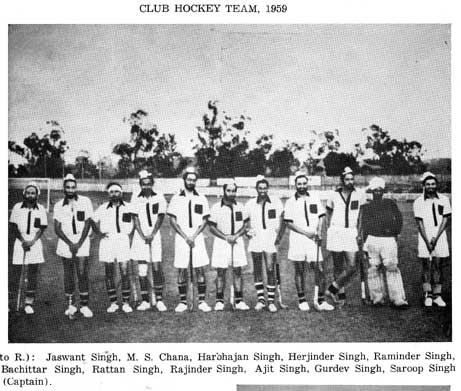
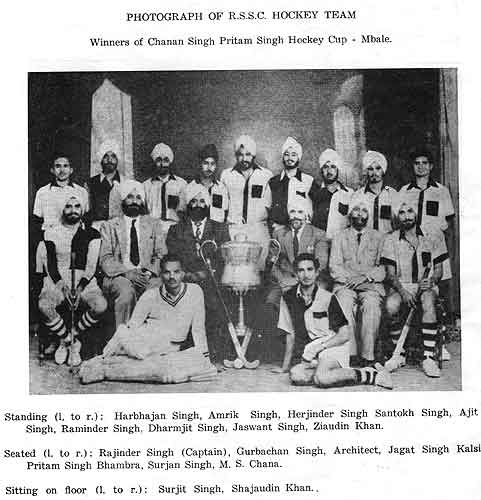
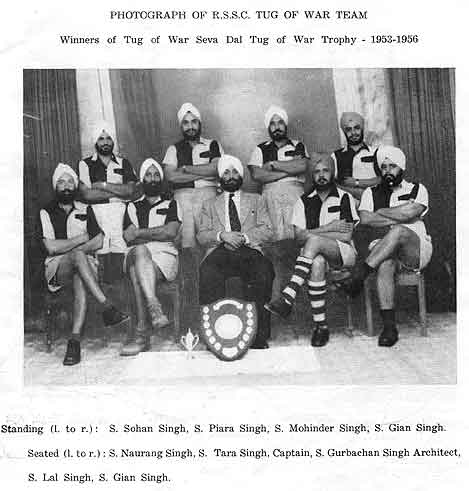
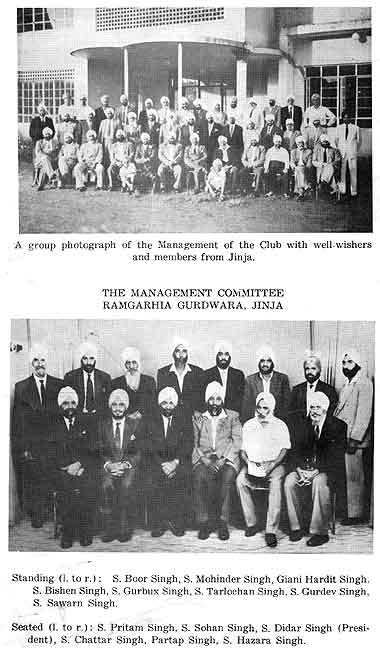
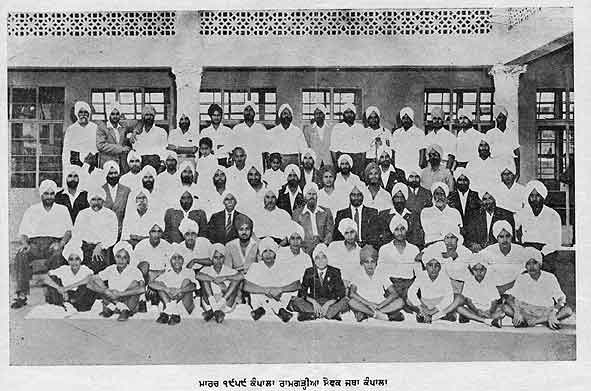
Ramgarhia Sewak Jatha Kampala - 1959
All above information & photos taken from souvenir 1966. Opening of Ramgarhia Sports Club.
-----------------------------------------------------------------------------------------------------------------------
Broadcasting Service in Kenya
The following narration is by Pritam Singh Chaggar, a radio, TV & stage personality whose contribution towards the development of Asian broadcasting is highly commendable. My thanks to him for providing me with information and rare photographs with Indian celebrities of yesteryears who visited Kenya during his time in the ‘Voice of Kenya’- the lovable Asian programme, which to date has no comparison anywhere in the Asian world. (Kanwal)
Pritam Singh Chaggar
I joined broadcasting on 1st March 1955. At the time English and Asian broadcasting was controlled by ‘Cable & Wireless’ from Kabete (near Nairobi) where the Studio and transmitter were located. There were M/s Arjan Singh & Hazara Singh working as engineers at the transmitters during the early days and they used to play Indian records from this transmitter site.
In 1959, the Kenya Government took over complete broadcasting service and all the Asian broadcasters were transferred to the new premises of Kenya Broadcasting Service at the new complex near the National Theatre, close to the Norfolk Hotel. At the time the Asian service was run by T.N.Soni, Musa Ayub and then by P.S.Chaggar (myself). Later on C.L. Chaman joined us at Kabete. Then came the expansion of the Asian program and Bikram Singh Bhamra was added to our existing strength. Other broadcasters were added to the team such as Inderjit Dhillon, Allaudin Qureshi, Bhaiya Murti to name a few. An Englishman Mr. Russell was appointed the head of the Asian section. It was during those days that the Maharaja of Patiala, Yadavendra Singh visited Nairobi and inaugurated the Patiala pavilion of the Sikh Union Club (now Simba Union) at the Forest Road, Nairobi. I had the honour of interviewing him (picture below)
In 1963 Kenya Broadcasting Service (KBS) started its television service and I was the first Sikh to read the Asian News Headlines on TV and do the continuity presentation for all English and Kiswahili programmes. (photo below)
Every year the Agricultural Society of Kenya used to have Agricultural show at the Jamhuri Park and we used to broadcast live from the show ground. There was a football match between the Kenya Government Ministers and diplomats at the Show Ground and during the half time I and my colleague Bikram Bhamra interviewed Mr. Tom Mboya, the Minister for Constitutional Affairs in the Kenya Government. This able Minister was later murdered on Government Road. (photo below)
I was honoured by the Sikh Community in Nairobi early in 2006 celebrating Golden Jubilee of my Broadcasting career. (photo below shows S Amrik Singh Virdee trustee of Ramgarhia Sikh Temple giving saropa)
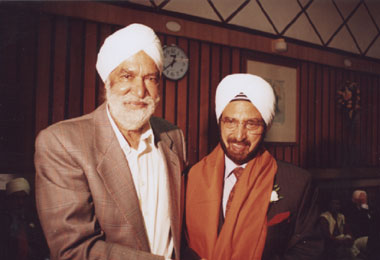
Social
At a function organised by the ‘Artists Welfare Guild’ at the City Hall Nairobi of which I was the President and Bhaiya Ram Moorti Maini (presenter of children’s program on radio) the secretary, a cheque was presented by myself to the wife of the Governor of Kenya Sir Patrick Renison for the ‘Heart Foundation’. (photo below)
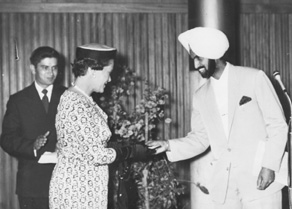
The Pakistan High Commissioner was the chief guest at a social programme where I interviewed him and other prominent personalities such as S. Mahan Singh the Kenya hockey coach and S. Niranjan Singh Niranjan, a prominent poet. (photo below)
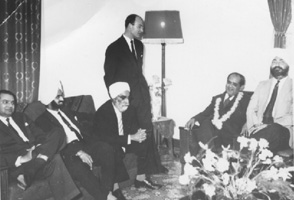
The honour of first Sikh to achieve the post of Colonel in the Kenya Airforce goes to Col. Gurcharan Singh Chana (Chani), also an accomplished Tabla Player who accompanied the great Jagjit Singh, the ghazal maestro on his tour of Kenya. (photo below)
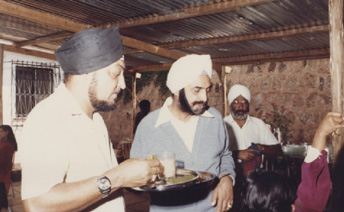
Promoting Stage, Entertainment & Art World
As a broadcaster I have had the privilege of interviewing and meeting a number of artistic dignitaries and prominent personalities such as :-
- Ustad Ali Akbar Khan, the eminent sarod player. (photo below)
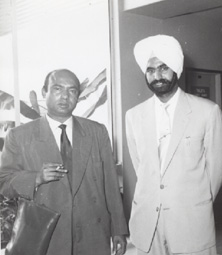
- The bollywood playback singer Mukesh, for whom I arranged a private musical evening and who was also a good friend. (photo below)
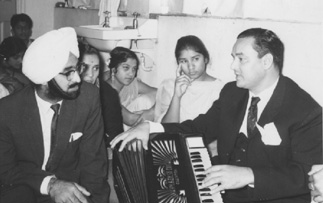
- Famous Indian Film Music directors, Pandit Husan Lal & Bhagat Ram on their visit to Kenya. (photo )
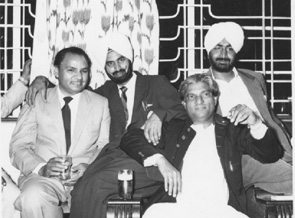
- Bollywood leading playback singer Mohammed Rafi when he visited Kenya.(photo)
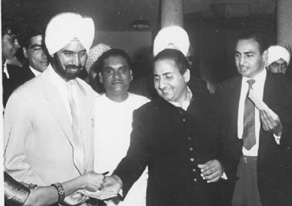
- Famous bollywood star Rajendra Kumar. (photo)
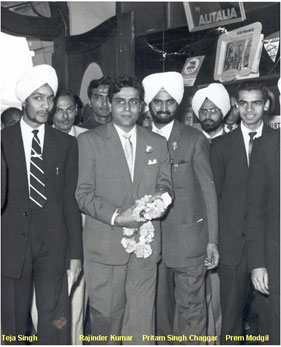
- ‘Chacha Sahib’ - a play enacted for the TV, where I played the leading role. (photo)
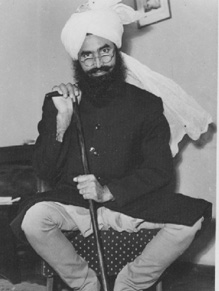
- I promoted the first freestyle wrestling in Kenya where world class wrestlers were invited to participate. The likes of Dara Singh, King Kong, Ray Apollon, Petrie Kumali, Tiger Joginder Singh, Sardara Singh, Gill Singh Tiger and many others from all over the globe flexed their muscles in the ring. (photos below with Dara Singh & Gill Singh Tiger)
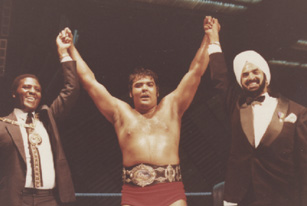
STAGE AND MIKE SIKHS
The adaptability and hard-working nature of the Sikhs have taken them to all the corners of the universe, inspite of a negligent number they are in. When we talk and think of the East African Sikhs we think of them as Engineers, Architects, Politicans, Doctors, Lawyers, Headmasters, Technicians, and also in the varied branches of the Civil Service, not of course forgetting the progressive businesses they are running.
That much for the professionals and the business-men. We then gauge the distinct mark they have made in all forms of sport and games-in actual participation on the field and on the administration side of it. They have a praiseworthy flair for this great physical and social activity.
Talking of the social aspect one is forced to focus a view on the field of art - art in general and fine arts in particular. We have had outstanding artist in Hardial Singh Sagoo, the brother of the then Hon. Kirpal Singh Sagoo, O.B.E. who have both left us now, leaving us to fill up this big gap; but many building artists like S. S. Phull are up and coming. We cannot here miss the distinctive contributions of paintings and drawings by Hari Singh Bansal whose paintings are ever-present. We must also acknowledge the wonderful job of work, several of our Architects are doing in the field of art. A mention must also be made of several out-standing Sikh photographers which are difficult to mention by name.
MR. BIKRAM S. BHAMRA, Producer, V.O.K.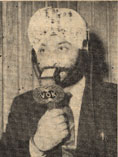
Let us now survey the "Mike" Sikhs whose knowledge of music has reached the hearts of all goodlisteners. We immediately think of masters like, Late Dr. Assa Singh, Late Ragi Labh Singh, Ragi Tara Singh, Ragi Jagjit Singh, Rajinder Singh Jabbal, Mohan Singh Musa Puri, Ragi Udham Singh and several others in the field of classical music and singing. We must also pay a glowing tribute to the popularity of Didar Singh Pardesi, Raghbir Singh Rahi, Channi Mohinder Singh, Mrs. Vasdev, Baldev Singh Chohan, Swarn Singh, and several others who have made their mark on the light side of music and singing.
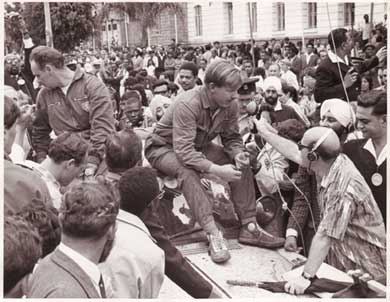
Bikram Bhamra & C.L.Chaman interviewing East African Safari rally drivers. (photo courtesy Amarjit Chandan)
Another very popular lot of Mike 'Sikhs have been the masters of voice like Bikram Singh
Bhamra, Pritam Singh Chaggar, Late Inderjit Singh Dhillon, Harbhajan Singh Preet and Teja Singh. Their contribution on the radio and television in the form of plays, talks, stories, news-reading commentries etc. has been tremendous and well acclaimed. The same have also done an appreciable bit on the stage as actors, producers, and masters of ceremonies. For that a special mention of the veteran character-actor Harbhajan Singh Preet must be made who was the first Non-European to win the Best Actor's Award at the Kenya Drama Festival in 1954. He, with Dilbagh Singh Chana had also shocked the orgainsers of the Elocution Contest for the Kenya Music Festival by winning awards and commendation. Teja Singh has participated in countless stage plays and produced twice for the Kenya Drama festival gaining a good overall position. He also produced for the Schools Drama Festival and gained a third place in face of tough competition. He is these days a regular contributor on the V.O.K. and almost a 'professional' Master-of-Ceremonies. K. S. Bawa's performances on the stage were always applauded.
Lastly, the Bhangra Dances of Kisumu are a lively lot who must be thanked for keeping up the
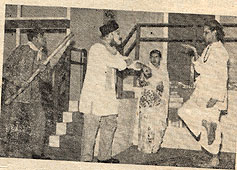
A SCENE FROM 'DHONG'
(L. to R.) Harish Dave, Harbhajan Singh Preet, Shashi Bhalla, Teja Singh
traditions of the Punjab by performing this dance of dances here there and everywhere.
A keen awareness is coming to pass and taking hold of the Sikh Community in participating and encouraging all forms of the fine arts and folk traditions.
(EDITOR. Late Teja Singh Bhabra -article taken with thanks from a magazine printed in 1966)
Artists Guild welcoming actor Rajendra Kumar in 1956. Teja Singh Bhabra, Pritam Chaggar, Ajit Sat Bhamra and Prem Modgill (contributer of this photo)can be seen. Prem Modgill, after his retirement as an educational Psychologist has seriously persued his acting hobby and has acted in the bollywood movie Ramji London wale.
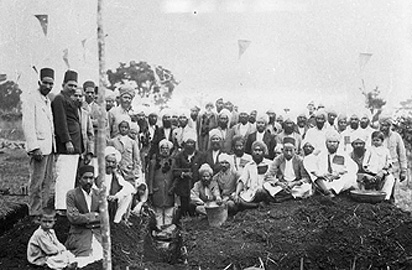
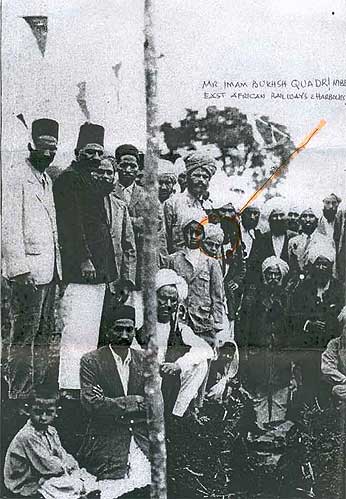 This photo taken out probably during the thirties or forties somewhere in Kenya. I found it in my archives and it was sent to Kenya for identification. It was printed in a paper and the response it got was a letter from Mr. Khan who identified his late father. His letter is given below. ANY OTHER IDENTIFIERS?
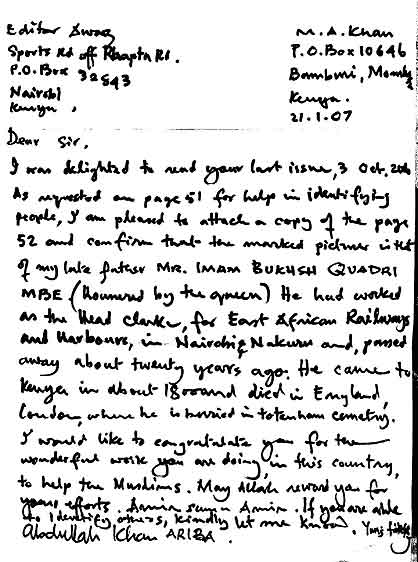
We present an article published by Leiden University, Holland.RE: International Institute for Asian Studies (IIAS) News Letter 43.Spring 2007 .(Courtesy of Amarjit Chandan and Leiden University) Click here to read and see photos in pdf form.
SCOUTING IN KENYA
The Scout movement was started by Lord Baden Powell - a brief history of this great man is given courtesy of Wikipedia.
Robert Stephenson Smyth Baden-Powell, 1st Baron Baden-Powell OM, GCMG, GCVO, KCB (22 February 1857 – 8 January 1941), also known as B-P, was a lieutenant-general in the British Army, writer, and founder of the Scout Movement.
After having been educated at Charterhouse School, Baden-Powell served in the British Army from 1876 until 1910 in India and Africa. In 1899, during the Second Boer War in South Africa, Baden-Powell successfully defended the city in the Siege of Mafeking. Several of his military books, written for military reconnaissance and scout training in his African years, were also read by boys. Based on those earlier books, he wrote Scouting for Boys, published in 1908 by Pearson, for youth readership. During writing, he tested his ideas through a camping trip on Brownsea Island that began on August 1, 1907, which is now seen as the beginning of Scouting.
After his marriage with Olave St Clair Soames, Baden-Powell, his sister Agnes Baden-Powell and notably his wife actively gave guidance to the Scouting Movement and the Girl Guides Movement. Baden-Powell lived his last years in Nyeri, Kenya, where he died in 1941.
The Scout movement in Kenya was very popular in all the schools and from here the cream of good scouts emerged who became King Scouts and afterwards Queen Scouts.
THE FIRST SIKH KING'S SCOUT IN EAST AFRICA
The honour of the first Sikh 'King's Scout' goes to Harcharan Singh Sehmi of Nyeri who got his his 'Bushman's Thong' from Lord Rowallan in 1950. Photographs of his journey to England and some other exploits are given here with courtesy to Hartcharan, who has kindly sent all the relevant photos and information. He lives in Isleworth, U.K. presently.
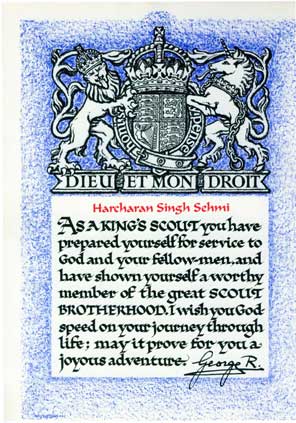
The 'King's Scout' certificate awarded to Harcharan Singh Sehmi in 1950. The signatures of King George VI can be seen on the right hand corner.
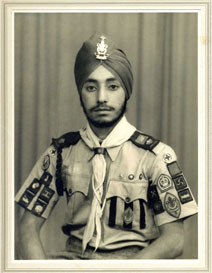
Harcharan Singh Sehmi who had the honour of being the first Sikh 'King's Scout' in East Africa.
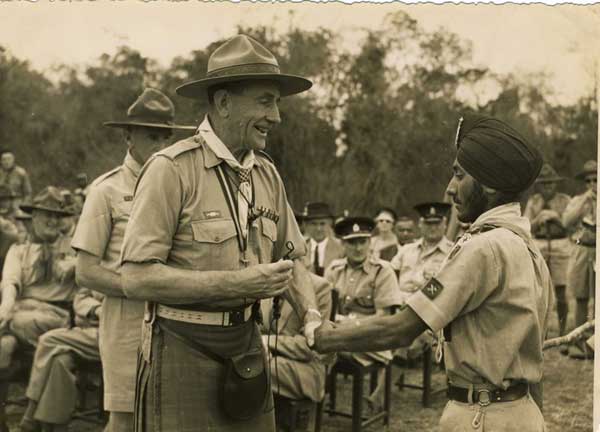
Harcharan receiving the 'Bushman's Thong' award from Lord Rowallan at the opening of the Ngong Camp at nairobi in 1950.
Guard of honour for the Chief Scout Lord Rowallan at the Eastleigh Airport 1950.
Ngong Forest camp.
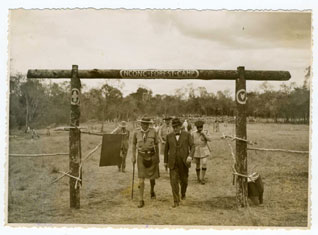
The Chief Scout coming out from the camp.
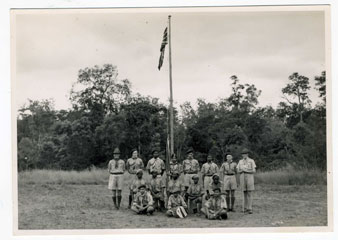
After the Ngong Forest camp, the scouts selected to attend the World Jamboree
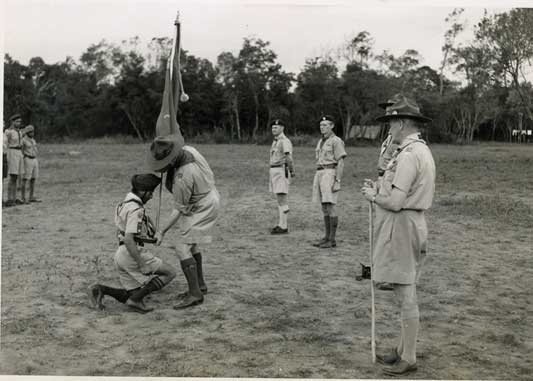
The Kenya Boy's Scout Flag being handed to Harcharan to attend the World Jamboree at Gilwell Park Ching ford U.K. 1951
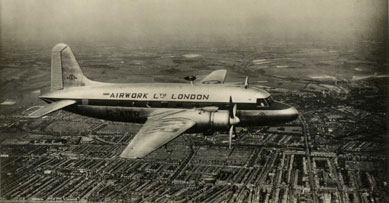
The plane in 1951 in which the scouts travelled to London for the Jamboree.
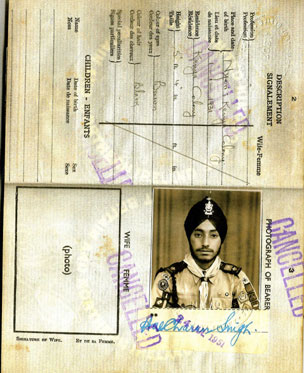
The passport of Harcharan on which he travelled to England for the jamboree
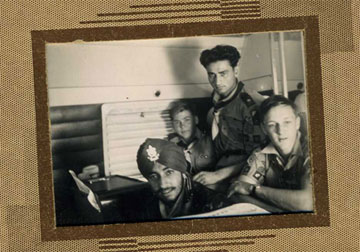
Channi & friend scouts in the plane.
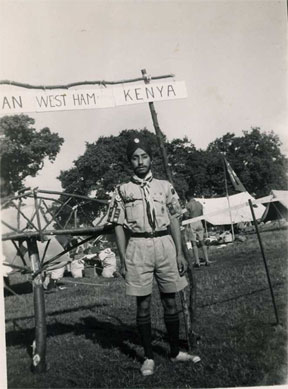
Harcharan (Channi) at the Gillwell Park, Chingford camp.
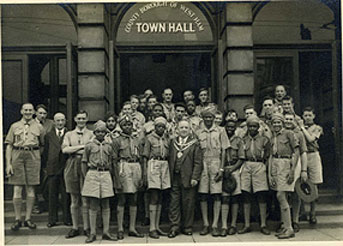
World Scouts with the Mayor of West Ham.
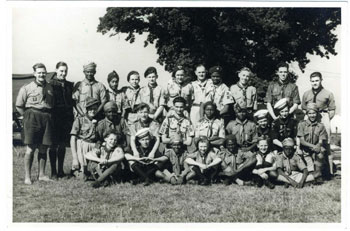
With Scouts from Sudan, Kenya & West ham.
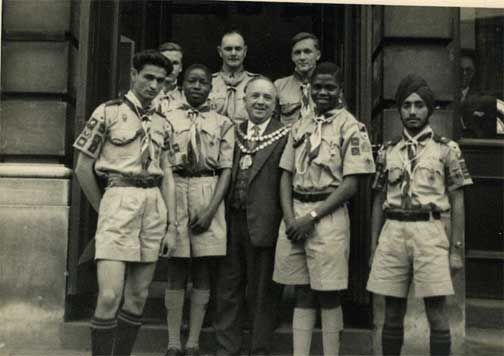
Kenya Scouts with the Mayor of West ham.
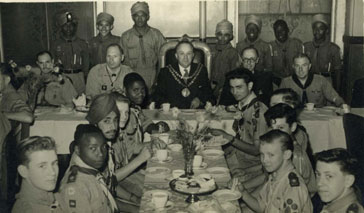
World Scouts having tea with the Mayor August 1951
At the camp with friend scouts
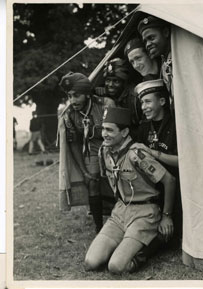
At the camp
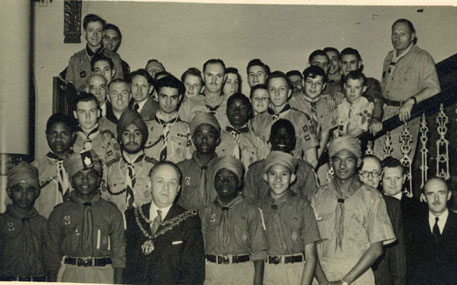
The Mayor with scouts from Sudan, Kenya & England.
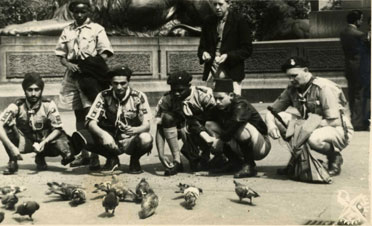
The scouts enjoying at Trafalgar Square London
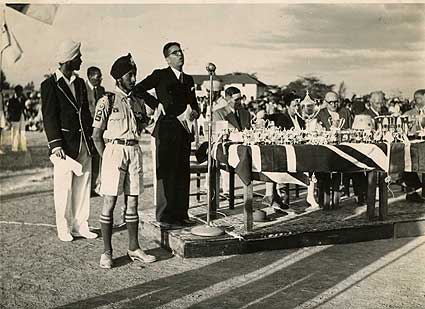
Sports Day at Government India High School (later Duke of Gloucester)- Year 1949. Principal Amar Nath making a speech while teacher Dalip Singh Jhally looks on - with Harcharan in his full Scout attire.
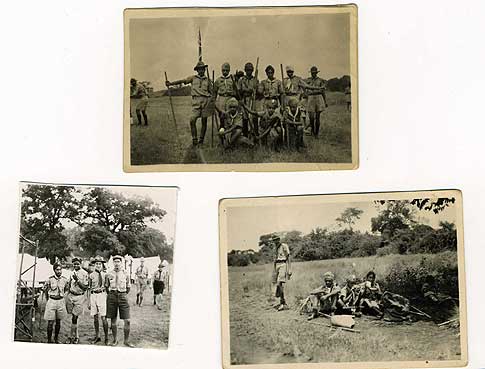
At the Uganda jamboree 1947
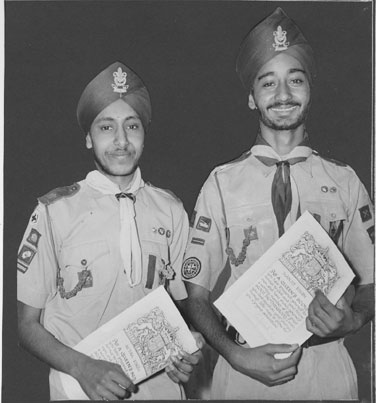
Avtar Singh Purba & Manjit Singh Dhillon with their 'Queen Scout' certificates-the highest award in the scout movement. These awards were presented to them by the Chief Scout of Kenya, Sir Godfrey Rhodes (below)
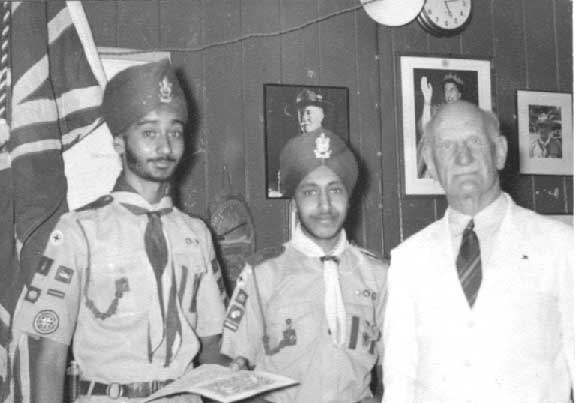
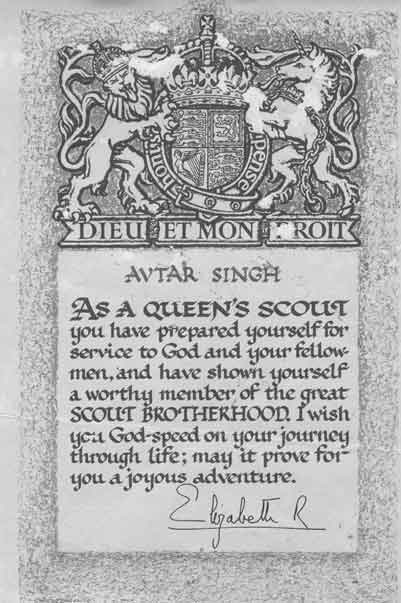
The Queen Scout Certificate (the highest Award for Scouting)
Avtar Singh was the only asian selected for the honour of laying a wreath on the grave of Lord Baden Powell in Nyeri,as being the first Queen Scout after Princess Elizabeth's accession to the throne.
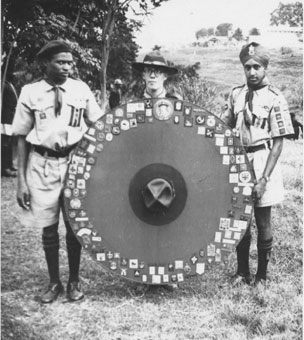
Avtar with two colleagues who laid the wreath on the grave of Lord Baden Powell (Below) at Nyeri
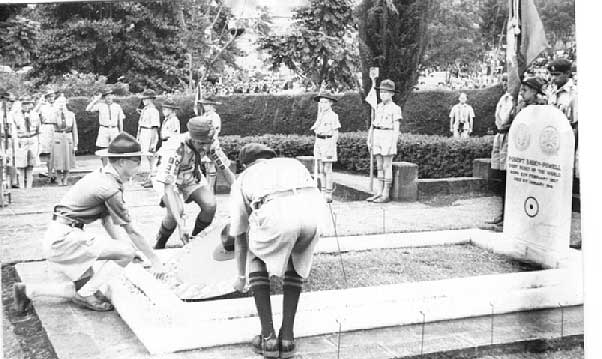
Avtar, being a first class scout, was an excellent all-rounder sportsman, excelling in Table Tennis, hockey, cycling mountaineering etc. He was the coast table tennis champion and represented Kenya many times in this field. He is seen below with the Kenya team which went to Egypt.
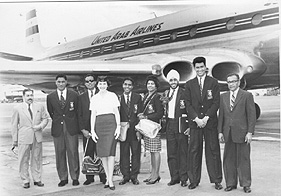
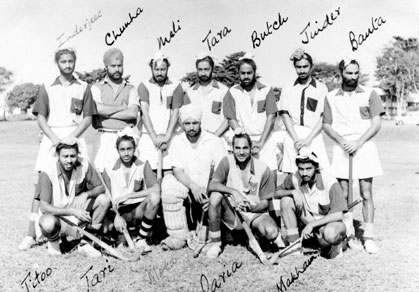
Avtar with the Sikh Union Tiger's team 1958
Avtar's passion for mountaineering took him to the top of Mount Kilimanjaro and Mount Kenya. He was the first Sikh instructor appointed to lead and organise trips to the Kilimanjaro. (Below)
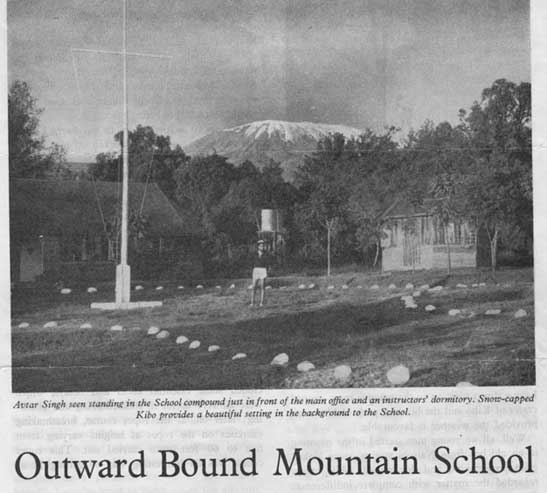
Avtar's long Cycling trips took him over hundred's of miles. Here he is seen with a friend, Avtar Bhamra on one of their marathon 300 miles trips to Mombasa from Nairobi. (Below)
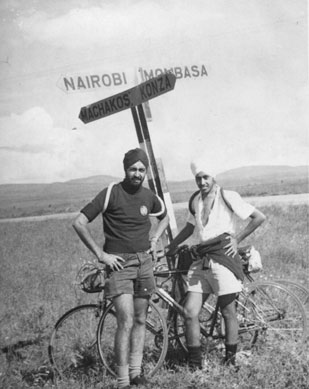
Avtar worked in the Hydrological and Water Development Board in Nairobi whrer he had the privilege of meeting the President of Kenya Mzee Jomo Kenyatta (Below)
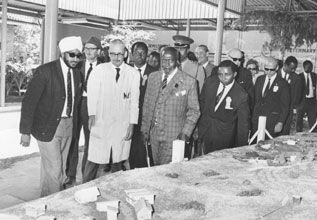
Avtar is retired now and living in England. His passion for Sports is still burning in him. He is a keen Golfer with a respectable handicap of 8 and a regular member of a golf club where one day he will have his 'hole in one'. (All information received with thanks from Avtar)
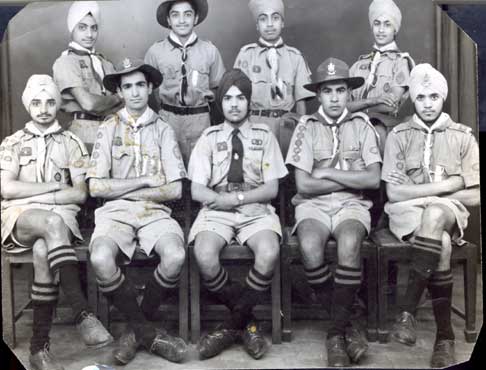
Scouts in Kenya (names and place unknown) Photo around 1949/50
Seated (L) S. Sohan Singh Rupra 01.06.1929 - 01-03-2005 (Info sent by Jaspall Rupra)
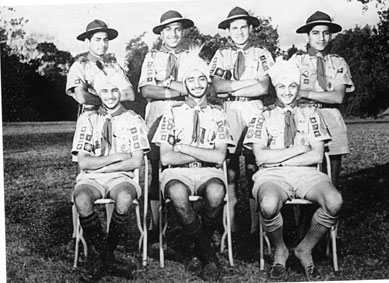
Scouting in Nairobi - Manjit Dhillon with other scouts
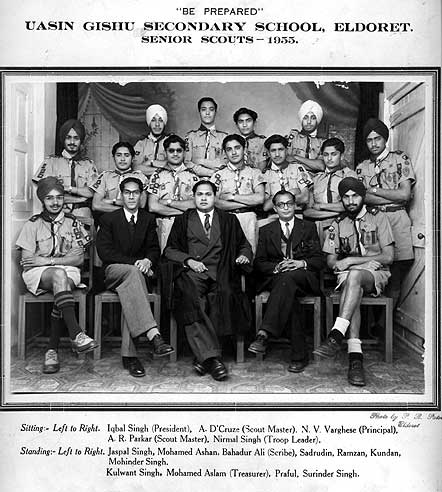
Eldoret Scouts
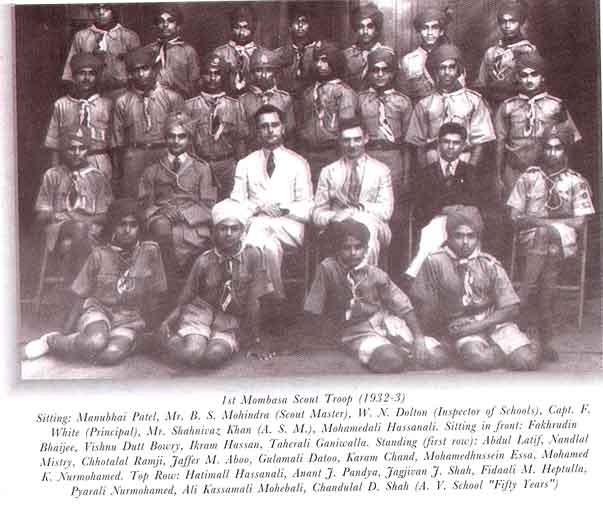
Scouts in Mombasa (1932/3) - See especially the 'Turbans', which was part of the uniform in those days for all. (courtesy 'We came in dhows)
KENYA SIKH GOING AROUND THE WORLD -THUMBING!
Sant Singh Bhamra, a civil servant working for the Ministry of Works in Kenya was responsible for the maintenance and operations of the Government Water Supplies to the Rift Valley province, which is the largest province in Kenya. He was always on Safari, travelleing almost everyday to maintain the Government propert all over the province. While travelling he used to give lifts to European 'hitch-hikers' who were visiting East Africa in this exciting way. From this he got the urge to also hitch hike throughout the world and see the beauty of it. After some small excursions, He embarked on this major mission on the 12th of March 1965. The following cutting from the news paper The Daily Nation briefly tells his story. (Story courtesy Parminder Bhamra son of Sant Singh)
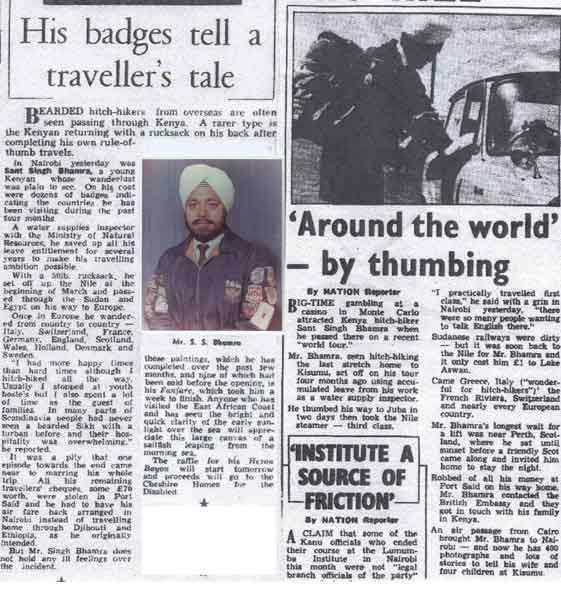
PIONEERS
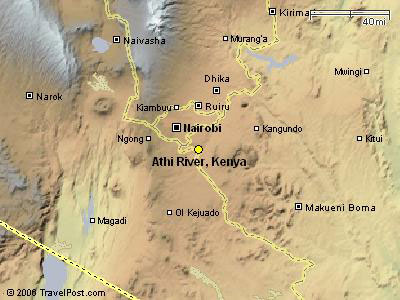
The late Mr Bir Singh Rayatt, the pioneer of Athi River township is a household name in Kenya. He passed away 30 years ago but people of all races still remember him even until this day because he had a big heart and helped many people in Athi River and Nairobi when ever they needed his help. People give his family a lot of respect due to him. Many attended his funeral in Nairobi.
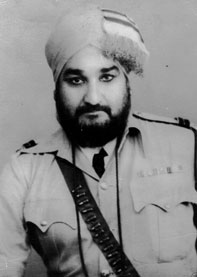
He joined Churanjilal & Co on his arrival from India. The company operated in Nairobi and dealt with building materials. He was sent to Athi River as a supervisor to manage the sand supplying business there. The year was 1940 and there were a few shops (duka’s) where a few asian families were residing. I was born in Athi River and grew up there. I could remember a few Asians working at the Athi River railway station who were very friendly to my father. The shop keepers were also very friendly to him. In 1952 state of emergency, my father joined Kenya Police as a reservist and helped many locals who were arrested and sent to detention camps. The locals appreciated what he did for them and nick named him D.C (District Commissioner). Even today many old local residents call me D.C’s son whenever they see me.
In 1953 he bought his first lorry and started his own business as a sand supplier in direct competition with his employers and got the sack. His business in Athi River flourished and became the main sand supplier to most of the building contractors in Nairobi. He also became a supplier to Nairobi City Council, Kenya Railways, and Ministry of Works. He was very religious and often went to Sikh Temples in Nairobi, despite staying 20 miles away in Athi River. He did a lot of sewa at Ramgharia temple off Race Course road, Nairobi. He also did a lot of sewa at Landhia and South C Gurdwara gurdwara. In 1975 he was elected Vice Chairman of South C Gurdwara. He passed away suddenly in 1977. His family is still in Athi River and running the family business under the name of Bir Singh & Co.
He was not educated but rubbed shoulders with the high and mighty. His close friends included Alderman Mohan Singh, the Deputy Mayor of Nairobi, the late Puran Singh, the late Naranjan Singh, the late Kala Singh, all of M/s Naranjan Singh brothers, Justice C.B Mahan, Justice Chanan Singh, top advocate D.N.Khanna and R.N.Khanna, chairman of Pangani Temple Bakhshish Singh Sian, Jaswant Singh Bilkhu and Jagat singh Matharu. He was also very close to Phuman Singh Sahota, Jasbir Singh Ghatora, Tarsem Singh Panesar and Harcharan Singh Matharu. As the VC of South C Temple, he got a lot of respect from the sat sangat of the temple who miss his wisdom, even today.
Courtesy-Ajit Singh Rayatt
P O Box 15
Athi River
---------------------------------------------------------------------------------------------------------
Shri Bhai Balbir Singh Chhibber
Being a Kenya born and descendant of Shri Bhai Mati Das, I am not only proud of my heritage but also always interested in reading on my birth country.Sadly, it seems that a lot of recent authors seem to have either not researched into members of the Mohyal community that migrated overseas in late 19th and early 20th Centuries to new found continents, or are just not interested.
My late father was Shri Bhai Balbir Singh Chhibber, (1932-2003), born as the second son of four to Bhai Balwant Singh Chhibber of Moshi and Arusha, Tanganika now Tanzania.
My grandfather, Bhai Balwant Singh Chhibber settled in East Africa in early 1920′s and was sponsored by his uncle Bhai Kasturi Singh Chhibber, who built the Gurdawara in Moshi, funded totally independently.
The family had various business interests but mainly owned a saw mill in Arusha, (Arusha Chini), from where they prospered supplying materials for the construction of East African Railways amongst others.The family was known for their generosity in Arusha and Moshi and had the reputation for having an "Open House" attitude for anyone passing through seeking shelter over night and food.
My father was a refrigeration engineer who was sent to England in 1950′ by his employers, Gailey and Roberts of East Africa (Caterpillar Construction Distributors in East Africa), where he qualified in his chosen profession and lived in Eldoret and finally Kisumu before relocating to London in 1975.
On returning to Tanzania after his brief studies, he married my mother..Amrit, d/o Dr Raizada Manohar Lal Bali.
Dr M. L. Bali was known for his generosity amongst the community in Uganda and early years in Kenya, was also the co-founder of the Free Masons in Kampala, holding the rank of Grand Master upon his early death.Dr Bali' house was next door to Idi Amin in Kampala and he was also a friend of Inder Singh Gill who you mention in your web site.My father is survived by his youngest brother Harjit, who also lives in London and may have early photographs etc if you are interested.
If you would like more information, please feel free to contact me.
Best regards,
P Chhibber
Nov 08 2012,
------------------------------------------------------------------------------------------------------------
PUNJABI INSTITUTES IN EAST AFRICA
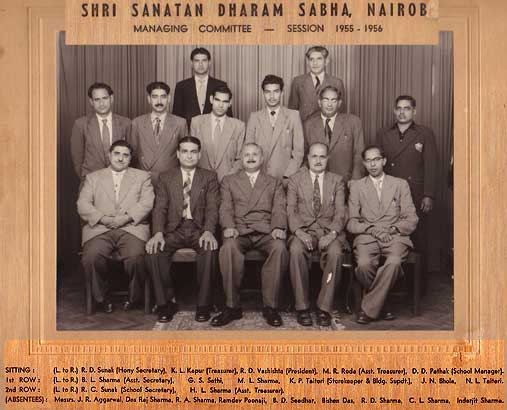
(Photo- courtesy K.P.Tateri)
The Shree Sanatan Dharma Sabha
The Sanatan Dharama Sabha known as SSD was founded in 1917 in Nairobi, and a first rest house of ten rooms was built. The very next year (1918) the SSD built the Radha-Krishna Temple, where the deities were installed in 1921. The mandir was in Duke Street adjacent to River Road.
The Arya Samaj
The Arya Samaj was founded in Nairobi on 5 July 1903, at a meeting at the home of Jai Gopal attended by forty-five people. The small group of Arya Samajis immediately began plans for a centre for its members and on 11 September 1903, the foundation for the first Arya Samaj building in East Africa was laid. Today there is a seven-storey building on this site.
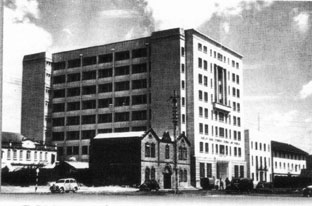 The old Arya Samaj Building next to Barclays Bank Queensway Branch.
 The new building of the Arya Samaj next to Barclays Bank.
------------------------------------------------------------------------------------------------------------
First Sikhs Remembrance Visit to the Monastir Road Indian Cemetery and Memorial in Salonika, Greece. Click here
-----------------------------------------------------------------------------------------------------
Sikh Soldier in East Africa
By Narindar Singh Dhesi
East African Rifles
The Imperial British East Africa Company (IBEAC) received a royal charter in 1888 to exploit the region of the Great Lakes in Central Africa and take over the British concessions negotiated with the Sultan of Zanzibar. The British also occupied Kismayu in Jubaland. They wanted a Cape to Cairo route. When the Company collapsed in 1895, Britain declared a Protectorate over the company’s East African territories. It covered present day Kenya and the land west of the Juba River. The Protectorate’s soldiers, consisting of Sudanese, Swahili, Sikhs and locally recruited tribesmen in equal number, were formed as the East African Rifles. They were based on the Company’s own body of armed guards which had been formed earlier from Sudanese, Somalis and the Swahilis. The first commandant of East African Rifles was Major Hatch, with headquarters at Fort Jesus, Mombasa. Major Hatch suggested that in view of the troubled state of the coast, 300-trained troops from a Punjab Regiment be recruited for East Africa. The establishment, authorized in 1895, allowed for 300 Sikhs, 250 Sudanese, 300 Swahilis, and 200 ‘mixed’ men. The force included fifteen Sikh gunners and some hospital attendants recruited in India.
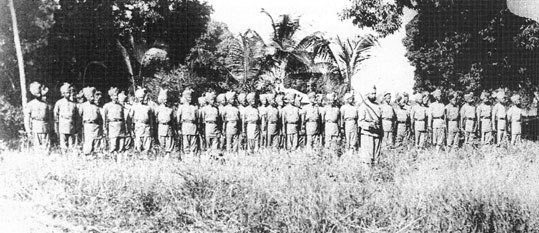
Sikh Soldiers in East Africa
Their first sortie in 1896 was against the Wakamba tribe, who had burned some police posts set up to prevent slave trading. A large collective fine was imposed, villages were burned, and a barracks constructed in the heart of Wakamba territory to discourage recurrence. In late 1897, East African Rifles were ordered to put down a mutiny in Uganda. Eighty men marched 360 miles in nineteen days to get to the scene and the railway line, although incomplete, was pressed into service to transport the remainder of the force. By the end of January 1898, 4 officers and nearly 400 Sikh and Sudanese troops from East Africa were in Uganda. The regiment lost 1 officer and 17 native officers and men killed, and 1 officer and 16 other ranks wounded during the operations. After the Uganda mutiny, the battalion was reorganized into five Sudanese and three Swahili companies. The Sikh contingent remained until their contracts expired in 1900, when a fourth Swahili Company replaced them.
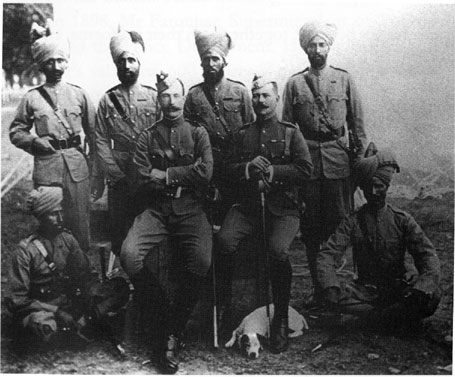
4th Punjab Rifles
Uganda Rifles
A mutiny in 1897 of the Sudanese troops used by the colonial government led Britain to take a more active interest in the Uganda Protectorate. An exploring expedition was projected, and Major J. R. L. Macdonald chosen to command it. The government of India had seconded two British officers and Jemadar Bhagwan Singh with 30 men of 14TH and 15TH Sikh Regiments as an escort for Macdonald’s party. Six other officers came direct from England, and Macdonald engaged a caravan of 350 Swahili porters, increased later by another hundred. Meanwhile a mutiny had broken out among the Sudanese regiments, who were joined by the men from Njemps, and the whole party made for Mumia’s. After threatening to attack the fort and demanding rations, they eventually withdrew. The mutineers next made for the fort at Lubwa, hoping to raise the garrison and join forces with the disaffected Muslim elements in Buganda. The whole force, numbering about 600 Sudanese and 200 Buganda Muslims, was admitted to the fort. Major Macdonald followed and occupied a hill dominating the fort with 10 Europeans, 17 Sikhs, and 340 half-trained Swahilis. On the following day, the mutineers attacked Major MacDonald’s force for five hours, but were defeated and driven back into the fort. This was a remarkable feat by the Sikhs, who with their Maxim guns had performed prodigies of valour, and the half- trained Swahilis and by the fact, the mutineers were led by experienced native officers. Another force, crossing a swamp supposed to be impassable, attacked the rebel stockade at Kabagambi, and carried it with great gallantry.
Writing about the Sikhs, Major Macdonald stated. ‘This detachment fully maintained the great reputation of the Sikhs, and fought with such gallantry that they secured the admiration of all’. Ten Sikh soldiers were awarded the Indian Order of Merit for conspicuous gallantry during these operations.
Realizing that after the mutiny the armed forces would have to be completely reorganized, Ternan submitted proposals to the Foreign Office without further delay. He suggested that 400 Indian troops should be enlisted, as the backbone of the forces. In 1898 Captain J. T. Evatt was appointed to raise the first Indian Contingent, 400 strong, for service in the Uganda Protectorate.
By 1900, the Uganda Rifles consisted of 1,952 men, organized in 16 companies; there was an Indian contingent of 402 soldiers with British officers, known as 1ST Battalion, Uganda Rifles. In 1902, the Uganda Rifles became part of the King’s African Rifles and the Indian contingent became 5TH Battalion, King’s African Rifles. (As was usual at that time, the Indian troops in the Uganda Rifles came from virtually every Sikh infantry unit in the Indian Army.) *
* The author growing up in Jinja, Uganda, remembers two Sikh Nco’s of the Kings African Rifles, marching through Jinja in 1956.
During the First World War in East Africa, apart from the Sikhs of the Punjab Regiments and the Mountain Batteries the following Sikh troops of the Sikh Princely States saw service in East Africa.
Faridkot Sappers and Miners
The Faridkot Sappers were in East Africa from November 1914 to February 1918. In the advance to Moshi, they were divided, half going from Longido with General Stewart, and half from Taveta with General Smuts. From March to May 1916, they were road making for General Van Deventer in a ceaseless downpour of rain. In June and July, they were at Mkalama. In August and September, they continued to work well in spite of rain and half rations. In December, they bridged the Rufiji River for Beve’s Brigade, and later for General Sheppard at Kibambawe. They then returned to Morogoro and were kept on road repair throughout the rains. In October, they were with the Belgians in the Mehenge area. In January 1918, they bridged the Rovena for the Lindi Force. In February, they returned to India. Lieutenant Colonel Nand Singh was awarded the O.B.I. and the I.O.M. Lieutenant Colonel Bishan Singh was awarded the O.B.I.
Kapurthala Infantry
The Kapurthala Infantry were in East Africa from October 1914 to December 1917. They were employed on outpost duties until August 1915, after which they served at Msambweni for three months. They were then kept on Railway duty in the Kiu District. Thereafter they were employed on reconnaissance and outpost duties until October 1917. For the last two months of their stay, they were at Tanga and Lindi. Major General Sardar Puran Singh was awarded the O.B.I., as well as C.I.E. Lieutenant Colonels Nihal Singh and Moti Singh and Major Maya Singh, and Captain Rur Singh were awarded the O.B.I.
Jind Infantry
The Jind Infantry were in East Africa from October 1914 to December 1917. They earned the highest opinions of all the generals under whom they served, especially their fighting at Jassin. Major General Natha Singh, who commanded with great gallantry, was awarded the O.B.I., as well as C.I.E. Lieutenant Colonel Baldev Singh was awarded the O.B.I.
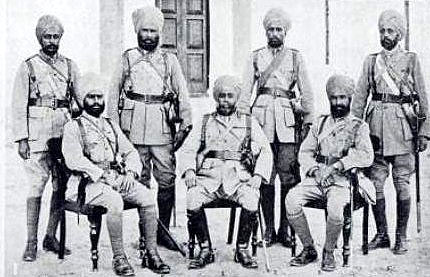
General Natha Singh with officers of the Jind Infantry
KENYA REGIMENT
The Kenya Regiment was formed in 1937 and served until 1945 in Madagascar and Burma when it was disbanded. The recall of volunteers started again in about 1950 with European settlers making up the main force. At the end of 1950, a call-up of eighteen year olds was introduced as the rumblings from the Mau Mau was making its presence felt. The first recruits were sent to Salisbury in the former Southern Rhodesia for basic military training and then on to operational units.
The Kenya Regiment then operated as a part of combined operations, which included British Regiments, King’s African Rifles, Kenya Police and Kenya Police Reserve, and the Royal Air Force. Apart from the Kenya Regiment operating in its own right, they were also instrumental in seconding Officers to the Kings African Rifles.
By 1962 the Kenya Regiment was a mixed force of European, African and Asian members.
The following Sikh soldiers had served in the Kenya Regiment
Dalip Singh Gill
Gurcharan Singh Chauahan
Harjit Singh Marjara
Harmeet Singh Gydee
Manmohan Singh Siyan
Manohar Singh Garcha
Mohinder Singh Barmi
Ranjit Singh Chaudhree
Ravinder Singh Gydee
Satwinder Singh Chana
Tarlochan Singh Soor
Tejinder Singh Nagi
The Kenya Regiment was disbanded in 1964.
.
Uganda Volunteer Reserve 1914 - 1916
In August 1914 Uganda, unlike the British East Africa Protectorate, had a Volunteer Reserve unit. This had started on 28 April 1903 with the formation of a Uganda Rifle Corps based at Entebbe and composed of European volunteers. On 25 June 1914 a Kampala Corps was formed for Europeans, and two months later another Kampala Corps was formed for Indian volunteers. In October 1914 a Jinja Corps was formed for Europeans. The organisation became:
Entebbe – No 1 Company of the Uganda Volunteer Reserve (UVR).
Kampala – No 2 Company (European).
Kampala – No 3 Company – Indian.
Jinja – No 4 Company.
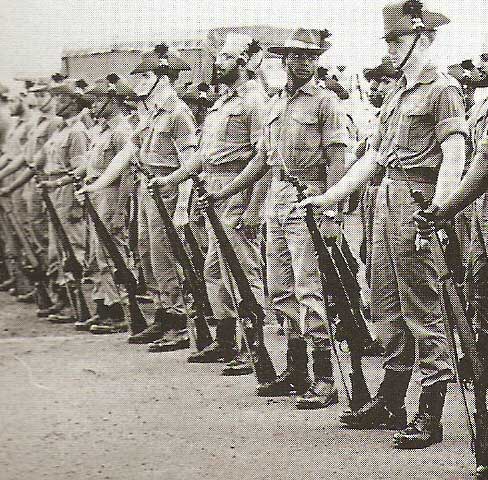
Review of Sikh troops at Entebbe 1906
The Indian company had a majority of Sikh members plus several Muslims and Hindus. About 30 of the men were ex-soldiers from the Punjab. When the 13th Rajputs was deployed on the Kagera Line five men from No 3 Company worked with the Rajputs as interpreters. Several other No 3 Company men served in clerical appointments both with the Field Force on the Kagera and in administrative units.
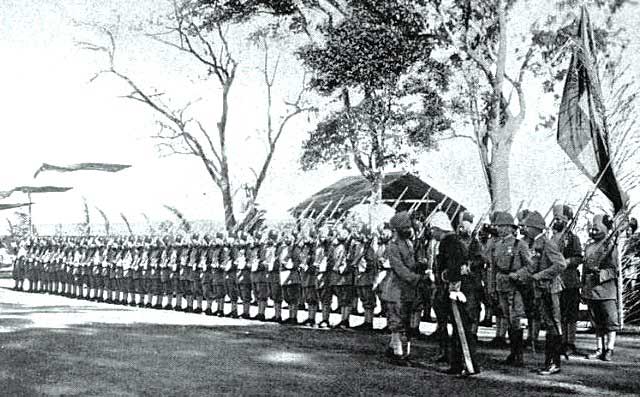
Sikhs at Entebbe 1908
-----------------------------------------------------------------------------------------
Sikh Lens USA printed this calendar with most of the material from my sikh heritage site. Here is a review of it by a well known Kenya journalist Kul Bhushan
SIKH CALENDAR 2013
‘EVEN OBAMA MAY LIKE It, GIVEN HIS KENYA CONNECTION’
Noted Former Kenyan Newspaper Editor, Kul Bhushan, reviews this heritage calendar with exultant memories of his 45-year stay in this country and personal relations with many of the outstanding Sikhs pictured on its 12 pages.
“Thanks for providing me with the calendar on Kenyan Sikhs,” said Sayantan Chakravarty, the editor of an NRI magazine INDIAN EMPIRE, “Even Obama may like it, given his Kenya connection.” Of course! But the US President would relate to it even more if the heading on the cover was ‘Sikhs in Kenya’ instead of ‘Sikhs in Africa’ which is too much for just one of at least 54 countries.
By all means, this large – 15 ins. by 24 ins. – calendar for 2013 presents a pictorial history of how the Sikhs have contributed to the establishment of modern Kenya and its progress since independence in 1963. Rare photographs poignantly tell the saga of Sikh contribution to nation building.
When Bicky Singh presented me with this calendar, I was delighted to find so many familiar faces I had known personally and interacted with them during my stay in Kenya. After the first three pages about their contribution up to World War I, the stories of my lasting friendship and professional associations with many them flooded my memory.
January, Dhows and Railway: Sailboats called a dhow have been bringing Indians to east Africa for over 2,000 years. In late 19th century, the British brought Indian labourers to build the Kenya-Uganda railway line and Sikhs played a leading role in harsh conditions battling diseases and lions. But they succeeded to build ‘the lunatic line’ and stayed on to develop Kenya.
February, Askaris: This Swahili word means soldiers and the Sikhs are renounced as brave warriors. Three hundred men from the Punjab Rifles arrived to protect the railway and attacks by local tribes. The Sikhs also formed a large part of the police force.
March, World War I: As part of the British forces, 35,000 Sikhs fought against the Germans in Tanganyika carrying Guru Granth Sahib ahead of marching Sikh battalions in serious battles and guerrilla warfare.
April, Gurdwaras – Ten different gurudwaras in Kenya are featured with Makindu as the most prominent. This gurudwara in the middle of African bush on the Nairobi-Mombasa road is famous as a stopover for all motorists where they can pray and also eat guru-prasad.
May, Policemen: Distinguishing themselves in service, the Sikhs rose to top posts in the police and Kenya Air Force. The outstanding achievers are pictured here in full uniform and their honours.
June, Kalasingha: Every Sikh is known as Kalasinghs by the Africans. This mystery is solved with the photo of the Sikh from Patiala by this name who arrived in 1896. Other notable pioneers of this community are featured here.
July, Prominent Ones: Community leaders and spiritual guides of Kenya include Kericho Walla Baba in the small town of Kericho and became known for his spiritual guidelines and example.
August, Political Activists: Sikh politicians advocated for Kenya’s independence and human rights in the peaceful struggle for freedom. Outstanding among them was the trade unionist Makhan Singh, a close associate of Kenya’s founding father Jomo Kenyatta.
September, British Honours: Kenyan Sikhs who made an impact on the global stage include Bhai Mohinder Singh honoured for his religious harmony; Gurinder Chadda for her films and Sir Mota Singh for his work in the judiciary in Britain.
October, Sports Stars: In motor rallying, Simba ya Kenya or Lion of Kenya, Joginder Singh won the East African Safari; Kugi Sagoo excelled at motor racing; and Surjit Singh in hockey, among others.
Kenya broadcasting had many Sikh stars like Pritam Chaggar, Chamn Lal Chaman and Bikram Bhambra; singers like Ragi Tara singh and Deedar Singh, poets like Sohan Singh and many others.
December, Creative Professionals: Photographers like Sir Mohinder Dhillon made their name globally, Ram Singh and jaswant Singh locally; architects like Tarlok Nandhra and Harbans Singh were outstanding.
A small photo of Baba Hari Singh on this page hides many talents of this quiet and egoless spiritual devotee who was a master mason, master carpenter, indeed a master craftsman and, above all, a creative artist whose religious paintings adorn many Sikh and Hindu temples. He worked on Makindu gurudwara, Nairobi’s Pumwani mosque and Sanatan Dharam Temple with equal dedication and devotion.
I can write a volume about my personal experiences and encounters with these notable Sikhs and also propose the names of many more who merit inclusion here but this will be a massive task that is most daunting. All that is needed now is a sincere compliment for this project. Here it is: Kudos to the publishers for their hard work and meticulous research!
After publishing a similar calendar for Sikhs in Britain, this is the second publication in this series. The first is planned to be re-published as a coffee table book for a longer shelf life and it is hoped this one will also be re-born as another. Yes, with a revised front page for Sikhs in Kenya, President Obama will appreciate a copy of this calendar, so hurry up, before this year is over!
ENDS
---------------------------------------------------------------------------------------------------
Sardar Nika Singh Lotay - Entrepreneur Extraordinaire - (Pyara Singh -Canada)
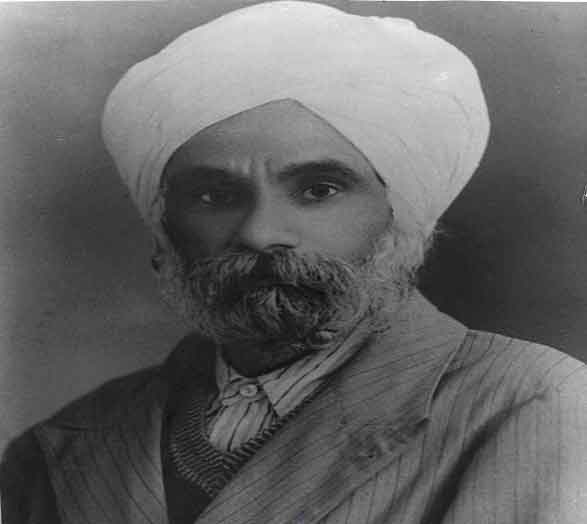
Sardar Nika Singh Lotay was one of the earliest of settlers in Kenya who came to Kenya in 1894 at the age of 15 years. S. Nika Singh Lotay was born around 1880, in Raikot, near Ludhiana India. Prior to the partition of India, Raikot was a predominantly Muslim city and a judicial center during the Mogul rule. Guru Gobind Singh, the 10th. Master met with Rai Bhular, the ruler of the area in that period. Rai Bhullar is recognised for offering Guru Sahib milk in the Ganga Sagar which is a part of Sikh history. Gurdwara Tahliana Sahib a is located in this historical city and Sikhs travel to visit this shrine from all over the world. Nika Singh was the youngest son of the three children of Sardar Wadhawa Singh. His older brother was Hari Singh and he had a younger sister, named Ralli. When Nika Singh was only 9 years old , his father died and his maternal uncle (Mamaji) who worked in Karachi took him along to work in a joinery shop. Child worker Nika Singh started by learning to make glue from animal bones and dried hides. He learnt the trade fast and soon became a very skilled carpenter, but more than that he became the leader of those who worked in that shop. He was not very tall, only 5foot 4 inches tall, but he was very agile and quick. He could take on a man twice his size at wrestling and speed pursuits. In 1894, he was recruited by the British East Africa Railways in Karachi, now in Pakistan at a monthly wage of 12(twelve) Indian rupees per month. He was hired as an Indentured Carpenter and had to sign a release bond of 100 Indian rupees, an undertaking to refund the Railways 100 Indian rupees if he quit his job. On arrival in Mombasa he lived in the worker encampment and his duties included working on bridge construction, laying the track as well as construction of accommodation and wagons. Since he was a young man, he learned to communicate in Kiswahili as well as some everyday English as required for his survival. He worked between Mombasa and Nairobi for six years and at the turn of the century he moved to the central workshops in Nairobi. Nika Singh established friendship with Sardar Gyan Singh, a friend ship that lasted as long as Gyan Singh lived. Gyan Singh owned a large tract of land by the Nairobi river, where he established a sub-division, called Shamba Gyan Singh. A lot of Sikhs and Muslims lived in that sub-division including the famous Haji Illam Din and Haji Jhanda whose wife Bebey Jhando was a renowned midwife. As a young tradesman Nika Singh established a reputation for being a go getter and the ability for taking on challenging assignments. In around 1904 a British settler who had a farm in Nyeri wanted to install a Posho Mill a turbine driven mill on a stream on his plantation. His inquiries with friends in the Railways led him to Nika Singh who offered his knowing how "Kharas" and "Gharat" were built in India to grind wheat as proof of his experience. This was his first assignment as an independent contractor. Nika Singh agreed to work on the assignment provided the settler reimbursed the Railways the bond money of 100 rupees and secure his formal release. The release bond was paid and Nika Singh went back to Karachi on the Dhow to get all the components required for the installation of "Gharat" the Posho Mill. He came back after four months built the large wagons and transported all the components andhardware to Nyeri and set about the task of the first industrial installation in Upstate Kenya. He lived in Nyeri for six months and worked all kind of hours to get the mill commissioned early in 1906. Many other farmers in the Nyeri and Nanyuki area hired Nika Singh to help them with similar installations on their farms and he established himself a s a reputable builder and industrial contractor. While in Nyeri he lived among the Kikuyu and the settler community improving his ability to speak very little English and becoming fluent in Kikuyu. During this period of high activity Nika Singh worked on several outstanding projects including several developments for the Jivanjee family and construction of the first Isrmaili Jamaat Khanna, a building with rough sawn timber walls and corrugated tin roof. He invested in several commercial buildings on River Road and owned several shops in the Indian Bazaar near Jivanjee Gardens off Government Road. He also established a workshop of his own on land he bought from his friend, Babu Gyan Singh, who worked as legal assistant in a lawyer's office. His friendship with Gyan Singh, inspired Nika Singh to get a good understanding of legal procedures He would spend a lot of time attending hearings in the Nairobi High court and observe civil disputes. He was able to understand spoken English very well for a man with no formal education. Sardar Chanan Singh of Sheffield, in 1990, narrated the story of Nika Singh's legal expertise in advising the lawyer working on the case of his daughter who was involved in a car accident. He started manufacturing wood products and furniture for sale to meet the growing demand by the European and Asian population. He went and recruited carpenters from Karachi and Ludhiana area. He provided them with free housing and boarding. Nika Singh had learnt to read Gurmukhi by recognition since he could not write. He would read the daily Nit Nem banis every day getting up at 5.oo a.m. He was a teetotaller and a vegetarian who kept his food intake simple and small. When and if he was sick, he would rest and refrain from eating till he fully recovered. That was his self remedy. He was President of Gurdwara Bazaar for several years and helped build the first Sikh place of worship in Nairobi. In 1910 Nika Singh went back to Punjab and got married to Basant Kaur and brought her with him to Kenya. His wife was almost six feet tall, a very imposing figure. The couple were blessed with five boys: Inder Singh, Harnam Singh and Gurpal Singh were born in Nairobi, Two sons Tara Singh and Sucha Singh and the only daughter Kartar Kaur were born in Raikot. In 1924 Nika Singh assumed ownership of the Star Soda factory originally started by one of the tenants in his complex at Shamba Gyan SIngh. He continued making soft drinks and sales grew when he established a network of distributors to whom the product was delivered and the empties collected by persons in his employment. His businesses flourished and he also manufactured wagons and ox carts and started a forge and metal shop. To celebrate the birth of his first born, he decided to buy a Buick car made in United States, amongst the first luxury vehicles seen in Nairobi. Around 1938 and prior to the outbreak of the second world war, Nika Singh felt he had amassed enough wealth and decided to consolidate and liquidate his assets and to return to India, his roots. The whole family moved back to Raikot where Nika Singh was chosen President of the Tahlianaa Sahib Gurdwara an important historical Sikh heritage place of Guru Gobind Singh's period In 1954 Nika Singh came back to Kenya to visit his family who lived in the Shamba Gyan Singh near Ramgharia Hall Gurdwara in Nairobi. He came back to Nairobi, now a city, that had grown into a Vast metropolis after the war and he must have felt like Rip Van Winkle. He decided to develop his old shop at Shamba Gyan Singh into a commercial establishment and rented the four shops to his Kikuyu friends from the Gatundu area. He was able to find an old friend from Nyeri, Thakar Singh who was now living in the Ngara Road area. The two would get together around 9.00 AM and could be seen every week day as they walked from Ramgharia Hall Gurdwara to the Post Office on Delamere Avenue and back.In 1959 one morning when Nika Singh was doing the Daily Nit Nem, he heard a thief entering Karanja's Gatundu General store. He got up and tip toed into the store and grabbed the thief single handed, keeping him pinned to the floor while shouting for help. The physical stress of this citizen's arrest kept Nika Singh in bed for two days. In 1962he travelled to Uganda and spent time with his son Harnam Singh and his family in Kampala. He also visited Budongo forest staying at the Forestry Guest house with his grandson, a civil engineer working in the Butiaba area. He also visited a Batwa (Pygmy) village deep in the jungle on the Zaire border. In 1968 Sardar Nika Singh Lotay, returned to India, and to his native city of Raikot and died there on June 9, 1969.
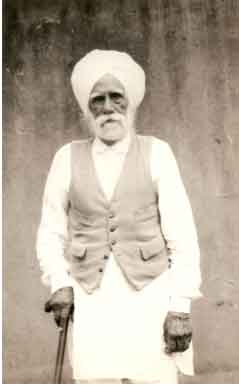
One morning while on the morning walk to Gurdwara Tahliana Sahib he fell, was taken to hospital but never recovered. He passed away to eternal bliss two days later. A pioneer, small in stature, great in ambition, an entrepreneur extraordinaire, who lived a great life and helped so many in the early settlement days and inspired future generations to excel by setting an example to be cherished. The Development of Africa started by Sardar Nika Singh is being carried on by the next generations of his family, by his grand children and by his great grand children.
=========================================================
The Westgate Nairobi attack (September 2013)prompted me to add this article to the site as a brave Kenyan Sikh, without any concern to his life, Saved a number of livesfrom the carnage. We salute this brave man.(Harjinder)
The Lion of Nairobi - proud to be a Sikh
The man who saved 40 lives talks to Zee Media in Nairobi He saved 40 lives in the Nairobi mall. When you give him the credit he cutely smiles and points his finger upwards saying it is Him who did it, not him. He tries to give credit to others but the survivors, 40 of them, say – if he had not been there, perhaps Al Shabaab militants would have butchered them as well. 37 year old Satpal Singh is a Sikh - a Kenyan of Indian origin.
Satpal Singh
He shared his experience with Zee Media. No amount of words can describe his humility, bravery beyond ordinary, a shining example of unflinching faith in the face of cowardly butchery by the terrorists As booby traps, bombs and blood are cleaned from the Westgate Mall here in Nairobi, Satpal Singh narrates to Zee Media the ordeal of more than 1000 people who were trapped inside the mall on the fateful four days.
Normal human reaction would have been to escape as grenades exploded and men, women and children fell to sprays of bullets. But Satpal tells Zee Media he never thought about running because Sikh religion does not teach you to run. I hold an incredulous expression; I cannot believe my ears as he says even his first reaction was not to run. So, Sikh teachings overcame the primeval survivor instinct to flee even in the face of danger? Intellectualise if you will, is his reply in a few words, but for him it is like this. “He will take care of me. He does his work, I do mine. It is His job to save me, then why should I be worried.”He was face to face with a terrorist who shot twice at him but Satpal cheated death, the bullets barely missed himI met many survivors - many refused to talk on camera; we understood it was a trauma they would rather avoid. What does Satpal feel when he looks back at the terrorist attack that claimed 67 lives? "I feel I could have done more," he says. So, is there no feeling of accomplishment? "No, we could have saved so many more lives and anyways there was an ex-British officer who was there. He said - you are a Sikh, a warrior, let`s join forces and get people out. We did what we could but still many lives were lost!" No hatred for terrorists. No big words. No ego. There is so much to learn from Satpal Singh. I have interviewed many people as we journalists do, but I have never felt so small, so inferior as a man as I did standing and clicking a photo with Satpal. And Satpal thanks - you have given many of us journalists and Indians and Kenyans a reason to believe that faith can indeed move mountains.
A man who lives the teachings of his Guru "Chidiyon se mein Baaz Ladaoon, Gidran to mein Sher Banoon, Sava Lakh se ek Ladaun, Tabhi Gobind Singh Naam Kahaoon"
Source - http://zeenews.india.com/exclusive/the-lion-of-nairobi_6677.html
--------------------------------------------------------------------------------------------------
PUNJABI HERITAGE IN EAST AFRICA
The history of the South Asians in East Africa is not very old. It is only about 100 years since the first Indians landed on the shores of Kenya, namely Mombasa. The journeys in those days were accomplished in dhows which were the main source of transport and starting from Bombay the journeys could take as much as months to complete as the dhows depended on the state of the winds. It was after a lot of hardships that some of our ancestors reached Kenya to serve in the Uganda Railways which was being built from Mombasa to Kampala.
The Punjabis (Hindus, Muslims & Sikhs) were the main source of skilled and semi skilled labourers who worked on the railways. They suffered numerous hardships including the lions of Tsavo.
Do You or Your parents or Grandparents had any escapades, adventures, memorable incidents, interesting stories, their rise to fame or riches, old photographs or mementoes, souvenirs, brochures of Kenya, Uganda, Tanganyika - magazines printed by gurdwaras or federations, clubs, schools, students etc. Any documents or photos about East Africa – anything!
I am in the process of writing a book on the ‘Punjabi Heritage in East Africa’ and I need information as much as possible. Just get in touch with me and send me the information (which will be returned after use). Your name will be acknowledged in the book.
Your assistance would help in inserting your ancestors’ names in the history of East Africa.
Kindly contact,
Harjinder Singh Kanwal,
20 Trewint Close,
Exhall,
Coventry CV7 9FG
U.K.
Phone: 024 7631 9483
E/mail: harjinder@kanwal99.freeserve.co.uk
